Get Full Government Meeting Transcripts, Videos, & Alerts Forever!
Get email alerts on the Thimble Creek Concept Plan topic
No spam. Unsubscribe anytime.
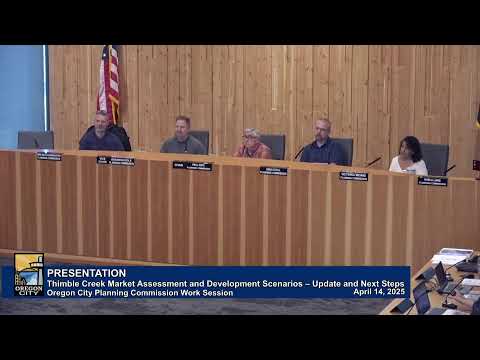
Oregon City staff present market assessment to revive Thimble Creek employment land
Summary
City planning and economic development staff on April 14 presented a market assessment aimed at identifying barriers to job‑center development in the Thimble Creek concept plan area and outlined next steps including potential code changes and partnership strategies.
City planning and economic development staff on April 14 presented a market assessment aimed at identifying barriers to job‑center development in the Thimble Creek concept plan area and outlined next steps including potential code changes and partnership strategies.
The assessment, paid for by a grant through Metro, examines why employment and commercial development have lagged behind recent residential growth and offers a menu of options ranging from targeted amendments to the land‑use code to financial incentives and public‑private partnerships. Christina Robertson Gardner, senior planner with the planning department, said the study is “really just one piece of a larger process — what are the barriers in this area and what can the city do to reduce or remove those barriers to help redevelopment.”
Anne Griffin, economic development coordinator, told the commission the work is intended to preserve and expand local jobs. “A city needs jobs. We need people that are earning money,” Griffin said, adding that job growth supports household incomes, local spending and the city’s fiscal health.
Staff identified several recurring factors slowing the pace of nonresidential development: small parcel sizes in the employment area (the largest parcel was described as about 21.5 acres), the cost of public infrastructure such as stormwater systems, and an anticipated future street parallel to Beaver Creek that some property owners see as complicating build‑out. Griffin and Robertson Gardner said property assembly remains a challenge for developers that prefer larger contiguous sites.
The consultants — Johnson Economics and HHPR — flagged specific development‑code provisions as possible impediments, including limits on outdoor storage, buffer and setback requirements between industrial and residential zones, and sustainability requirements embedded in site‑design review. Robertson Gardner said staff could pursue “targeted, strategic changes” to the code if the City Commission directs a legislative review but that any changes must still meet the concept plan’s intent of integrating jobs and housing.
Staff also discussed financing options to support infrastructure: state loans and grants, tax increment financing tied to an urban renewal district, local improvement districts (LIDs), or a combination of tools. When Commissioner Sowell asked for an overview of LIDs, Griffin replied, “Local improvement district is an area where the different property owners agree to contribute to a local fund that will help for, you know, things like the improvements of storefronts in a particular commercial area or sometimes it's for, like, sidewalk improvements or other infrastructure improvements, but it's paid specifically by the property owners.” Staff noted LIDs are sometimes difficult to implement when many property owners hold differing visions.
The assessment also points to a recent sale: one large parcel of roughly 20 acres was described as purchased by Clackamas Community College, which staff said could be a potential institutional partner for future development and innovation uses, including student housing and applied labs.
Next steps: staff told the Planning Commission there is no action required at the work session. City leaders identified Mayor McGriff and Commissioner Mitchell as project champions; staff said the City Commission will formally acknowledge receipt of the assessment by adopting a resolution in May as part of the grant requirements and will decide whether to direct staff to pursue legislative code changes or financing strategies. Robertson Gardner offered to forward any comments from Planning Commission members to the commission champions as they refine a work plan.
The presentation and discussion focused on options rather than firm commitments; staff emphasized that recommended changes would be targeted and would return to the Planning Commission if the City Commission directs legislative review.