Get Full Government Meeting Transcripts, Videos, & Alerts Forever!
Get email alerts on the Higher Education topic
No spam. Unsubscribe anytime.
Guam Community College requests $23.7 million for FY2026; senators press on benefits, vacancies and projects
Summary
Leaders of Guam Community College presented a $23,695,909 FY2026 operating request to the Committee on General Government Operations and Appropriations, outlining capital projects, workforce programs and grant awards while senators probed rising employer benefits costs, funded vacancies and lost grant opportunities.
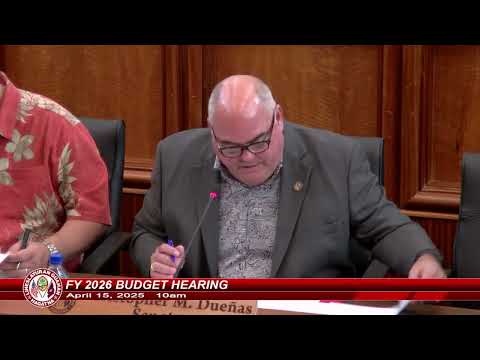
Guam Community College officials presented a $23,695,909 fiscal year 2026 budget request at a public hearing before the Committee on General Government Operations and Appropriations on April 12, 2025, and described capital projects, workforce programs and recent grant awards while senators questioned rising employer benefit costs, staffing vacancies and a recently lost federal grant.
The budget hearing matters because GCC’s request covers campus renovations, a planned $2 million solar parking and battery-storage project, regional workforce training programs and newly launched initiatives — all of which affect government operating funding, grant-dependent programs and job training pipelines on Guam.
Carlo Leon Guerrero, chairman of the GCC Board of Trustees, opened testimony by summarizing recent institutional improvements and accreditation work. “GCC has demonstrated unwavering commitment to advancing education, fostering workforce development and expanding and enhancing the institution’s infrastructure,” he said. Board testimony noted an accreditation site visit in March and said official results are expected in the coming months.
College leaders cited specific grants and programs that will affect FY2026 operations. GCC reported a $250,000 U.S. Department of State grant to host the Academy for Women Entrepreneurs, a 12‑month virtual training program culminating in on‑island workshops for 30 women leaders from Pacific islands. The U.S. Department of the Interior’s Office of Insular Affairs provided $60,000 for a Regional Forensic Science Symposium. GCC also said it launched the island’s first YouthBuild program, a community-based workforce program for 16‑ to 24‑year‑olds; GCC estimates up to 66 participants and said partners include the Guam Department of Labor, Guam Housing Corporation and Micronesia Community Development Corporation.
“I want to start by congratulating … the GCC accreditation team for their amazing job,” Leon Guerrero said in testimony. President Mary Okada and another presenter, Mario Carter, each addressed senators about operational pressures and program growth. Carter told the committee, “Today, I present a budget request of $23,695,909.” Okada described capital work in progress, including near completion of Building B renovation, the Workforce Development Center and a Culinary Arts and Baking Center, plus an installed generator for Building 2000 and a planned solar parking and battery storage project estimated at $2,000,000.
Senators focused questions on two budget drivers: employer benefit rates and funded but vacant positions. GCC told lawmakers they developed the FY2026 request using an employer retirement contribution rate of 34.8 percent for planning purposes; staff said the rate used during the prior fiscal year’s final accounting fell to 30.77 percent and that medical insurance costs have “soared” since 2024. Senate questioning probed how GCC would absorb higher costs if actuarial rates or insurance premiums exceed budget assumptions. Okada said the college would manage higher costs by delaying hires or lapsing funded vacancies where necessary.
Committee members also asked about recruitment and retention. GCC officials said roughly 20 funded vacancies appeared in the FY2026 budget across general fund, Manpower Development Fund and non‑appropriated funds, with many vacancies rotating over time and the longest gaps — generally up to two years — concentrated in nursing positions. GCC reported it launched its first cohort for an associate degree in nursing earlier in March with 20 students scheduled to complete in December 2025 and a second cohort planned for August 2025.
Lawmakers pressed GCC about capital project funding and grant changes. Officials said a FEMA Building Resilience Incentive for Communities (BRIC) application that would have supported hardening of Building 600 — a project valued at about $1.6 million — was not awarded and the anticipated funds were withdrawn. GCC also said it had completed drawdowns of Higher Education Emergency Relief Fund (HEERF) money tied to past projects and that a small USAID grant was terminated for convenience after work already paid for had been completed.
GCC described ongoing workforce initiatives: multiple boot camps in ship repair, environmental technician training, home health aide and related fields; a partnership to be the region’s first institute offering SNAP Employment & Training reimbursements as a third‑party employment and training partner; and continuing ship‑repair cohorts supported by private partners including a Metallica grant. Officials said the college has begun a software‑as‑a‑service upgrade of administrative systems, an 18‑month transition expected to finish in September 2026.
Budget mechanics and special funds drew sustained attention. Senators and GCC staff discussed the Manpower Development Fund (MDF) and how revenue timing and legislative allocation affect GCC’s appropriation: when MDF receipts are higher the legislature may increase MDF allocations and reduce general fund support, and vice versa. GCC said excess MDF revenue historically has flowed to the college on a delayed schedule and that MDF disbursements are sometimes split with the Department of Labor. Senators also asked about the community college foundation, which GCC said had reached about $20 million at market peak and sits below that level after market declines; foundation proceeds have been used primarily for capital projects and scholarships.
Committee chairman Senator Christopher M. Duenas closed the hearing by reminding the public the committee will accept written testimony for seven calendar days following the hearing. The session adjourned at 11:14 a.m.
The hearing record includes questions about the post commission executive director’s administrative placement, GCC involvement in the forensic crime‑lab annex HVAC work and specific grant timelines; GCC’s answers are summarized above and reflect the testimony entered on the record.