Get Full Government Meeting Transcripts, Videos, & Alerts Forever!
Get email alerts on the School Improvement topic
No spam. Unsubscribe anytime.
High school placed on targeted improvement list over chronic absenteeism; board outlines interventions
Summary
The Tea Area School District reported that the high school has been designated a targeted school because a subgroup fell in the bottom 25% statewide for attendance; district staff outlined an action plan focused on monitoring, family outreach, incentives and targeted supports.
Tea Area School District 41-5 administrators told the board the district's high school has been designated a targeted school for improvement under state accountability rules because one student subgroup's chronic absenteeism rate placed it in the bottom quartile statewide.
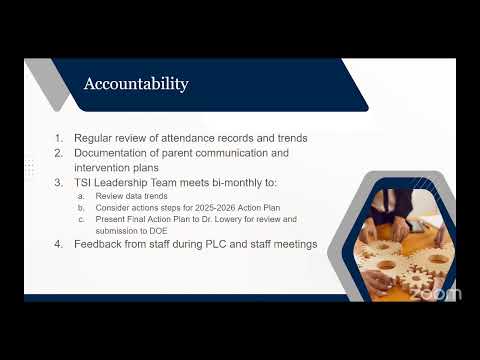
District leaders said the designation stems from subgroup performance and attendance patterns tracked in the state reporting system. The district must submit an action plan to the South Dakota Department of Education in May for implementation during the 2025-26 school year. Staff described a timeline: notification in the fall, leadership-team formation, full data analysis, development of a school success/action plan and submission to the state for approval.
Board members heard that staff are already using a number of interventions and monitoring tools. Current measures include daily attendance monitoring, automated and personal family outreach at 5, 10, 15 and 20 days of absence, individualized improvement plans for students with persistent patterns, and positive incentives for meeting attendance goals. The district also uses the South Dakota STARS data export to track attendance flags (for example, green/yellow/red thresholds tied to percentage attendance) and said it plans to continue and refine that monitoring.
Administrators described targeted incentives already in use — for example, small rewards and public recognition for students who meet quarter goals — and noted staff are experimenting with increased school social work involvement, SRO (school resource officer) coordination for unexcused absences, and better cross-building communication about students who transfer between district schools. The district said it will continue to examine coding options in its student information system to capture absence reasons more consistently across sending and receiving districts.
District officials also noted the limitation that very small subgroups can trigger targeted improvement status: staff emphasized that while subgroup counts are small, the district treats every affected student's attendance as important and is pursuing sustained supports rather than one-off fixes.
Board members did not take a separate vote on the designation; the presentation was informational and staff said the formal action is submission of the improvement plan to the Department of Education.