Get Full Government Meeting Transcripts, Videos, & Alerts Forever!
Get email alerts on the Traffic And Highway Improvements topic
No spam. Unsubscribe anytime.
Caltrans: ramp meter would smooth US‑101 but not cut traffic on SR‑156; county officials question who should pay
Summary
Caltrans presented two engineering options to ease merging at the SR‑156 to US‑101 southbound on‑ramp but said a ramp meter would not reduce traffic on SR‑156 itself; local officials and residents pushed back on using San Benito County funds for a state highway problem.
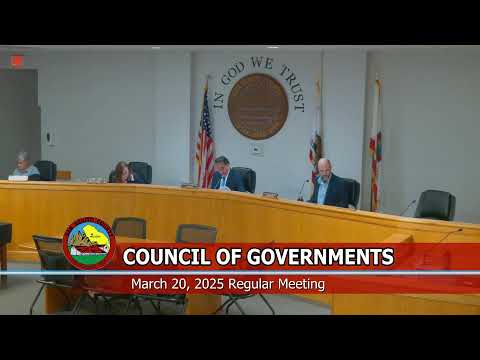
Terry Thompson, a Caltrans presenter, told the San Benito County Council of Governments on March 20 that a ramp meter at the SR‑156 southbound on‑ramp to U.S. 101 would help smooth traffic on 101 but "will not serve your purpose of decreasing the traffic flow around 156." Thompson said the agency studied reconfiguration options to lengthen the merge taper and reduce turbulence on 101.
Why it matters: The stretch where SR‑156 traffic joins southbound US‑101 is a recurring congestion point for commuters and weekend travelers to the coast. Caltrans officials said engineering work on the ramp could improve 101 flow, but local leaders and residents argued improvements to 101 would not solve backups on SR‑156 and questioned whether county COG funds should pay for a state highway problem.
Caltrans described two primary local partnership options. Thompson said one alternative would add roughly 600 feet of merging taper and would require about $2,550,000 in partner funding; a smaller reconfiguration with about 500 feet of taper was estimated at approximately $1,250,000. Thompson and Caltrans staff emphasized those cost estimates do not include the ramp‑meter hardware, supporting infrastructure, or a maintenance vehicle pullout.
"Our minor program can support up to $1,250,000," Kelly McClendon, senior planner with Caltrans District 5, told the board, noting Caltrans had previously tried to fully fund an earlier concept but that project costs have since risen. She described how most Caltrans funds are prioritized for maintenance and preservation and that larger interregional improvements must compete statewide for roughly 25% of a particular funding pot.
Directors and members of the public said the congestion on SR‑156 often stems from weekend traffic heading to the coast and argued that responsibility should rest with the state. "Why do we have to pay for a state highway issue?" asked Director Kosmicki, summarizing a recurring concern from board members. Several directors urged Caltrans and the COG to pursue solutions that address the right‑hand merge behavior and other lower‑cost, short‑term fixes before committing local dollars.
Public commenters offered operational and behavioral ideas as potentially more cost‑effective near‑term measures. Ray Cancino, chief executive officer of Community Bridges, suggested changing lane markings to make the right lane a clearer “no‑cross” zone and adding signage and enforcement: "Make it a yellow lane only about a thousand feet from the turn off," Cancino said, arguing criminal enforcement would deter lane‑crossing. Local trucker Joe Tinashe and others described longer travel times and economic impacts from the backups.
Caltrans staff told the board they had not evaluated every possible interim fix during this study and that some suggestions — such as widening bridges or adding lanes on SR‑156 overcrossings — would likely require substantially larger capital investments. Thompson estimated that expanding the two one‑lane bridges overpass sections would be on the order of tens of millions: "I would think in this day and moving forward, it would cost at the minimum $55,000,000 to repair both of these, on ramps," he said.
The board did not vote on a funding commitment for the ramp work. Directors asked staff to continue seeking community input and to explore lower‑cost operational changes, enforcement and signage options, and the feasibility of leveraging Caltrans minor program support rather than using COG general funds.
Ending: Caltrans said it is willing to contribute its capped minor program amount and to further evaluate short‑term operational fixes; the COG asked staff and Caltrans to return with more analysis of low‑cost deterrents and options that focus on SR‑156 behavior before pursuing a multi‑million‑dollar partnership for ramp reconfiguration.