Get Full Government Meeting Transcripts, Videos, & Alerts Forever!
Get email alerts on the Municipal Budgeting topic
No spam. Unsubscribe anytime.
Findlay council sets 20% income-tax allocation for capital after debate
Summary
After discussion about reserves, enterprise fund balances and revenue volatility, Findlay City Council voted 6-2 to allocate 20% of income-tax revenue to capital improvements for the 2026 budget process.
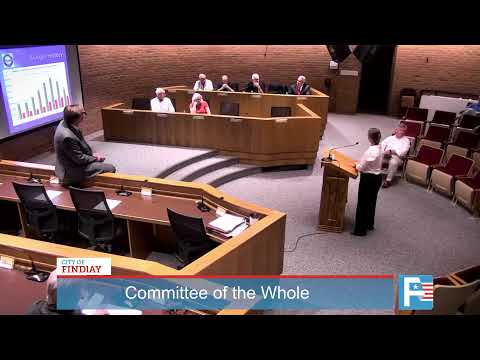
Findlay City Council voted Tuesday to allocate 20 percent of the city's income-tax revenue to capital improvements for the 2026 budget process, following an hour-plus discussion of reserves, enterprise fund balances and revenue uncertainty.
The decision came after members debated an alternative proposal to set 22 percent for capital. That motion failed 3-5 before the council approved the 20-80 split by a 6-2 vote.
The vote matters because the council's allocation determines how much of the city's general income-tax receipts are available for capital projects such as streets, water and sewer infrastructure and equipment. City Auditor (name not provided) told the committee that capital allocation must be set before the auditor can complete revenue-side budget calculations for 2026 and 2027.
The City Auditor framed the budget discussion with a series of fiscal readings: the city's general fund receipts, the volatility of business net-profits tax, and enterprise-fund cash balances. He noted several funds with large cash balances relative to their operating budgets and cautioned against making rate or spending decisions until multi-year plans are complete. For example, he reported a projected cash balance for the water fund of $5,300,000 against a 2025 operations budget of $10,100,000 and a projected Seward WPC cash balance of $16,100,000 against a $6,000,000 operations budget. The stormwater restricted account was reported at roughly $2,200,000 versus a $345,000 operations budget.
The auditor also told council that the city could consider calling a $3.6 million outstanding general obligation bond in 2026; preliminary estimates suggested a payoff could save about $450,000 over the life of the loan if the city used available cash to retire the debt.
Members and staff discussed several alternatives for funding capital beyond the standard 80/20 split. Finance staff proposed a variant that would direct 10 percent of income-tax revenue to capital and instead allocate hotel-motel tax receipts plus interest earnings to capital, a combination staff estimated would yield roughly $4.9 million and approximate the existing 20 percent total while shifting which revenue streams feed the capital fund. The mayor cautioned that interest income is likely to shrink because general-fund balances have fallen, and urged caution before committing more money out of the general fund.
Councilmembers pressed on process as much as dollars. The City Auditor said the capital allocation must be set that night to allow him to finish revenue calculations for the budget process; several councilmembers said they preferred to keep the traditional 80/20 split so staff and incoming councilmembers could budget with familiar assumptions. One councilmember argued for increasing capital allocations to address long-term pavement replacement needs; another emphasized maintaining margin in the general fund given economic uncertainty.
After a roll-call-style voice vote, the council confirmed 20 percent to capital. The City Auditor said he would use that number for the revenue-side budget work and that the formal budget adoption would occur under the statutory schedule in January.
The committee also discussed the budget calendar and the upcoming one-night abbreviated budget review currently scheduled for Dec. 9. The auditor and mayor urged department heads to tighten year-end estimates in the budgeting system (Tyler system) so carryforward projections are realistic. Staff noted that some enterprise funds have statutory or administrative constraints and that enterprise subsidies (for example, parking, pool and airport) are paid from the general fund.
The discussion included references to Ohio law, state auditor financial indicators, and best-practice guidance from the Government Finance Officers Association as context for reserve targets, deficit budgeting flags and capital-planning requirements. Several speakers repeatedly urged the council to develop a longer-term financial results-evaluation process that ties strategic goals to multi-year fiscal planning.
The committee adjourned after confirming the capital allocation and scheduling the abbreviated budget review. The 20 percent allocation will be reflected in the auditor's revenue calculations for the formal budget that the council will consider in January.