Get Full Government Meeting Transcripts, Videos, & Alerts Forever!
Get email alerts on the Community Improvement Grants topic
No spam. Unsubscribe anytime.
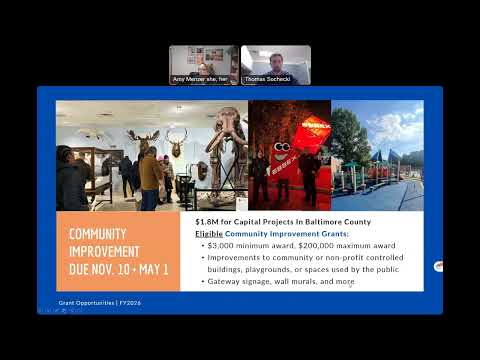
Baltimore County opens Community Improvement Grants with $1.8 million, Nov. 10 and May 1 deadlines
Summary
Baltimore County Department of Planning opened applications for its Community Improvement Grants, announcing $1.8 million for capital projects, two application deadlines (Nov. 10 and May 1, 2026), eligibility rules, required documentation, and a review timeline that could lead to award announcements by spring.
Amy Menzer, senior project manager with the Baltimore County Department of Planning, outlined the department’s Community Improvement Grants program and application process during a public webinar, saying the county has allocated $1,800,000 for capital requests and that there are two application deadlines: Nov. 10 and May 1, 2026.
The program is intended to support projects that advance the county’s Master Plan 2030 and targeted revitalization efforts inside the county’s urban–rural demarcation line, Menzer said. Grants are for capital projects that are not movable and should be designed to last at least 15 years; the department is looking for projects that can be implemented within two years of the grant agreement.
Tom Sahetski, Planner II with the Department of Planning, described application mechanics, eligibility and review steps. The grant rounds are split into two tiers: requests of $3,000–$15,000 (tier 1) and $15,001–$200,000 (tier 2). Eligible applicants must be 501(c)(3), (c)(4) or (c)(6) organizations and be in good standing with the State of Maryland; smaller or newer organizations may submit scaled financial documentation appropriate to their size, Sahetski said. Projects located on county-owned or county-managed parks and public or private schools are expressly not eligible for this funding source, he added.
Applicants must provide a completed county application for financial assistance, a project budget, recent financial statements, a board list, property-owner permission or documentation of site control, and a screenshot showing good standing with the State of Maryland. Sahetski said applicants proposing projects on public rights-of-way must also submit a county citizen-generated request form and that some projects may be subject to review by the Landmarks Preservation Commission or a design review panel; those approvals are not required to apply but will be part of project implementation if the grant is awarded.
For projects over $15,000, the department expects applicants to show how the project implements one or more goals from Master Plan 2030, to identify the population or geography served, and—where practicable—provide quantifiable measures of community benefit. Sahetski noted the department favors projects that build on other area work, can be replicated elsewhere, and advance equity and inclusion across the county.
All applicants will receive a completeness check within about one week of submission. Sahetski said staff aim to schedule site visits within three weeks after the application deadline; for the Nov. 10 deadline the department hoped to complete most site visits before Thanksgiving. Menzer and Sahetski said the Planning Department aims to forward recommendations to the next level of county review within 45 days of the Nov. 10 deadline, after which grants will go through the county’s normal cross-departmental review and a County Council 14-day notice period that may include council pull requests.
The presenters described a likely calendar for applicants who apply by Nov. 10: recommendations within about 45 days, cross-departmental review and County Council processes after the new year (approximately four to six weeks), and award announcements in mid-to-late March or April. Menzer cautioned that actual payouts could occur later—potentially late April or early May—depending on the grant agreement and administrative steps.
Sahetski said the county expects to implement a quarterly reporting system and final report for these grants; staff plan webinars on the reporting template and process (the presenters referenced an upcoming reporting webinar scheduled for Oct. 21). For previously funded projects and for awarded grants, the department will request before-and-after photos as part of reporting.
On pass-through arrangements, Menzer and Sahetski said a 501(c) organization can act as a fiscal sponsor for a group that lacks tax-exempt status. The pass-through organization will be the legal recipient of county funds and must provide documentation—such as invoices and proof of payment—showing how grant dollars were spent. The presenters said Baltimore County staff are typically willing to forward-fund part of a project (they gave 50% as a typical forward-funding example) but will require documentation that those funds were spent before releasing remaining payments.
During the webinar a Waters Edge Community Association representative asked whether personal grant experience within an organization counts toward the “prior experience” question for larger grants; Sahetski and Menzer encouraged organizations with limited direct grant experience to discuss project scope at the required pre-application meeting and to consider starting with smaller-tier requests. The presenters reiterated that the department requires a pre-application meeting for all applicants to confirm eligibility and to help applicants prepare stronger submissions.
Examples shown during the webinar included murals, signage, playground improvements on non-county property, community-building renovations, and other capital improvements on community organization property. Examples emphasized that county-owned park projects, public and private school projects, and gated-community improvements are not eligible under this funding source.
Contact information and application materials are posted on the grant hub on the Baltimore County website; Sahetski provided an email contact on the webinar for scheduling pre-application meetings (tsuchecki@baltimorecountymd.gov). The department said it will post the webinar slides and the application hub link on the grant web page.
The presentation and Q&A covered procedural details but did not include formal votes or funding decisions. Applicants seeking clarification on eligibility, partnership arrangements, reporting requirements, or timeline were instructed to contact Department of Planning staff to schedule pre-application meetings and to consult the application hub for required forms and supplemental questions.