Get Full Government Meeting Transcripts, Videos, & Alerts Forever!
Get email alerts on the Healthcare 340b topic
No spam. Unsubscribe anytime.
Senate amends 340B oversight rules, approves bill after debate over audits and contract pharmacies
Summary
The Senate Finance, Ways and Means Committee recommended Senate Bill 1414 for passage to the calendar after adopting a compromise amendment that preserves manufacturer audits through June 1, bars new restrictions after July 1, and assigns oversight to the Tennessee Attorney General.
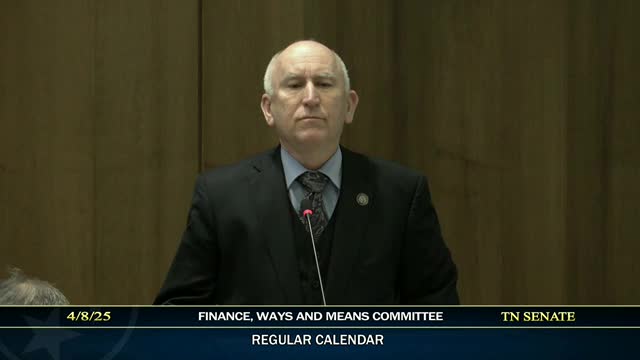
The Senate Finance, Ways and Means Committee recommended Senate Bill 1414 for passage to the calendar after a lengthy hearing on April 8 that focused on federal 340B drug‑pricing program rules and the role of contract pharmacies.
Senator Briggs, the bill sponsor, told the committee the measure responds to complaints that pharmaceutical manufacturers had imposed additional restrictions on covered entities and contract pharmacies participating in the 340B program. The bill as amended preserves existing manufacturer restrictions in place through June 1 and prevents manufacturers from imposing additional restrictions after July 1; it also assigns oversight and enforcement in Tennessee solely to the state Attorney General and clarifies that funds saved under 340B may not be used for abortion services or for transgender care of minors, language the sponsor said reflects Tennessee law.
The bill drew detailed questioning from several senators about whether manufacturers could continue to obtain patient or claims data, how contract pharmacies are registered, and whether adding many contract pharmacy locations equates to expanded access. Senator Hensley asked whether pharmacies could continue to obtain patient data; Senator Briggs said the amendment grandfathered existing data‑sharing arrangements up to June 1 but barred new restrictions after July 1. Dr. Shannon Berger of SIMBA Community Care (Chattanooga) told the committee that the amendment does not prevent covered entities from adding contract pharmacy locations; she explained that federal registration rules now require each physical pharmacy address to be registered separately, which inflates published lists of participating pharmacies without necessarily increasing dispensing volume at each site.
Kristen Pardy of the Pharmaceutical Research and Manufacturers of America (PhRMA) and other witnesses described how contract pharmacies commonly fill specialty drugs and how 340B arrangements create a spread that typically accrues to the covered entity rather than being automatically passed through to commercial payers. Witnesses and senators discussed patient pricing for uninsured patients and the variety of operational models used by covered entities; one clinic representative described charging uninsured patients the agency’s acquisition cost plus a $4 dispensing fee.
The committee adopted a finance amendment that the sponsor described as “a major compromise.” The amendment preserves manufacturer audit and data requests that were in place before June 1 (i.e., those arrangements are grandfathered) and prevents manufacturers from adding new contractual restrictions after July 1. The amendment also made the Attorney General — not the Department of Commerce — responsible for oversight of the program in Tennessee.
After debate and questions of witnesses, the committee voted to recommend Senate Bill 1414 as amended for passage to the committee on the calendar. The clerk recorded the tally as 8 yeas and 3 nays.
Why it matters: 340B supports safety‑net hospitals, children's hospitals and rural providers by enabling them to purchase outpatient drugs at discounted prices; disputes over contract pharmacy arrangements and manufacturer audits have prompted state legislatures to consider limits and procedures. The committee’s amendment preserves some existing manufacturer oversight while attempting to curb new manufacturer restrictions, and it shifts enforcement responsibility to the Tennessee Attorney General.
Where it goes next: The measure was recommended for passage to the calendar committee; the amendment and sponsor’s summaries say implementation depends on maintaining the federal program’s qualifying status and on covered entities’ compliance with federal requirements.
Provenance: Committee discussion and witness testimony on April 8, 2025; committee vote recorded in the hearing transcript.