Get Full Government Meeting Transcripts, Videos, & Alerts Forever!
Get email alerts on the Utility Scale Solar topic
No spam. Unsubscribe anytime.
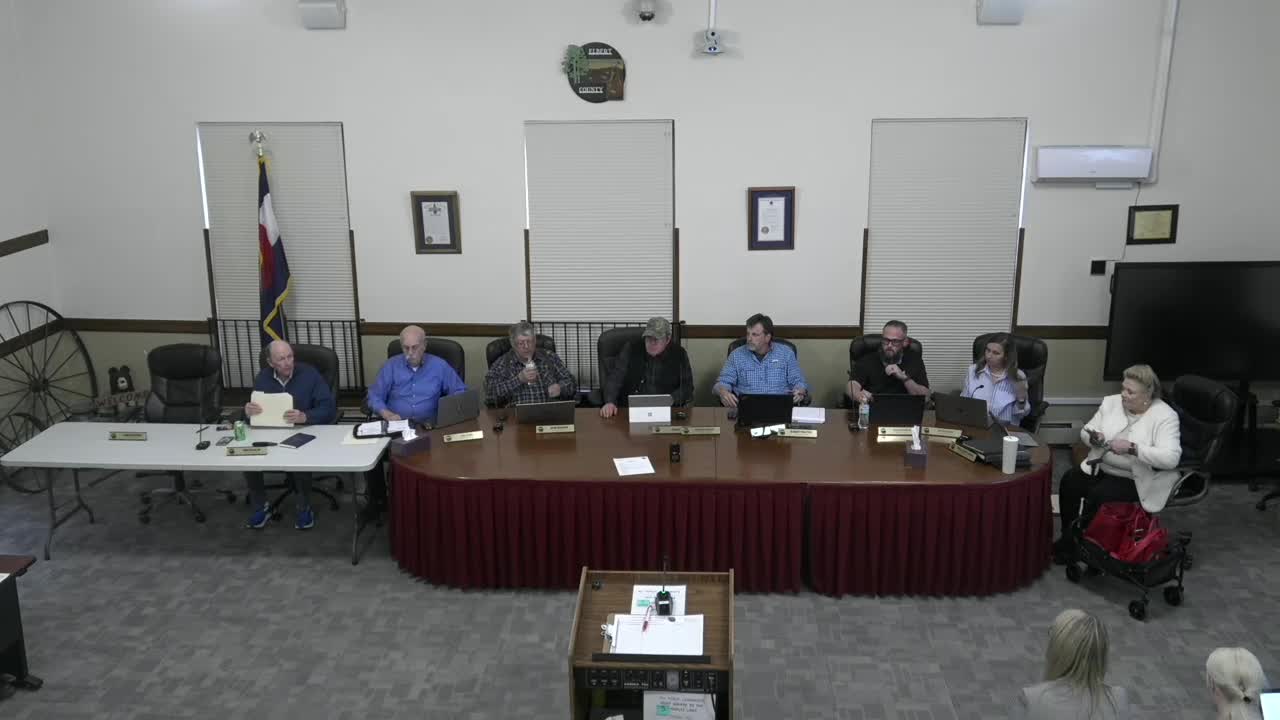
Elbert County planning commission continues Sundance Solar review after questions on cultural surveys, fire safety and finances
Summary
The Elbert County Planning Commission continued its review of the proposed Sundance Solar project to April 22 after commissioners and residents raised unresolved questions about cultural-resource mapping, wildfire protections, financial assurances and community impacts.
The Elbert County Planning Commission voted to continue its review of the proposed Sundance Solar project to April 22 after commissioners and members of the public raised outstanding questions about cultural-resource mapping, wildlife and fire safety plans, financial documentation and community benefits.
Commissioners said the outstanding items — including a disputed overlay between the applicant’s site plan and a third-party cultural-resources survey, confirmation of 24/7 remote wildlife monitoring and the form of financial assurances — were material to the county’s Major 1041 and Special Use Review (SUR) approval criteria and must be resolved before the commission makes a recommendation to the Board of County Commissioners.
The continuation gives the applicant time to provide written responses and supporting documents addressing the commission’s list of questions and proposed conditions. Chair (name not specified in the transcript) opened the session by resuming discussion of the Sundance Solar Major 10‑41 permit and special use review, and commissioners spent the hearing probing environmental compliance, emergency response and the project’s financing.
Zach Bartholomew, representing Cypress Creek Renewables, answered multiple technical and procedural questions during the hearing. Bartholomew said the project "is not funded by subsidies. Our projects, including this one, are eligible for certain federal tax incentives, but this project in specific is not." He also confirmed the project's solar panels are sourced from Vietnam and said the developer has measures to address tariff volatility.
Addison Fairchild, an attorney with Holland & Hart representing Cypress Creek, told the commission the applicant had coordinated with referral agencies including Colorado Parks and Wildlife (CPW) and said, "they are taking their recommendations into account pursuant to the code and pursuant to CPW's recommendations." Fairchild also said the applicant had complied with the outreach requirements to referral agencies under the county's review process.
Commissioners and members of the public repeatedly pressed the applicant for more detail on a cultural-resources (Phase I) survey and its spatial mapping. Commissioner Kyle DiNardo asked why the applicant's environmental-site assessment did not include Colorado State Historic Preservation Office (SHPO) records and requested the cultural‑survey report; Fairchild and an applicant representative said the developer would provide the report but that some details are withheld as sensitive archaeological information. The applicant displayed site plans and, in a public overlay, the commission flagged at least one area where the survey-data buffer and the applicant’s proposed panel layout appeared to overlap.
Commissioner Nicole raised public-safety concerns, particularly wildfire response times and monitoring. The applicant said game cameras and remote monitoring systems are planned and that CPW had recommended an 8‑foot perimeter fence; the developer described fire-breaks and a perimeter "fire bridal" as part of coordination with Kiowa-area fire departments and said an operations-and-maintenance agreement includes monthly reporting. Nick Parton of McCarthy Building Companies said the project design includes a 30‑foot cleared perimeter around panels as a fire break.
An applicant representative confirmed the battery storage technology proposed is lithium iron phosphate and described an approved battery-specific emergency response plan. On water use, the applicant said trucking construction water is the preferred approach and agreed — if a permit condition were required — not to drill or use on-site wells for construction, operations or maintenance without explicit county approval.
Commissioners and residents also sought clarity on decommissioning assurances. The applicant said a third-party estimate establishes the decommissioning bond and that the bond amount is updated every five years; the developer emphasized lease terms and recorded conditions would run with the land and that lenders typically have contractual rights to step in to maintain obligations in the event of a default.
The commission set a series of items for the applicant to supply in writing before the continued hearing: a confidential overlay or verified GIS shapefile reconciling the cultural-resources survey buffers with the site plan; the cultural-survey report for commission review (not for public posting, per the applicant); documentation showing coordination with referral agencies (including CPW) and local fire districts; clarification of wildlife-monitoring and gate/slide‑gate plans for fenced sections; more detail on decommissioning-bond methodology and escalation; confirmation that on‑site wells will not be used absent county approval; and specified examples or proposals for additional landscape screening or berming and for a community-benefit commitment to be considered as conditions of approval.
The planning commission continued the Major 1041 and the SUR to April 22 at 6:00 p.m.; the commission recorded the continuance as passed by voice vote and asked staff to collect the requested items in writing so the applicant could respond in a single packet prior to the continued hearing.
Looking ahead, staff told the commission the application had been deemed complete on Feb. 27 under the county's completeness review and noted state statute (House Bill 23‑1233 / Colorado Revised Statutes §30‑28‑113.5) creates a 90‑day decision window from the date an application is deemed complete. Staff said the county’s deadline under that timeframe is May 28 and that the Board of County Commissioners is scheduled to hear the case May 14, meaning the commission and staff must resolve outstanding questions promptly.
Ending: The commission will reconvene April 22 to hear the case again; the applicant agreed to provide written responses and the confidential cultural documentation ahead of that meeting.