Get Full Government Meeting Transcripts, Videos, & Alerts Forever!
Get email alerts on the Planning And Zoning topic
No spam. Unsubscribe anytime.
Kentucky League of Cities trains Lexington planning commission and board of adjustment on new House Bill 321 rules, bylaws and hearing procedure
Summary
A joint training session covered recent statutory changes to training and standing under House Bill 321, guidance on drafting bylaws and best practices for meeting and hearing management for Lexington’s Planning Commission and Board of Adjustment.
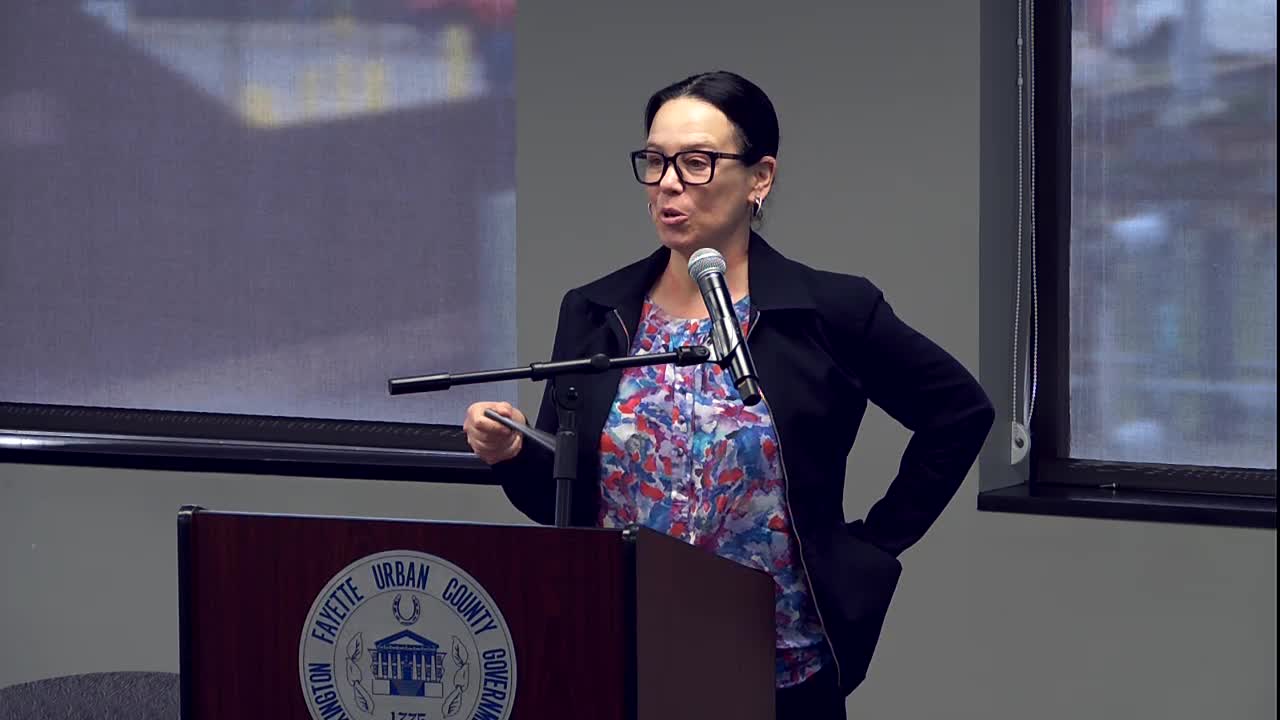
Members of Lexington’s Planning Commission and Board of Adjustment attended a training session led by Kentucky League of Cities (KLC) attorneys that reviewed recent statutory changes, the bodies’ bylaws and guidance on meeting and hearing procedure.
KLC attorney Megan Griffin summarized changes from House Bill 321, saying the law reduces some training hours for volunteer commissioners but adds a new required hour on “the impact of planning and zoning on housing supply and accessibility.” Griffin said the new law changes orientation to three hours within one year prior to or one year after appointment and provides seven hours of continuing training every four years for commissioners; planning professionals’ orientation was described as seven to eight hours with 15 hours of continuing education depending on position.
“Just because you can doesn’t mean you should,” Griffin told commissioners, urging compliance with training requirements even though appellate guidance has not voided prior decisions solely because of missing training.
Why it matters: the session aimed to reduce procedural risk and to align local practices with state law. KLC lawyers told members that House Bill 321 also narrows who may appeal final actions to circuit court by requiring that an appellant own real property in the same zoning classification as the subject parcel, a change KLC said provides an “objective standard” for standing that may limit appeals from parties without a direct property interest.
The training reviewed practical implications for bylaws. Griffin and Director of Municipal Law Morgan Patterson discussed whether bylaws should be broad or detailed: broader bylaws provide flexibility and reduce the chance of accidental procedural violations, while more detailed bylaws can increase transparency and clarity but may require formal amendment to change. Patterson said boards may adopt more detailed operational rules as separate standard operating procedures to avoid frequent formal bylaw amendments.
Patterson also reviewed parliamentary procedure and hearing process fundamentals, urging boards to tailor Robert’s Rules of Order to local needs rather than adhere rigidly to arcane motions. “The basics are, how do you want your meeting run? Have your motion, have your second, have debate, and try to have an orderly, functional meeting,” Patterson said. She reminded members that certain votes and actions under state law require roll-call recording of individual member votes.
On procedural due process for hearings, presenters told members to base decisions only on evidence in the official record, avoid ex parte communications, and disclose potential conflicts or recusals. The presenters warned that overly detailed time limits in bylaws (for example, fixed minutes for staff presentations) can create grounds for challenge if not followed consistently and suggested placing fine-grained hearing rules in amendable procedures rather than in bylaws.
Next steps and schedule: staff confirmed the Planning Commission’s next zoning hearing is scheduled for April 24 and the Board of Adjustment will meet May 12. KLC offered follow-up assistance and said attendees would receive credit for the training.
Ending: Presenters encouraged members to review and, if necessary, update bylaws to reflect current practices and legislative changes while preserving due-process protections and meeting efficiency.