Get Full Government Meeting Transcripts, Videos, & Alerts Forever!
Get email alerts on the Public Safety Transportation topic
No spam. Unsubscribe anytime.
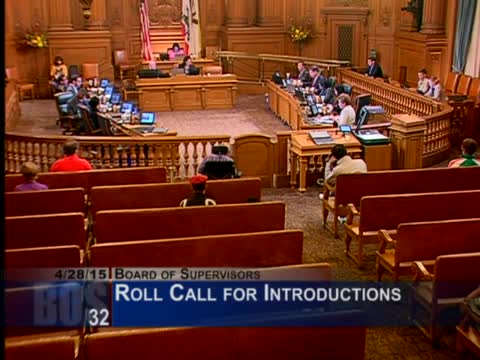
Supervisor Farrell introduces sheriff presumptions for occupational illnesses and requests white paper on private commuter shuttles
Summary
Supervisor Farrell introduced legislation to extend presumptions for occupational illnesses to sheriffs hired after February 2012 and requested a white paper from SFMTA and the Transportation Authority on private commuter shuttle services.
Supervisor Mark Farrell (as recorded in the April 28 transcript) introduced two items: legislation to extend workers’‑compensation‑related presumptions for certain illnesses to sheriffs hired after February 2012, and a request for the San Francisco Municipal Transportation Agency (SFMTA) and the Transportation Authority to produce a white paper on private commuter shuttle services.
On the first item, Farrell said the legislation would give sheriffs hired after Feb. 2012 the same presumptions afforded to police officers and firefighters for illnesses such as cancer or heart disease — presumptions that can ease access to workers’ compensation, early retirement benefits and death benefits for families. Farrell told the board he had met with members of the sheriff's department and the Department of Safe and Fearless (DSA) who raised the oversight, and he argued sheriffs perform comparable work and should have equal protections.
On the second item, Farrell asked that SFMTA and the Transportation Authority report back with a white paper examining how private commuter shuttle services fit into the city's transportation, sustainability and climate goals and to answer specific questions including jurisdictional control, accessibility, routing, curb‑space management, training and insurance requirements, consumer protections, commercial requirements, emissions and vehicle types. Farrell said the goal is to gather data so any regulation is informed and balanced, allowing services to operate while mitigating neighborhood impacts. He said he plans a hearing when the agencies complete the report in a few months.
Both items were introduced as new business; no final votes or ordinance numbers were recorded on the April 28 transcript.