Get Full Government Meeting Transcripts, Videos, & Alerts Forever!
Get email alerts on the Downtown Development topic
No spam. Unsubscribe anytime.
Committee approves Downtown Investment Authority assistance for historic rehab on Lower Street
Summary
The committee approved DIA assistance for a historic rehabilitation project near Laura Street, including forgivable funding and a deferred principal loan. The package drew debate over the ratio of private equity to public subsidy before passing 4-2.
The Neighborhoods Committee approved a Downtown Investment Authority (DIA) funding commitment for a historic rehabilitation project on Lower Street that the DIA said would restore retail space and activate a key downtown corridor.
DIA CEO Laurie Boyer and underwriting lead Steve Kelly described the proposed commitment and the developers proposed equity contribution. Steve Kelly said the projects modeled total development cost is roughly $5.8 million and the minimum owner equity requirement in that model was $900,000; the developer indicated a likely increase to $1.2 million to close a funding gap.
Kelly outlined the DIA components: a $512,000 deferred-principal, must-pay obligation due in 10 years with interest payments during the term, and about $2,048,000 in forgivable components structured per program guidelines; total city assistance modeled at roughly $2.56 million. He said the city forgivable portion is generally structured to reflect historic rehabilitation and code-compliance elements.
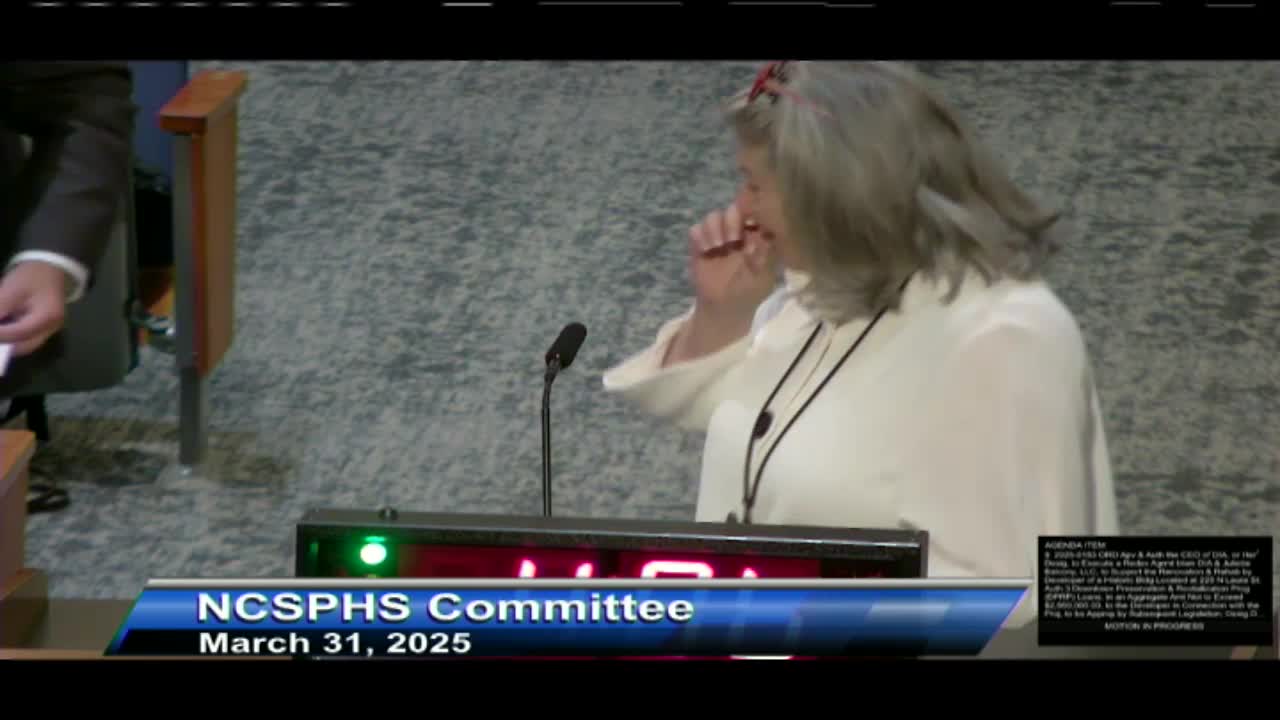
Council members debated the private equity share and the scale of city subsidy. "We're putting forward $2,000,000 in forgivable loans. It doesn't sound like we're assisting. It sounds like we're leading," Councilmember Boiling said, adding he could not support the measure. Councilmember Salem said the project cost and the public commitment appeared large relative to private equity and declined to support the request.
Supporters said the project would anchor the Lower Street corridor and catalyze nearby investments. Councilmember Paluso said the owners have a record of completing historic rehabs and argued the project is a strategic "single" that fits the DIAs corridor-building strategy.
Vote and outcome: the committee approved the request by roll call, 4-2. The record shows two members opposed.
Project timeline and conditions: DIA staff said the redevelopment agreement would be executed within 30 days of bill effective date, construction would commence within six months of that execution, and completion was estimated within 18 months of construction start. The developer committed to increasing the owner equity contribution from $900,000 to $1.2 million to cover an underwriting gap.