Get Full Government Meeting Transcripts, Videos, & Alerts Forever!
Get email alerts on the Urban Forestry topic
No spam. Unsubscribe anytime.
Committee substitutes ordinance to use tree mitigation funds for staffing, equipment and some affordable-housing waivers
Summary
Committee approved a substitute that expands permissible uses of the tree mitigation funds, authorizes hiring urban-forestry staff and equipment purchases, and waives one portion of mitigation fees for qualifying affordable/workforce housing projects. The substitute passed unanimously.
The Neighborhoods Committee on March 31 substituted and approved ordinance changes to expand how the citys tree mitigation funds may be used, including hiring additional urban forestry staff, purchasing equipment, and waiving a portion of mitigation fees for qualifying affordable and workforce housing projects.
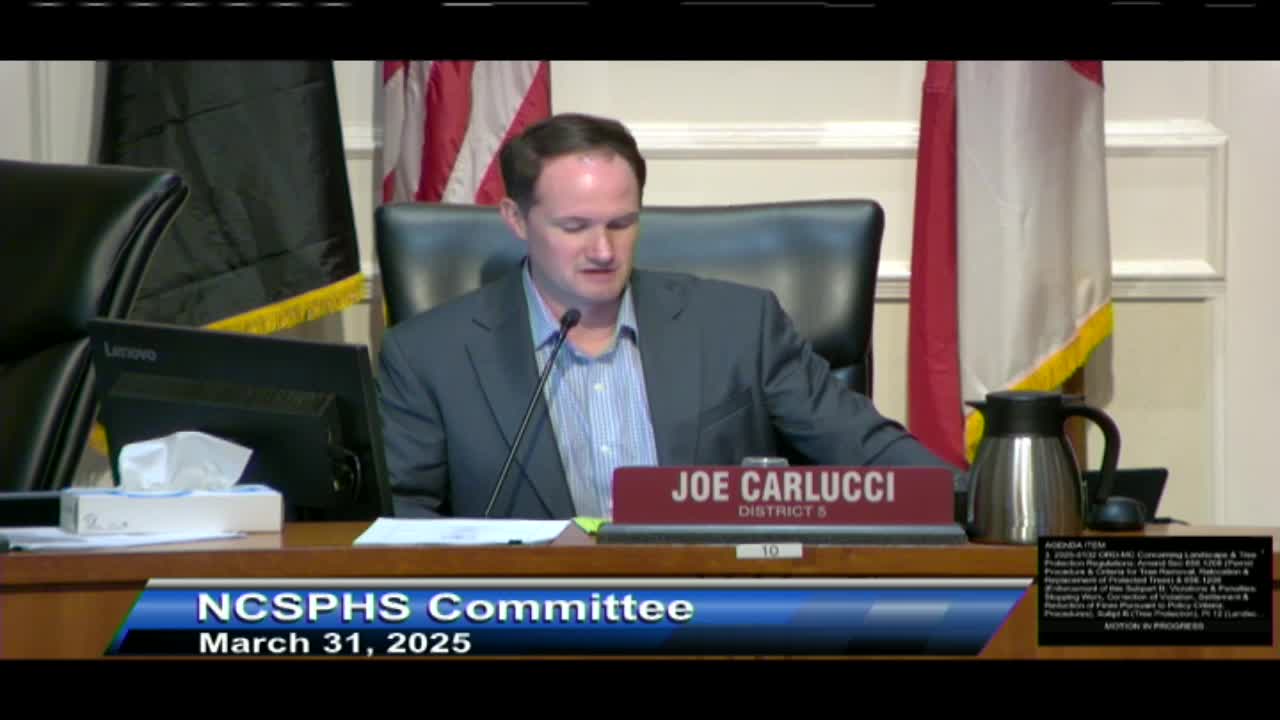
The substitute to bill 2025-102 was presented by Councilmember Joe Carlucci and approved unanimously by the committee. Committee members said the intent is to move money that has sat idle into staffing, planning and on-the-ground planting.
"The main snag with the tree fund dollars is this. We have only 1 city arborist for the entire city of Jacksonville and that is to say understaffed is is an understatement," Carlucci said, explaining the substitute would fund positions such as an urban forester, a landscape architect and a city arborist, plus equipment needed for planting and maintenance.
What the substitute does: it authorizes use of the ordinance account to fund additional positions and tools for tree planning and planting, provides for the tree commission to review staffing and priorities, and waives the ordinance portion (but not the charter portion) of mitigation fees for developments that meet the bills definition of affordable or workforce housing. The committee clarified the waiver applies to projects whose affordability is tied to recognized federal, state or local funding programs with enforceable affordability periods.
Financial context: committee staff said the ordinance fund balance stands at about $15.5 million and the related charter fund at roughly $8.3 million. The substitute limits the waived fee to the ordinance portion; projects would still pay the charter account requirement.
Process and oversight: council members requested the Tree Commission be given the substitute text and invited comment; staff said commission members had seen earlier drafts and the planning department had recommended approval of the substituted language. An amendment to further define affordability (proposed by Councilmember Paluso) failed on the floor after debate about whether the substitutes statutory- and program-based definition better captured long-term, deed-restricted affordable housing.
Outcome: the substitute to bill 2025-102 passed by voice vote and the bill as substituted then passed on the ballot, 7-0. The substitute directs further work on implementation, and staff must return with administrative steps and job descriptions to operationalize the new positions.