Get Full Government Meeting Transcripts, Videos, & Alerts Forever!
Get email alerts on the Energy Efficiency topic
No spam. Unsubscribe anytime.
Shoreline council approves $300,622 in CDBG funds for Energize Shoreline heat‑pump program, 4‑2
Summary
Shoreline City Council voted 4–2 April 14 to reprogram $300,622 in Community Development Block Grant funds to subsidize low‑ and moderate‑income heat‑pump installations under the Energize Shoreline program; council debate focused on equity, program reach and alternative uses for small-dollar CDBG capital funds.
Shoreline City Council voted 4–2 April 14 to reprogram $300,622 in Community Development Block Grant (CDBG) funds to expand the Energize Shoreline program and subsidize home electrification for income‑qualified households.
Bethany Walbrook Dunn, the city's community services manager, told the council the funds available for reprogramming total $306,422 from 2022–2024 CDBG allocations and recaptured funds; federal regulations and the seven‑year spending window constrain how small amounts can be used. Walbrook Dunn said the proposal would use the available CDBG funds alongside a federal EECBG grant and city one‑time funding to subsidize heat‑pump installations for low‑ and moderate‑income households and to support outreach and workshops.
Paige Scheid, the city’s environmental sustainability program manager, described the Energize Shoreline pilot in 2024 and the benefits of heat pumps: reduced greenhouse‑gas emissions, improved indoor air quality and summer cooling. She said upfront cost is the primary barrier and that installations in the region can range from about $10,000 to $30,000 depending on home size, envelope condition and electrical work. Scheid said the pilot provided educational workshops that led some homeowners to pursue incentives and that a targeted low‑income track produced a waitlist of applicants for subsidized installations.
Supporters argued the program advances the city's Climate Action Plan and helps households that otherwise could not afford conversions. "Low‑income people are frequently boxed out of this," Deputy Mayor Mork said, urging support so the city can reduce greenhouse‑gas emissions and improve quality of life for qualifying residents.
Opponents urged caution about program scale and equity of impact. Councilmember Ramsdell, who voted no, questioned the program's reach and participation rate, noting the pilot produced a modest installation rate among workshop attendees and saying the same funds could be used for other capital projects that assist more households. "I kind of wonder like how many of these people would have done it anyway," Ramsdell said, citing program participation and per‑household costs.
Staff described eligibility and selection plans: the program will run two tracks (a publicly promoted rebate track for all residents and a subsidized income‑qualified track). For income‑qualified installations staff said they will run a competitive application period and use a lottery to allocate limited slots; contractors complete site assessments to verify feasibility before installation.
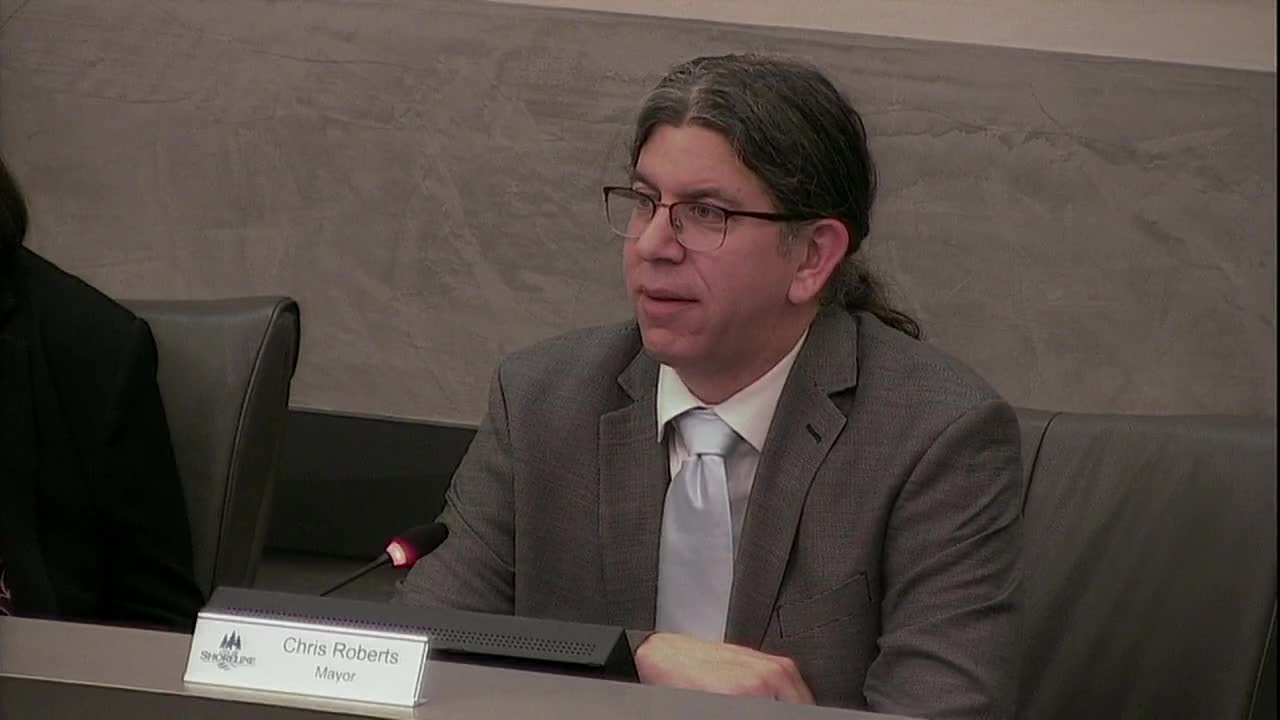
On a motion to follow staff’s recommendation, the council voted Aye (Mayor Roberts, Council members Robertson, Ademasu, Deputy Mayor Mork) to Nay (Council members Ramsdell, Povey) with Council member Scully absent, approving the reprogramming of the CDBG funds to Energize Shoreline. Staff will proceed to implement the expanded program and return with details on outreach, selection and the expected number of subsidized installations.