Get Full Government Meeting Transcripts, Videos, & Alerts Forever!
Get email alerts on the Land Use Planning topic
No spam. Unsubscribe anytime.
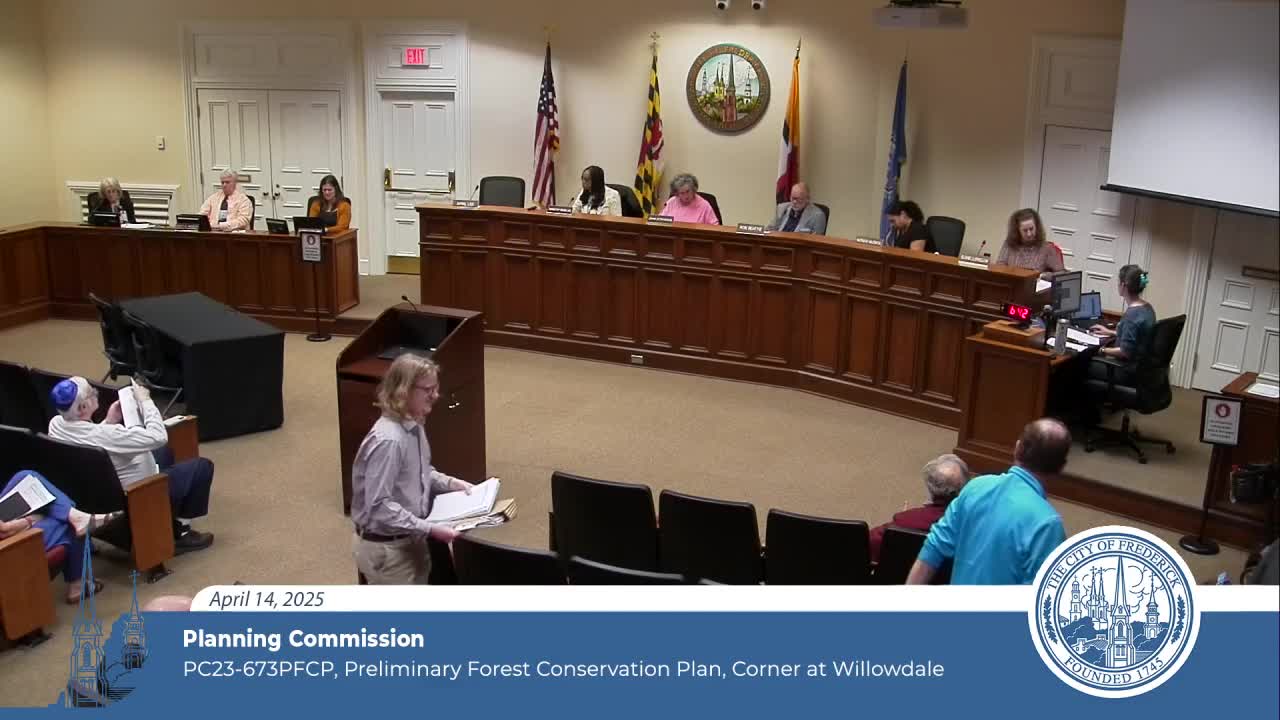
Planning commission approves Rock Hill preliminary plat amid neighbor concerns; forest conservation plan split in two votes
Summary
The Frederick City Planning Commission voted 3-2 to approve a preliminary plat that would reconfigure about 13.47 acres in the Rock Hill area into 50 single‑family lots, while later rejecting the project's preliminary forest conservation plan in a separate vote.
The Frederick City Planning Commission voted 3-2 to approve a preliminary plat that would reconfigure about 13.47 acres in the Rock Hill area into 50 buildable single‑family lots, while narrowly rejecting the project's preliminary forest conservation plan in a separate vote.
Planning department case planner Sharon Kemper Suarez summarized the proposal, saying the project "comprises approximately 13.47 acres" and would create "50 recorded lots for single family detached units and with supporting roadways and infrastructure," including stormwater work and a required forest conservation area.
The commission's approval of the preliminary plat included modifications to city street and access standards. Commissioners found the request consistent with the 2020 Comprehensive Plan and said the street and driveway deviations were driven by the need to accommodate stormwater facilities and modern infrastructure within the previously platted layout. The motion to approve the preliminary plat passed 3-2; Commissioners Valencia and Manelas voted no.
The proposal drew extensive public comment at the hearing. Neighbors raised concerns about traffic and parking on the narrow, mostly two‑way local streets that serve the neighborhood, stormwater and flood risk from development atop the hill, and the loss of mature trees and wildlife habitat. Resident David Simpson said the proposal would increase housing in the neighbourhood by roughly 60 percent and that "it's disturbing to hear that there's no study done" addressing traffic impacts. Multiple speakers described recurring flooding and limited pedestrian infrastructure.
Applicant representatives said the design includes stormwater facilities intended to reduce post‑development runoff, on‑site parking for each lot and sidewalks within the new street grid. The applicant stated the plan provides two‑car garages and two driveway spaces per lot (four potential on‑site parking spaces per lot), and that frontage and internal sidewalks would be constructed as part of the subdivision. On stormwater, the applicant told the commission the project uses planters, underground systems and regional basins and that post‑development discharges from the site will be less than current conditions.
Two forest‑related votes followed. The commission approved a modification to allow removal of certain specimen trees (4-1), but when commissioners voted on the preliminary forest conservation plan itself the motion failed (2-3): Commissioners Beattie and Strawson voted yes while the remaining commissioners voted no. The PFCP included on‑site preservation of about 1.09 acres of forest, credits for street trees, and a proposed fee‑in‑lieu for the remaining requirement; staff calculated a fee in lieu for a 2.66‑acre remainder equal to $34,760.88.
Staff also told the commission the project must comply with other conditions before recording, including final plat recordation, MPDU payment or provision, and technical notes for the street details, landscaping, and APFO (adequate public facilities ordinance) documentation. Because the reconfiguration preserves the previously recorded count of 50 lots, staff said the application qualified for the APFO general exemption that applies when a subdivision does not create additional lots. Staff and the applicant acknowledged that if the applicant had sought more than 50 lots the APFO analysis would have applied.
The commission's split votes reflect tensions highlighted at the hearing: neighbors said infrastructure and traffic capacity were insufficient and that past platting (dating to the mid‑20th century) shouldn't preclude modern impact analysis; staff and the applicant emphasized regulatory compliance, stormwater improvements and the difference between on‑site design review and APFO capacity testing. The planning commission approved the preliminary plat 3-2 but did not adopt the PFCP, leaving outstanding forest conservation requirements and related conditions for the applicant to address if it seeks further action.
The commission read conditions into the record that the developer must satisfy before final plat recordation, including notes on NAC mapping, landscape plans signed by a registered landscape architect, MPDU payment agreement recording, APFO certificate updates, and documentation of community outreach meetings. The next steps for the applicant include satisfying those technical conditions and deciding whether to revise the PFCP and return to the commission.
Votes at a glance
- Preliminary plat for Rock Hill (PC 231045 PSU): Approved 3-2 (Opposed: Commissioner Valencia; Commissioner Manelas). - Modification to 6.01 access management (Lots 4 and 6 driveway spacing): Approved (unanimous roll call earlier in session). - Modifications to Section 6.11 street improvement standards (Hope Place, Birch, Maple, Poplar and Linden frontages): Approved (unanimous earlier roll call). - Modification to allow removal of specimen trees under Section 7.21: Approved 4-1 (Commissioner Manelas opposed). - Preliminary forest conservation plan for Rock Hill (PC 231047 PFCP): Failed (2-3) — Commissioners Beattie and Strawson in favor; others opposed.
What happens next
Staff listed a set of technical conditions the applicant must meet before recording the final plat and noted that infrastructure issues such as water and sewer capacity are evaluated at permitting and that sidewalk priorities and other public improvements are funded through the city's capital program or developer obligations. The applicant may revise the forest conservation plan and return for commission consideration.