Get Full Government Meeting Transcripts, Videos, & Alerts Forever!
Get email alerts on the Commute Trip Reduction topic
No spam. Unsubscribe anytime.
Lynnwood holds public hearing on updated commute-trip reduction plan; no public testimony recorded
Summary
City staff briefed the council on updates to Lynnwood's Commute Trip Reduction plan, including a 67% drive-alone performance target, employer requirements and a menu of options. The public hearing drew no speakers; staff signaled a council ordinance for adoption could be considered in two weeks.
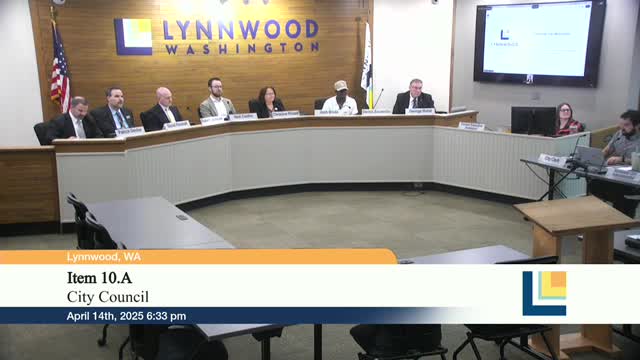
The Lynnwood City Council on April 14 held a public hearing on updates to the city's Commute Trip Reduction (CTR) plan and proposed code changes, but no members of the public spoke during the hearing.
Zach Spencer, a city staff presenter, reminded the council that Washington's CTR law was enacted in 1992 and is codified in the state's Clean Air Act chapter of the Revised Code of Washington (RCW). He said jurisdictions must adopt CTR plans for major worksites and set performance targets. In Lynnwood's draft, one such target is a drive-alone commute rate of 67% for affected worksites.
Spencer said major employers are defined as employers with 100 or more full-time affected employees at a single worksite. The draft code proposes a menu of employer options grouped into three categories; employers would select a total of five options with at least one from each category. Mandatory elements include designating an employee transportation coordinator (ETC) at each major worksite to administer the plan and collect progress data.
The city has partnered with Community Transit and a consultant to prepare model plans, conduct outreach and create a model ordinance adapted to Lynnwood. Spencer said the city's last formal CTR update occurred in 2017 and that a planned 2021 update did not proceed because commuting patterns changed during the pandemic.
Spencer noted Lynnwood's growing regional transit connections, including the light-rail station, two Swift bus lines and Community Transit's Stride BRT (expected to begin construction in 2028). He said Community Transit would assist with implementation and tracking of employer progress toward the city's performance targets.
The hearing record shows no public speakers during the allotted public-comment period. Councilmember Decker asked clarifying questions about how malls and shopping centers are treated; staff said individual businesses that meet the 100-employee threshold are considered worksites rather than the mall as a single worksite. Staff estimated roughly 20 major worksites in Lynnwood.
Mayor Christine Frizzell closed the hearing after council questions. Spencer told the council staff would present a draft ordinance and motion for consideration at a future meeting in approximately two weeks, at which time the council could vote on adoption.
The public hearing was procedural and legislative; no adoption occurred at the April 14 meeting.