Get Full Government Meeting Transcripts, Videos, & Alerts Forever!
Get email alerts on the Public Safety Crime Stats topic
No spam. Unsubscribe anytime.
DeSoto police: reported crimes down 8.4% year‑to‑date; ShotSpotter, gunshot reporting and neighborhood watch get push
Summary
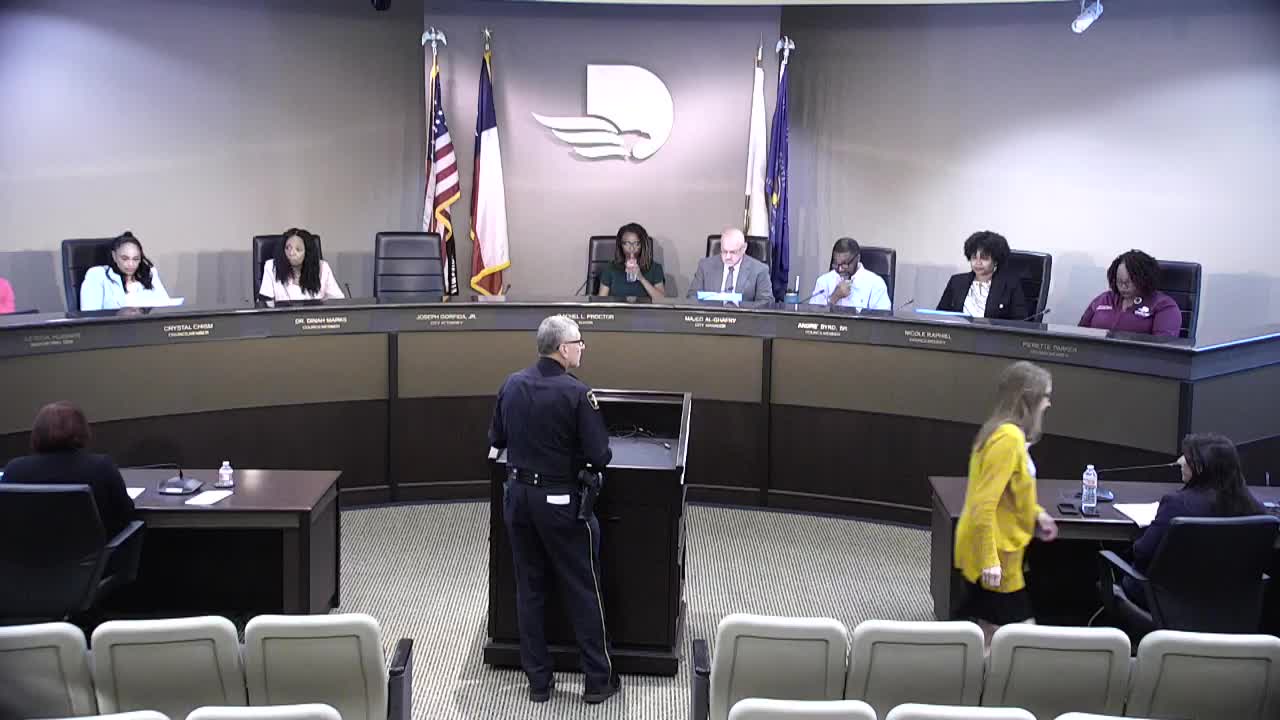
Police Chief Joe Costa told the DeSoto City Council on April 14 that the department’s crime report for January through March 2025 showed 392 incidents so far this year, down from 422 in the same period in 2024.
Police Chief Joe Costa told the DeSoto City Council on April 14 that the department’s crime report for January through March 2025 showed 392 incidents so far this year, down from 422 in the same period in 2024. “So we’ve gone down, 8.4%,” Costa said during the quarterly presentation.
The chief said three of the city’s four policing districts showed declines; District 4 was the only district with an increase, up by about 14 incidents. Costa walked council members through the department’s process for documenting gunshot calls, noting that all calls for service are recorded and that calls may later be ruled fireworks or vehicle backfires if investigators find no evidence of gunfire. He also described how ShotSpotter — the city’s acoustic gunshot detection system — is used to verify gunfire and prompt rapid dispatch when the system registers a real event.
Council members raised multiple questions about how “gunshot” calls are labeled and tracked. Councilwoman Nicole Rafael asked whether loud noises reported by residents always appear as crimes in the statistics. Costa replied that calls without witnesses or physical evidence often cannot be charged as crimes: “If we don’t catch anybody because we don’t have anybody to charge … there’s no crime, if you will.” He said the department will pull camera footage when available and use ShotSpotter data to focus investigations.
Several council members asked for greater visibility of the underlying call data — not only confirmed crimes — so residents can see what types of calls dispatch receives. Costa said dispatch documents all calls for service and that the department keeps track of gunshot calls even when they are not ultimately classified as crimes.
The presentation also included an update on the department’s neighborhood crime watch outreach. The police said they held a town hall and are working with community groups to restart and strengthen neighborhood watch programs. The department has produced a printed crime prevention booklet and a separate coloring booklet aimed at youth. Staff asked council members to invite officers to neighborhood meetings and offered to supply starter materials, signs and a “watch box” of resources for groups that want to organize a watch quickly.
Officers said small groups of neighbors — as few as four or five households — can form an effective watch and that the program will use Nextdoor and other local platforms to recruit participants. The department also said it will produce a clearer “how to start” packet so neighborhood leaders leave meetings with a step‑by‑step checklist and the contact information they need to connect with police.
Council members and staff agreed to continue reporting crime statistics publicly and to explore additional ways to present call‑for‑service data so that residents can better compare perception and recorded incidents.
Ending: The council did not take formal action on the crime statistics; Costa’s slides and the conversation were presented for information and follow‑up.