Get Full Government Meeting Transcripts, Videos, & Alerts Forever!
Get email alerts on the Transportation Funding topic
No spam. Unsubscribe anytime.
STA board approves strategy to coordinate $28.4M in Sacramento County STIP funds via proposed MOU
Summary
The Sacramento Transportation Authority board on March 13 approved a staff-recommended strategy to pursue a memorandum of understanding among county agencies to coordinate Sacramento County's share of State Transportation Improvement Program funding — about $28.4 million — while applications remain subject to SACOG and state eligibility.
The Sacramento Transportation Authority on March 13 approved a strategy to pursue a memorandum of understanding that would coordinate Sacramento County's allocation of State Transportation Improvement Program (STIP) funds, staff said.
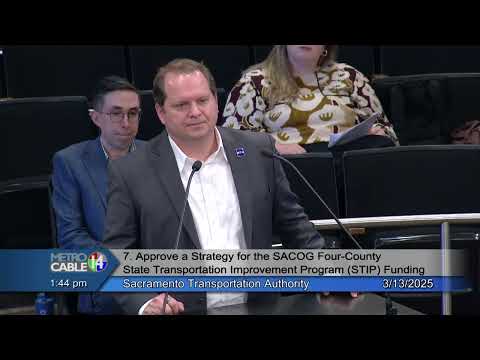
Kevin Busey, executive director of the Sacramento Transportation Authority, told the board that "for Sacramento County, there's $28,400,000 available for projects within the county." He said the proposal would use an MOU-based partnership approach that preserves competitive application requirements while increasing funding certainty for local agencies.
The nut of the proposal is to program roughly 90% of the county's STIP share to projects located within Sacramento County, with about 10% remaining for regional, multi-county projects administered by the Sacramento Area Council of Governments (SACOG). Under the approach described by Busey, 22.5% of the county pool would be set aside "off the top" for rail and transit, consistent with the local partnership formula used for SB 1 funds, and the remainder would be distributed by a population-lane-miles formula among eligible agencies.
Busey described the timeline: staff circulated a draft MOU to member agencies, requested comments by March 28 and planned to return to the STA board on April 10 with a final MOU for formal adoption. STIP applications are due to SACOG on June 6; staff said they have started working groups for the rail/transit and roads/active-transportation buckets so agencies can prepare competitive pre-applications.
Supervisor Pat Hume asked whether the funds would flow through STA or SACOG; Busey replied the funds "still flow through SACOG" and STA's role would be to shepherd consensus among local agencies and help coordinate applications rather than to receive or distribute the dollars directly.
Eric Johnson, deputy executive director of operations at SACOG, addressed the board and confirmed the county-based coordination is consistent with changes in how SACOG and the state calculate and allocate STIP shares. He also noted a discretionary 10% of STIP funds will continue to be available regionally through SACOG.
The board voted by voice to approve the strategy. The motion to proceed with the MOU approach was made on the record by Supervisor Pat Hume and seconded; the clerk recorded the action as carried by voice vote with no opposition noted.
The staff report and draft MOU were attached to the meeting materials. Busey and SACOG staff said the parties intend to keep projects competitive for state criteria even as they seek greater predictability for local agencies.