Get Full Government Meeting Transcripts, Videos, & Alerts Forever!
Get email alerts on the Highways Budget topic
No spam. Unsubscribe anytime.
Cochise County highways staff urge larger chip-seal stockpile as budget lines shift to materials and contingency
Summary
Highways staff told supervisors a 12,000-ton purchase will cover roughly this fiscal year’s chip-seal work but recommended building a 20,000-ton reserve; the presentation also detailed overhead allocations, contingency funds and professional-services spending tied to contractor miles.
During a Cochise County budget briefing, highways operations staff described plans to buy 12,000 tons of chip-seal material to support roughly this fiscal year’s chip-seal program and recommended building a larger reserve of about 20,000 tons to sustain work into the next fiscal year.
The county’s highways presenter said the 12,000 tons “will give us everything we need this year plus some towards next fiscal year,” and added that staff “are looking to stockpile more material than that. What we'd like to have is probably 20,000 tons of material sitting at our sites so that we can go out and chip seal any roads, and we can hire a contractor, and we're not sweating having this material around.” The presentation noted that 12,000 tons would not quite cover 70 miles of chip sealing when accounting for prior-year activity and the program’s fiscal-year timing.
Why it matters: chip-seal material availability, haul distance and contractor logistics affect how many miles the county can surface each year and the labor hours required on site. Highways staff said stockpiles should be held at fenced and secured road yards when possible to prevent theft and to keep contractors working without long truck turnarounds.
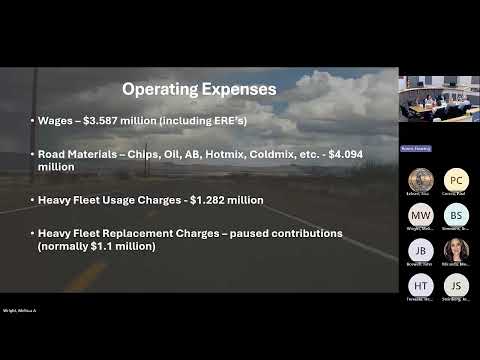
Key budget trade-offs and numbers discussed included a planned cushion for materials of roughly $300,000–$400,000 and a contingency line of about $2.9 million. Staff described shifting a previously scheduled $1.1 million annual contribution to fleet replacement into road materials and professional services for the current year because an existing fleet contingency allowed pausing the contribution. The presenter said the highway fund typically pays about $11,500,000 in professional services annually, which in recent years bought roughly 16–20 miles of contractor work, and that a $2,200,000 contract line was included in the current budget materials slide.
Speakers discussed logistics and local supply. The presenter said the county often trucks material from local suppliers “right from Maddox and Sons” and that the county uses solid-waste transfer sites and other county-owned right-of-way properties (examples mentioned: Sunsites, Gleeson, Wilcox and Fort Grant Road) to stage material. The highways staff also identified Western Emulsions in Tucson as an emulsified-oil supplier the department uses. Staff noted that using a more distant plant — for example, in Safford, Benson or Douglas — would increase truck idle time and labor costs and reduce productivity for chip-sealing operations.
Participants asked whether new or nearby asphalt plants could be used for hot mix. The presenter said the county sometimes uses small quantities of hot mix to patch areas ahead of chip sealing and that KENG’s (identified in the discussion as a local source) and a planned plant in Douglas could be potential sources when they are operating. The presenter cautioned that logistics and distance remain important for efficiency.
The briefing also covered internal cost allocations. Board members pressed for detail about a roughly $983,000 overhead charge allocated back to the highway fund; staff explained that overhead represents internal services such as human resources, finance and legal support and is calculated annually through a cost-allocation report. One supervisor asked for the underlying cost-allocation report to better understand whether legal fees, insurance and other internal charges were being double-counted across lines. Staff agreed to provide that report for further review.
Operational items discussed included heavy-fleet usage charges (direct charges from fleet for graders, dump trucks and other equipment), and a note that the county had paused a $1.1 million highway contribution to fleet replacement this year because fleet retained contingency funds. Staff said the pause freed funds for materials and contractor services during the current year but that the county would likely resume the $1.1 million contribution in the next budget year.
Staff described an investment in road-management technology (RMT) — described in the presentation as a subscription mounted on about 20 vehicles — that will provide pavement condition index data, cameras and vibration/density measures to prioritize repairs. The presenter said the RMT work will generate red/yellow/green pavement-condition mapping to help engineering prioritize crack filling and other needs.
Board members also asked about a line item labeled cash carry-forward and how it matched to expenses; staff said carry-forward was being used largely for materials and professional services and that some carry-forward entries were reflected as reciprocal budget lines. The presenter said the highway fund is a special revenue fund, separate from the general fund, and that interest revenue and unrealized gains or losses on investments can cause the year-to-year interest line to fluctuate.
Several operational points were clarified: the department reported having around nine staff in one local work group and ‘‘roughly 40’’ staff across highway operations; the department recently repaired two bridges this year and sometimes uses operations staff rather than contractors when time and funding allow; and the county occasionally discovered small parcels with back taxes that were paid and now are being prepared for auction because the county has no need for the land.
No formal board motions or votes were recorded in the transcript segment provided. The presenter closed by inviting additional questions and noting the meeting would reconvene later for a separate discussion on the county treasurer’s investments.
The transcript indicates follow-up items the board requested, including the cost-allocation report showing how the $983,000 internal-services overhead is calculated and more detail on how overhead and direct charges (attorneys, risk management, insurance) are being applied to the highway fund’s budget lines.