Get Full Government Meeting Transcripts, Videos, & Alerts Forever!
Get email alerts on the Municipal Budget topic
No spam. Unsubscribe anytime.
Wyoming presents FY 2026 budget proposal; $141.2M revenue, major water and sewer capital draws
Summary
Finance staff presented a proposed Fiscal Year 2026 budget with $141.2 million in projected revenue and nearly $181 million in planned spending driven by capital projects; council was told the budget will be published for public review, with a public hearing May 5 and adoption planned for May 19.
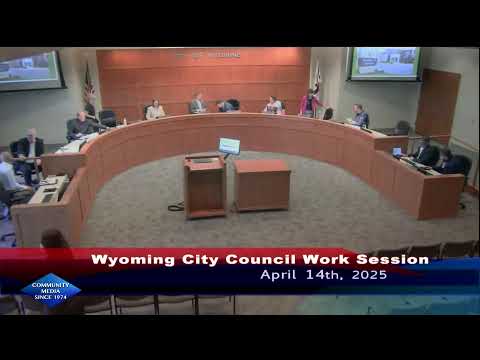
City of Wyoming finance staff on April 14 presented the proposed Fiscal Year 2026 budget and the timetable for adoption, telling council the budget book will be posted this week, a public hearing will be held May 5 and council will be asked to adopt the budget on May 19.
"When we add all of our revenue sources together, including the property taxes and our charges for services and other grants and things, we end up at a hundred and $41,200,000 in revenue for the fiscal year 26 budget," Jody said during the presentation. She said that number excludes interfund transfers and that planned expenditures total nearly $181,000,000, with roughly $40 million to come from previously accumulated fund balance for capital projects.
Why it matters: The proposed budget funds a large slate of capital investments — especially in water and sewer — that will draw down reserves and shape utility rates, infrastructure timelines and vehicle/equipment replacement over the next year.
Highlights from the presentation: - Property tax revenue: Staff said property-tax–driven revenue is just over $41 million. Finance staff described the effect of Michigan's Headlee/Headlee-style rollbacks (presented in the discussion as "Headley" reductions) that reduce millage rates as taxable values rise; staff said FY25 millages totaled 13.1493 and reported a proposed total millage for the coming year as part of the rollback calculation. - Capital and fund-balance draws: Planned fund-balance use totals about $40 million; the largest components are $24.2 million from the Water Fund (surge suppression system, generator and controls, continued work on the 42-inch transmission main assessment, and settling basin rehabilitation) and about $9 million from the Sewer Fund (design work for a digester or dryer and $6 million toward Headworks rehabilitation). - Major projects and programs: Continued construction on the City Center (approximately $3.8 million from the city center project fund), Marquette Park redevelopment ($1.5 million from parks and $1 million from library/parks capital), ongoing water/sewer system projects, and motor pool replacements (22 vehicles planned for FY26 plus two new pieces of equipment and eight equipment replacements). - Intergovernmental and joint ventures: The Grand Valley Regional Biosolids Authority (GVRBA) budget for 2026 was presented for information; the GVRBA's 2026 budget is about $12 million, with Wyoming's share approximately $5.1 million, driven by solids production and reductions in landfill activity noted by the partner municipality. - Revenue composition and internal rates: Staff noted that charges for services (including water and sewer user charges) exceed property-tax revenue in total and that some internal service fund balances were intentionally reduced to lower rates charged to operating funds.
Staff said the budget process seeks to smooth capital contributions across years through the city's six-year capital improvement plan, assess department needs, and consider inflationary pressures and staffing. Public-safety costs remain a major portion of the General Fund, with a General Fund contribution to public safety of about $15.6 million in the proposed budget.
No formal vote on the budget occurred at the work session. Staff said the final budget book will be posted by Thursday and that the council will hold a public hearing on May 5 before a final vote on May 19.
Other context from council discussion included questions about the solids management alternatives for wastewater (digesters versus dryers), with staff noting a digester can reduce solids volume substantially while a dryer reduces water content and that both options are costly and under evaluation for cost-effectiveness.