Get Full Government Meeting Transcripts, Videos, & Alerts Forever!
Get email alerts on the Zoning Rezoning topic
No spam. Unsubscribe anytime.
Council reviews second reading to rezone 738 East Main from residential to neighborhood commercial
Summary
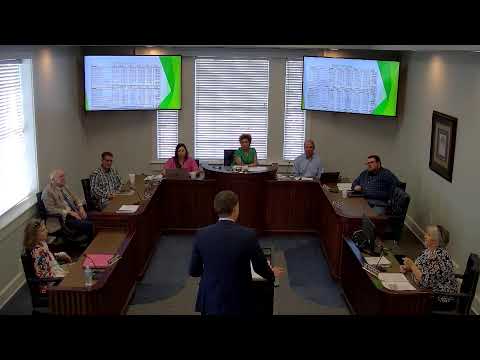
Easly City held a second-reading discussion April 14 of Ordinance 202502 to rezone about 0.815 acres at 738 East Main Street from residential (R7.5) to neighborhood commercial.
Easly City held a second-reading discussion April 14 of Ordinance 202502 to rezone about 0.815 acres at 738 East Main Street (at the intersection of South D Street and East Main) from residential (R7.5) to neighborhood commercial.
The applicant, Daniel Hilliard, answered council questions at the podium and said neighborhood commercial is what he wants for the property. "The neighborhood commercial is exactly what I want," Hilliard said.
Council members and other attendees pressed Hilliard on the practical difference between neighborhood commercial and office/institutional zoning. One council member referenced the planning commission minutes to summarize earlier public comment that Hilliard had said he wanted to "utilize the parcel to its full potential." That prompted back-and-forth about whether a more restrictive office/institutional (OI) zoning would better protect the building from being torn down or reused for retail uses such as a convenience store.
Council members noted that OI is a restrictive commercial zone allowing uses such as professional and medical offices, banks, beauty shops and day cares, and suggested it might better match Hilliard’s stated preference for small professional uses. Hilliard said he preferred neighborhood commercial to allow some flexibility for potential buyers and uses. One council member warned that once sold, the seller generally cannot control what later buyers choose to do with the structure.
Speakers discussed the tension between preserving an older house on the parcel and market pressures. Council members and Hilliard said whether the structure would be kept or torn down would likely depend on future buyers, building condition and market economics.
The transcript records the item as being on second reading; the meeting record does not include a clear, attributable final vote in the transcript excerpt provided.