Get Full Government Meeting Transcripts, Videos, & Alerts Forever!
Get email alerts on the Election Administration topic
No spam. Unsubscribe anytime.
Residents urge delay of ballot-marking device contract renewal, cite barcode and touchscreen concerns
Summary
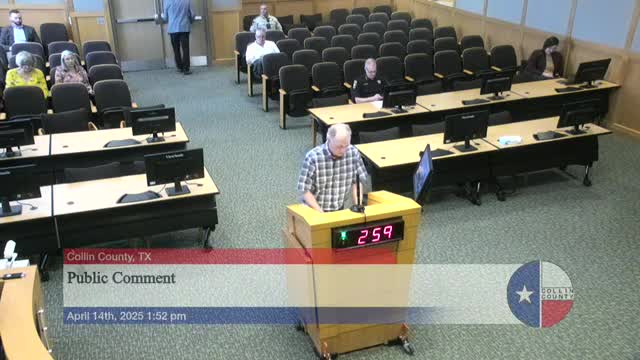
Several residents urged the Commissioners Court to delay or amend a contract renewal for ballot-marking devices and maintenance, citing concerns about touchscreens, barcodes and state/federal actions that could change equipment needs before the 2026 primaries.
Multiple residents urged Collin County commissioners to delay or amend a maintenance/renewal contract for ballot-marking devices and related services, arguing state or federal changes could reduce equipment needs and that touchscreen/barcode systems present security and verifiability concerns.
One speaker, identified in the transcript as "Mr. Reynolds," raised broad security concerns and referenced a recent presidential discussion and a U.S. intelligence briefing, arguing the county should move toward hand-marked paper ballots. Another commenter, Debbie Linster of Citizens Defending Freedom, asked the court to delay a vote by 30 days or amend the contract to include a refund provision if upcoming legislation reduces equipment needs; she cited pending Texas proposals that could allow combined precincts of up to 10,000 voters and a merged early and election-day voting period.
Aida Snowback told the court she opposed "contract amendment number 10," characterizing it as a 3.5% increase over the prior renewal (an additional roughly $20,000) and saying maintenance fees of $370,215 make up the largest portion of maintenance costs; she said total spending on these machines and maintenance has exceeded about $13,500,000 to date. Another resident urged delay until legislation is resolved and referenced an executive order encouraging hand-marked ballots.
No formal action on the contract was recorded in the transcript during this meeting; the comments were part of the public-comment period.