Get Full Government Meeting Transcripts, Videos, & Alerts Forever!
Get email alerts on the Transportation Safety topic
No spam. Unsubscribe anytime.
Caltrans District 1 presents Vision Zero and safe systems approach to MCOG board
Summary
Caltrans District 1 staff presented the Vision Zero and safe systems approach to the Mendocino Council of Governments, outlining crash statistics, rural safety challenges, and design countermeasures including roundabouts and quick-build protected crossings.
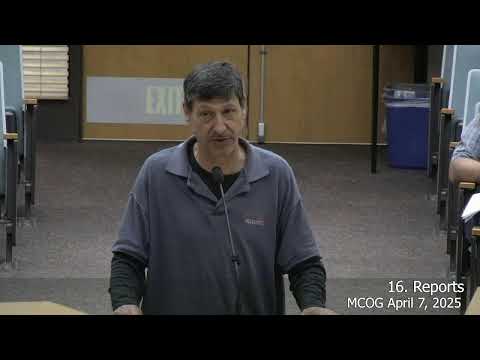
Caltrans District 1 representatives presented Vision Zero and the safe systems approach to the Mendocino Council of Governments on April 7, framing the strategy as a people-centered paradigm aimed at eliminating fatal and serious traffic injuries.
Andreas Kraus of Caltrans' safe systems unit told the board the state adopted Vision Zero in 2022 and that the safe systems approach focuses on preventing fatal and serious injuries by designing roads and speeds to keep crash forces at survivable levels. Kraus highlighted statewide numbers: roughly 3,600 traffic deaths annually in California and about 13,000 serious injuries, and he showed county-level averages discussed in the presentation: about 200 fatal-injury crashes and 800 serious-injury crashes annually in Mendocino County.
Why it matters: Caltrans presented evidence that small reductions in speed in the 20'to'40 mph range greatly lower fatality and serious-injury risk for pedestrians. Kraus explained the physics (kinetic energy grows with velocity squared), described how roadway design and speed management shape driver behavior, and urged systemic, proactive deployment of proven countermeasures such as roundabouts, separation of road users, self-reinforcing streetscapes and quick-build demonstrations (paint, flexible posts and modular materials) to test changes quickly and affordably.
Board members pressed for funding and grant options for rural traffic calming and for adopting elements of the guidance in local projects. Chair Hascheck and directors noted that rural conditions, long distances and limited enforcement (CHP or sheriff) complicate speed enforcement and that disadvantaged communities and tribal areas tend to face higher per-capita crash rates. Caltrans staff pointed to Federal Highway Administration and Caltrans grant programs, Caltrans' new Intersection and Operational Safety Assessment Process (ISOAP) guidance, and recommended local policy changes such as adopting ISOAP guidance and shifting away from level-of-service metrics toward measures that support multimodal and safer designs.
Caltrans emphasized that traffic signals are not a panacea for safety; the presenter noted roundabouts, when appropriate, typically produce large reductions in fatal and serious injuries compared with signals. The presentation closed with a call for shared responsibility among local agencies, transit providers and Caltrans to incorporate Vision Zero principles into land use, planning and project selection.
Ending: Caltrans provided resource links and encouraged the regional agencies to pursue available planning funds, consider adopting Vision Zero approaches in local plans, and integrate quick-build pilot projects to test safety countermeasures in Mendocino County.