Get Full Government Meeting Transcripts, Videos, & Alerts Forever!
Get email alerts on the Solid Waste Management topic
No spam. Unsubscribe anytime.
City staff propose raising commercial and nonresident green‑waste disposal fee to $5.28 per cubic yard
Summary
Public Works proposed raising the green‑waste disposal fee for commercial and nonresident customers to $5.28 per cubic yard to recover processing and equipment costs, reversing a long period in which the service was subsidized by city residents.
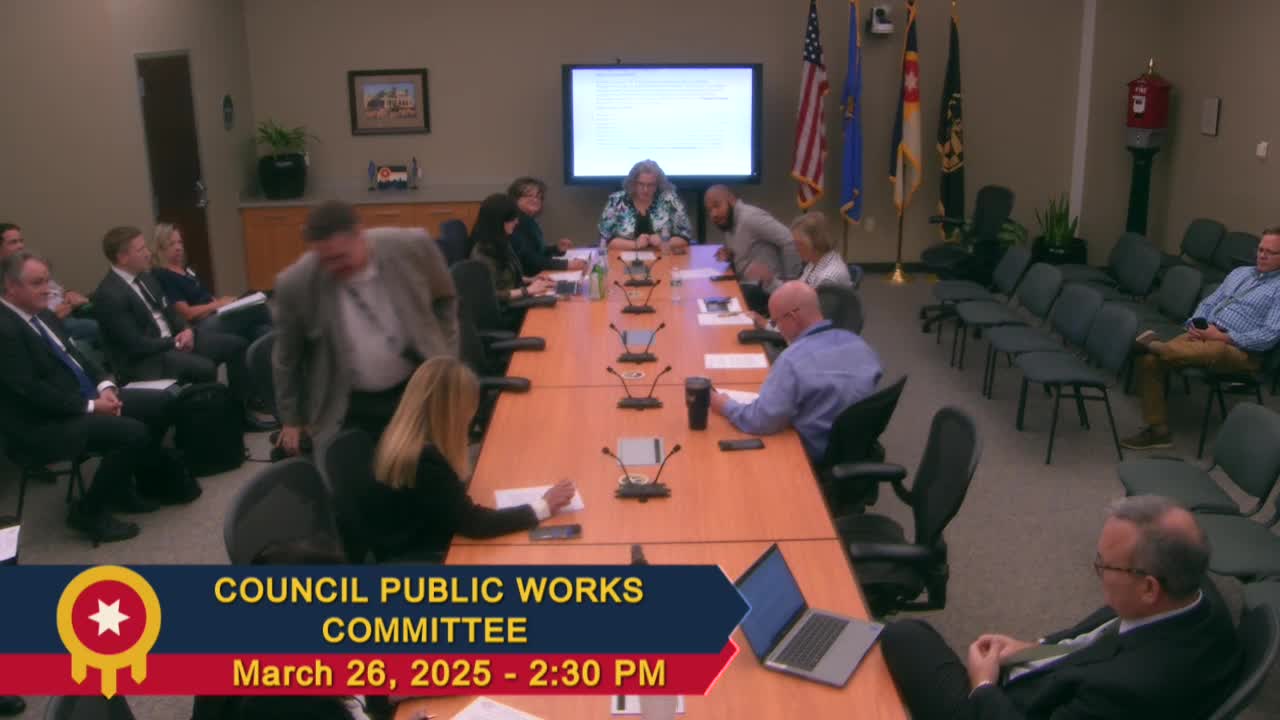
Public Works staff presented an ordinance to the committee proposing an amendment to Tulsa Revised Ordinances Title 11B, Chapter 5, Section 502(b) to raise the green‑waste disposal fee for commercial and nonresident customers from the prior rate (historically 55¢ per cubic yard) to $5.28 per cubic yard. Cheryl Black, financial planning manager for Public Works, and Philip Peaks (operations) told the committee the increase reflects an internal cost study of the actual processing cost per cubic yard.
Philip Peaks said the previous rate had been set at 55¢ for a long period and that residents were effectively subsidizing processing costs for commercial and nonresident users. Black said staff phased the change as a two‑tier system to ease the impact on users, and the new rate represents the second tier that aligns the fee with the department’s documented cost to process a cubic yard of green waste. Staff said the city is not seeking profit but is recovering processing and equipment costs.
Councilors asked about outreach to contractors and the operator transition for commercial services. Staff said rate notices were posted at the gate beginning in January and that the city has been negotiating a contract with an outside operator (a Kansas City firm was named in staff comments) to assume all commercial-side operations, leaving the city to focus on residential service. Committee members also questioned the condition of processing equipment; staff reported that one grinder was operational while other grinders and a front‑end loader were under repair and that routine maintenance and equipment replacement factored into the cost study.
Staff did not present a formal estimate of how many commercial customers would be affected; they said contractor lists change frequently and that the city could not immediately quantify the impacted contractors. No final vote was taken in committee; the ordinance carries an emergency clause and is scheduled for the legislative sequence noted on the agenda.