Get Full Government Meeting Transcripts, Videos, & Alerts Forever!
Get email alerts on the Public Safety Violence Intervention topic
No spam. Unsubscribe anytime.
Tulsa unveils nearly $2 million DOJ grant to fund community-based violence intervention program
Summary
City officials described a $1.99 million Department of Justice award that will fund a Cure Violence model program led by Impact Tulsa with multiple community partners, data dashboards and annual public reporting; the grant includes three years of funding and subrecipient contracts for local partners.
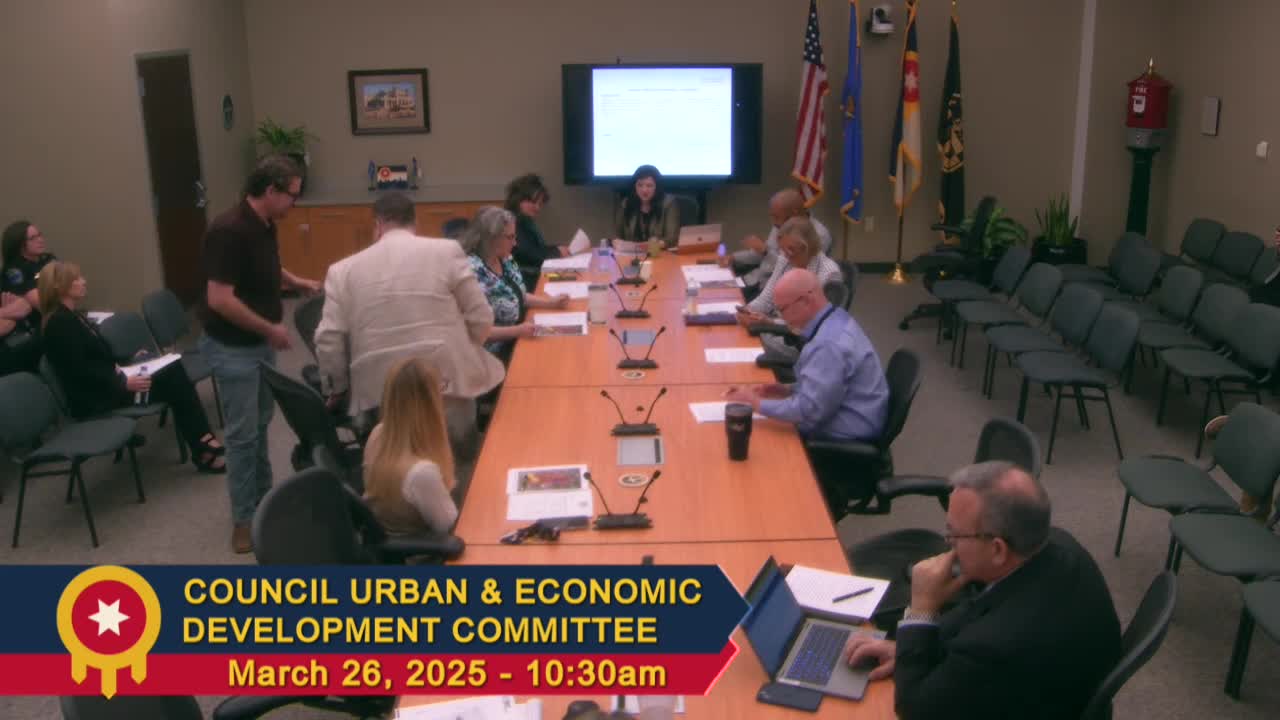
Tulsa officials told the Urban Economic Development Committee on March 26 that the city has been awarded a nearly $2 million Department of Justice grant to fund a community-based violence intervention (CBVI) program focused on areas and populations experiencing concentrated gun violence.
Dr. Rebecca Hubbard, the city's chief mental health officer, said the award is a three-year grant worth $1,991,900 that will fund a Cure Violence model implementation. Impact Tulsa will serve as the lead community partner, working alongside the Tulsa Police Department, Transgressor Foundation (translates as "Transgressor Foundation" in the packet), youth services providers and Cure Violence as a technical assistance and training partner.
Hubbard said the grant will support hiring a city-based coordinator, subrecipient contracts with local partners, credible messengers and outreach workers, youth programs and data-driven violence-interruption activities. "This is almost $2,000,000 from BJA for community-based violence intervention," Hubbard said, summarizing the award and partners.
Captain Sheldon Seibert and other Tulsa Police Department representatives said the department will provide actionable data, including heat maps and case information, to community partners so interrupters and outreach workers can target likely retaliatory incidents and other near-term violence risks. TPD officers will remain responsible for law enforcement operations while community partners provide outreach, mediation and services.
Councilors asked about grant timing, reporting and budgets. Hubbard said the award includes an initial authorized release of first-year funds and that the grant is structured as a multi-year award with annual subrecipient contracts; the city is in the grant's nine-month planning period and expects program operations to be active by July. She said Cure Violence will act as a subrecipient technical-assistance provider and will train credible messengers and outreach staff.
On data and public reporting, Impact Tulsa will coordinate outcomes data and Power BI dashboards. Hubbard said operational dashboards that could identify individuals or locations at elevated risk will not be publicly available for safety and CJIS-related reasons; the city will provide public outcome reporting on an annual schedule and must also report outcomes to the federal grantor.
Councilors asked whether the program modeled other cities; Hubbard said city staff reviewed models in Omaha, Boston and Atlanta and cited Omaha's reported decreases in shootings over a multi-year period. Council members also asked about how outreach worker stipends and service-provider selection will be handled; Hubbard said specific staffing and stipend arrangements will be decided with community partners during the planning period.
Why it matters: the federal award brings sustained, grant-funded community intervention resources to Tulsa neighborhoods with high rates of gun violence and is explicitly designed to pair community outreach with police-provided data to interrupt retaliatory shootings and support at-risk youth.
What the committee requested: councilors asked for a consolidated budget and a single view of how grant dollars will be distributed to the listed partners; staff agreed to provide the full planned budget and annual reporting expectations as subrecipient contracts are drafted.
No vote was taken; the item was a staff briefing and planning discussion.