
Commission clears feasibility study for permeable reactive barrier to reduce nitrogen into Long Pond
Get AI-powered insights, summaries, and transcripts
Subscribe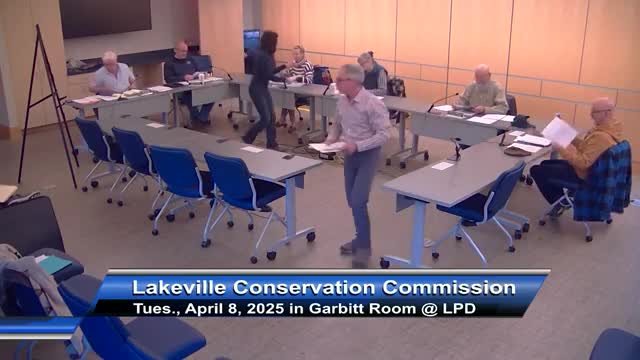
Summary
The Lakeville Conservation Commission on April 8 voted to close a public hearing and issue a negative determination allowing a feasibility study for a permeable reactive barrier along the western shore of Long Pond near Clark Shores.
The Lakeville Conservation Commission on April 8 voted to close a public hearing and issue a negative determination allowing a feasibility study for a permeable reactive barrier along the western shore of Long Pond near Clark Shores.
Karen Petinelli, an environmental planner at the Southeast Regional Planning and Economic Development District, told the commission the project will place 11 small-diameter borings and install four permanent groundwater monitoring wells to assess nitrogen concentrations and the feasibility of a pilot PRB. “It pulls, like, 90% of the nitrogen from the groundwater out of of the groundwater before it enters the pond,” Petinelli said, describing the technology.
The study will sample groundwater horizontally and vertically along about 4,000 feet of corridor to identify a 200- to 400-foot pilot stretch for a PRB. “We’re looking to assess where best to import a a pilot study…we’re looking at a stretch of about 200 to 400 feet,” said an engineer from Fuss & O’Neil, who described field instrumentation, laboratory confirmatory testing and the plan to place monitoring wells upgradient and down-gradient of any pilot installation.
Why it matters: Long Pond has persistent nitrogen and water-quality problems. The pilot is intended to test whether an in-ground reactive media (wood chips or emulsified vegetable oil) can trap legacy nitrogen in groundwater before it reaches the pond and inform a potential larger installation later. Petinelli said the project is funded with state-allocated follow-up money that is being administered through the Division of Ecological Restoration as part of a municipal vulnerability/ watershed program.
Commission discussion focused on maintenance, longevity and cost responsibility. Commissioners asked who would pay for future reinjection or replacement if the media loses effectiveness. The consultants described two common media approaches: a wood-chip trench and injections of emulsified vegetable oil (EVO). The consultants said field experience shows PRBs may remain effective for multiple years; one speaker said “these PRBs…will last 4 to 7 years,” and the group also referenced longer estimates for wood chips in some cases.
The consultants said PRB design depends on groundwater depth, hydraulic conductivity and vertical concentration profiles. If groundwater is shallow and impacted near the surface, a trench filled with organic material may be preferable; if impacts are deeper, EVO injections may work better. The team also said trenches or columns would be backfilled and finished to restore the roadway or vegetated surface; temporary siltation controls would be used during drilling and well installation.
Public and owner engagement: Petinelli said the project leader had met with Clark Shores association members and that the association had approved moving forward with the feasibility study. Drilling for the borings was announced as scheduled for the coming Monday, Tuesday and Friday; the team asked to be reachable by phone to obtain the commission’s determination before field work begins.
Vote and conditions: The commission closed the hearing and issued a negative determination allowing the borings and monitoring-well installation, with two conditions: (1) if any siltation control or barriers will be used around the wells, the applicant must notify the commission’s agent in advance for inspection and (2) the applicant must provide the monitoring data and feasibility report to the commission when available. A motion to issue the determination passed (mover/second not specified on the record). The commission member asked that the applicant deliver the study results to the commission and preferred that the applicant notify staff before work on siltation barriers began.
Next steps: The feasibility study will collect field parameters (pH, temperature, oxidation-reduction potential, dissolved oxygen, ammonia, nitrate and sulfate), send select samples to a lab for confirmation, and use those data to size a pilot PRB. If the pilot shows positive results, the team would seek additional funding and permits for a larger installation (consultants referenced a possible future design length of roughly 1,500 feet identified in earlier watershed work).