Get Full Government Meeting Transcripts, Videos, & Alerts Forever!
Get email alerts on the Wastewater And Solid Waste topic
No spam. Unsubscribe anytime.
Hawaii County Department of Environmental Management outlines wastewater upgrades, landfill lifespan and recycling gaps
Summary
Director Wes Segawa told council members the county is beginning conditional work on the Hilo wastewater rehabilitation, must meet multiple AOC obligations and faces a landfill airspace shortfall estimated at about 15 years — prompting questions about diversion and revenue options.
HILO — The County’s Department of Environmental Management (DEM) briefed the County Council on May 20 about a large slate of wastewater rehabilitation projects, landfill airspace limits and related recycling programs, saying the agency is under pressure to deliver on court-ordered cleanups and soon-to-be-implemented upgrades.
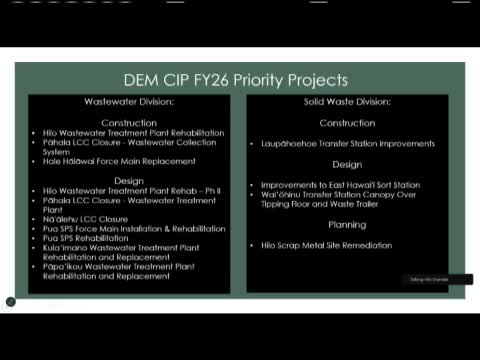
Wes Segawa, DEM director, and senior staff reviewed the agency’s FY26 program and capital priorities. The Hilo Wastewater Treatment Plant rehabilitation project is moving toward construction: DEM issued a conditional notice to proceed (NTP) allowing the winning contractor to purchase equipment and materials while county staff finalize terms and ready construction management resources. Segawa said contractors’ schedules anticipate months of lead time for long-lead equipment.
The county must also comply with multiple administrative orders on consent (AOCs) and a recent Kealakehe settlement that requires conversion of the Kealakehe facility to R1-quality reuse water. Segawa and finance staff said agency leaders have been meeting weekly to model costs, schedules and staff capacity; Finance Director Diane Nakagawa told council members the administration is developing a feasible multi-year funding and delivery plan for presentation to EPA and the council.
DEM told the council the island’s active landfill (Puʻu Anahulu) now shows an estimated remaining airspace of approximately 15 years at current tonnage and operating conditions, a figure council members described as alarming. Staff said that estimate is sensitive to tonnage trends; countywide municipal solid waste influxes — especially from commercial sources — can shorten the life of landfill cells. DEM’s solid waste chief said the department is pursuing outreach, recycling partnerships and equipment purchases to conserve airspace.
Council members pressed DEM on diversion and recycling. Segawa said the county’s recycling partners take “clean” high-5 containers for export to mainland markets; non-high-5 glass and some other recyclables are handled on-island when markets exist for them. DEM staff described recent island-wide collection events for tires and refrigeration equipment and said they are improving transfer-station signage to reduce contamination of drop-off streams.
Staff also raised staffing pressures. DEM reported about 29% of budgeted department positions were vacant at the time of the budget session, and directors said the work needed to manage large capital projects and legal commitments will require steady staff and outside contracting support. The director said some projects that DEM will manage include Hilo treatment-plant phases, the Kealakehe R1 work (which has an estimated preliminary cost in existing planning documents), Pāhala cesspool closures and the Lāpuaʻhōʻe transfer-station improvements.
Why this matters: DEM’s capital projects and court-ordered cleanups are large, technically complex and potentially costly. The department is managing near-term construction, long-lead procurement and an urgent need to plan for landfill capacity beyond the next decade. Council members urged the administration to develop multi-year financial and operational strategies to present to state and federal partners.
Looking ahead: DEM and Finance said they will build a more complete five- to ten-year funding model for EPA and council review and will pursue grant and partnership options. Council members asked for clearer timelines, contingency plans for equipment failures at the Hilo plant during the procurement period, and a more aggressive diversion and recycling strategy to extend landfill life.