Get Full Government Meeting Transcripts, Videos, & Alerts Forever!
Get email alerts on the Mass Transit topic
No spam. Unsubscribe anytime.
Hawaii County Mass Transit plans electric buses, microtransit vans and readies for end of fare-free period
Summary
Acting administrator Zach Burgum told the County Council the Mass Transit Agency expects four battery-electric buses to arrive in June, plans to buy microtransit vans for rural service, and is preparing for fare reintroduction after a county-funded fare-free period ends in December.
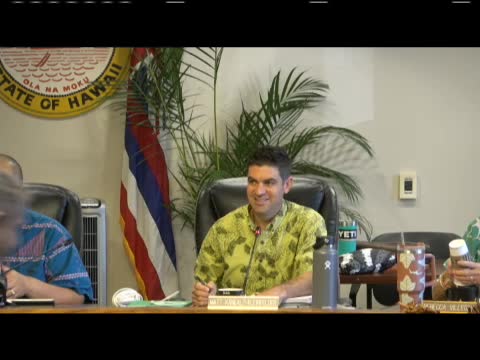
HILO — Hawaii County’s Mass Transit Agency told the County Council on May 20 that the agency will receive four battery-electric buses in June and intends to expand services for rural riders using smaller “microtransit” vans, while it prepares for fares to be reinstated after a temporary fare-free period ends in December.
Acting administrator Zach Burgum presented the agency’s FY26 budget request and a multi-year vehicle procurement plan at the council’s special budget session. Burgum said four Gillig-built battery-electric buses and two chargers are due in June and will be the first step toward a zero-emission fleet. The agency also expects nine paratransit vans and eight “hometown” buses to arrive this year, and plans purchases of hybrid and refurbished buses in the months ahead.
The presentations emphasized investments in maintenance infrastructure tied to new vehicle types, including fall-protection scaffolding for rooftop battery work and training for mechanics on new vehicle models. Burgum said the battery-electric buses come with vendor-provided training packages; he estimated a 60-hour training package per bus to equip mechanics while minimizing service interruptions.
Burgum also described the agency’s microtransit concept — smaller vans that can operate like “first-mile” connectors from remote neighborhoods to official bus stops. He said the agency plans to buy eight microtransit vans and hire a program manager to coordinate services. The vans would be smaller than fixed-route buses, able to operate on narrow or unpaved roads where large buses cannot.
Council members pressed staff on several funding and operational issues. Burgum said the agency is funded largely by the county’s general excise tax (GET) allocation and prior federal grants. The free-fare program — funded in part with COVID-era federal money and later local support — is scheduled to end in December; Burgum said the county will revert to the fare structure in county code unless the council directs otherwise. Diane Nakagawa, Finance director, reminded the council the fee schedule is in code and any permanent change to fares would require council action.
Burgum said ridership recovered strongly; FY24 fixed-route ridership was just under 1 million trips and preliminary FY25 counts (not aligned to the fiscal year NTD reporting cycle) showed about 472,209 fixed-route rides to date. He told council members the agency reports ridership to the National Transit Database (NTD) on a September–August reporting schedule; staff will provide a fiscal-year total on request.
The budget requested roughly $59.9 million in total spending for Mass Transit in FY26, driven by contract costs for operations and paratransit, higher equipment procurement and uncontrollable costs such as fuel and insurance. Burgum said staff will pursue federal grants to support vehicle purchases and hydrogen infrastructure planning; he referenced a recent application for about $10.3 million for hydrogen planning and infrastructure.
Council members asked about security at bus shelters, bus stop signage, ADA upgrades and staffing. Burgum described ongoing town halls for bus stop plans, and said shelters and stop improvements are pursued in phases aligned with grant opportunities and state cooperation for projects on state roads. He said security presence at some high-traffic stops is expensive but has reduced safety incidents. Council members pressed for route-by-route ridership breakdowns and greater transparency on how fare reinstatement would affect riders; Burgum and finance staff said they will provide route-level data and noted that fares collected before the free-fare program produced roughly $376,000 in revenue in FY22.
Why this matters: County leaders face near-term choices about how to sustain service levels and fleet modernization while federal grant support is uncertain. Battery-electric buses and microtransit purchases are aimed at reducing emissions and increasing rural access, but they carry up-front equipment and training costs and require maintenance planning.
Looking ahead: Burgum said the agency will continue applying for federal and state grants and return to the council with more detailed ridership and fare-impact analyses. Council members requested route-level ridership, updated vehicle delivery timelines and a plan for fare reintroduction timing and community feedback.