Get Full Government Meeting Transcripts, Videos, & Alerts Forever!
Get email alerts on the Hf2438 Transportation Omnibus topic
No spam. Unsubscribe anytime.
House committee advances omnibus transportation bill after contentious debate over climate rules and transit cuts
Summary
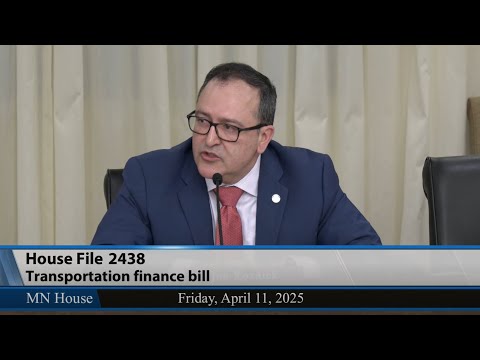
The Minnesota House Transportation Finance and Policy Committee on April 11 adopted a delete‑everything amendment to House File 24‑38 and referred the omnibus transportation finance bill to the House Taxes Committee after hours of testimony and amendments.
The Minnesota House Transportation Finance and Policy Committee on April 11 adopted a delete‑everything amendment to House File 24‑38, the omnibus transportation finance bill, and referred the measure to the House Taxes Committee after several hours of testimony and a sequence of amendments.
Committee co‑chairs and members said the bill balances multiple priorities, but the hearing showed sharp disagreement over several provisions — most prominently a proposed delay to implementation of a 2023 law that requires greenhouse‑gas and vehicle‑miles‑traveled (VMT) impact assessment for trunk‑highway projects and a package of reductions to transit and active‑transportation funding. Testimony also ranged across airport and ferry funding, changes to electric‑vehicle fees, delivery‑fee exemptions and new transparency requirements for MnDOT project reporting.
Why it matters: House File 24‑38 would direct spending and policy changes that affect road and bridge maintenance, local roadway grants, transit operations in the Twin Cities and Greater Minnesota, and implementation of the state’s VMT/greenhouse‑gas requirements. Several witness panels told the committee the bill’s choices could change how Minnesota plans projects, spend transportation dollars and meet climate and safety goals.
Committee action and next steps: After debating and voting on a series of amendments, committee members adopted the DE1 amendment to HF 24‑38 and voted to send the bill as amended to the Taxes Committee. Two roll‑call amendments failed on tie votes (8–8): Representative Jones’s amendment to remove the delay to the greenhouse‑gas/VMT law and Representative Kraft’s amendment to change the electric‑vehicle surcharge proposal. Several other technical and policy amendments were adopted by voice vote or withdrawn during the session.
Key testimony and issues
MnDOT fiscal concerns and project priorities: Minnesota Department of Transportation Commissioner Scott Daubenberger (for the record, identified in testimony) told the committee the bill “provides important investments to help construct, operate, and maintain Minnesota’s transportation system,” but warned the trunk‑highway fund in the draft language appears to show a shortfall. "The proposed spending in the trunk‑highway fund appears to exceed the available unreserved fund balance in the fiscal years 26‑27 biennium by approximately $75,000,000," Daubenberger said, recommending fiscal staff and MnDOT work together to resolve the technical gap. He also flagged an $8.94 million cut to passenger rail funding that would limit support for Borealis service between Saint Paul and points east and south.
Climate and VMT dispute: The most heavily contested policy debate centered on language that delays implementation of the transportation greenhouse‑gas and VMT assessment that was enacted in 2023. Supporters of the statute — including transportation, public‑health and climate advocacy organizations and several municipal officials — urged the committee not to delay the law. Miguel Maravic of the Rocky Mountain Institute (RMI) told the committee RMI’s analysis of the VMT standard estimated a roughly $1,700 annual direct cost savings to the average Minnesota household if the policy is implemented in projects and tied to affordable transportation options.
Opponents of the statute’s immediate implementation argued the technical tools and administrative mechanics need more time. Representative Jones moved an amendment to remove the delay; that amendment failed on an 8–8 roll call. In committee debate, Representative Kraft and others said the law had a phased implementation path and that additional time in statute would push project effects out further into the planning cycle.
Transit and active‑transportation funding: Dozens of testimony speakers warned about made‑in‑the‑bill cuts to both Greater Minnesota and metro transit programs and reductions to active‑transportation funding. Move Minnesota, the Bicycle Alliance of Minnesota, Metro Council and Greater Minnesota transit leaders testified that proposed reductions — including a multi‑year reduction schedule in the DE language — would reduce service at a time when many residents, seniors and workers rely on transit. The Minnesota Public Transit Association provided a breakdown of unfunded projects and said a $6 million reduction to a biennial grant round would jeopardize existing service hours.
Local roads, bridges and localized grants: County officials and local public‑works directors said the bill retains and adds money for several local road programs that they value: the local road wetland replacement program, the local road improvement program, corridors‑of‑commerce increases and local bridge rehabilitation. Otter Tail County Chair Wayne Johnson and county engineers from Anoka and Dakota counties described local safety and commerce problems tied to specific bridges and interchanges and thanked the committee for allocations included in the DE language.
Suicide‑prevention barriers on Washington Avenue Bridge: Testimony included strong advocacy for permanent safety barriers on the Washington Avenue Bridge in Minneapolis. Eric Mishke of SAVE (Suicide Awareness Voices of Education) urged permanent barriers and said temporary protections already installed are saving lives. Representative Jones offered an amendment to direct a portion of metro area sales‑tax monies to fund barrier work; that amendment did not pass in committee.
EV fee, delivery fee and deputy‑registrar issues: Committee debate included proposed changes to the state’s electric‑vehicle registration surcharge, with competing amendments considered. A Representative Kraft amendment to raise the EV annual surcharge to $125 (and index it in certain ways) failed on an 8–8 roll call after other proposals to direct EV‑fee increases into a greenhouse‑gas mitigation account were adopted in part. The bill also includes provisions to reimburse deputy registrars for certain no‑fee transactions and to allow additional online services; deputy‑registrar leadership said reimbursement language was a step toward addressing shifts in transaction workloads.
Transparency and project portal language: The DE and follow‑on amendments created or clarified requirements for MnDOT to produce multi‑year project planning information and reporting. Co‑chairs said they sought to align portal reporting time horizons with MnDOT’s 10‑year planning practice and reduce duplication of effort; MnDOT testified support for some portal clarifications while noting the transparency provisions would require additional staff and effort.
What the committee voted on (selected formal actions)
- Approval of minutes (April 10, 2025): moved by Vice Chair Myers; outcome: adopted by voice vote. - Motion to move the DE1 amendment to House File 24‑38: moved during the meeting (mover recorded as Representative Kosnick earlier in the hearing); outcome: DE1 adopted and later used as the bill text for referral to Taxes. - A series of amendments (A10, A11, A12, A17, A18 and others): many were adopted by voice vote; several were withdrawn by their sponsors during the session. (See committee record for a line‑by‑line roll.) - Amendment A13 (Representative Jones) to remove the statutory delay to the greenhouse‑gas/VMT law: roll call 8 ayes, 8 nays — failed (motion did not prevail). - Amendment A14 (Representative Kraft) to revise the EV surcharge proposal: roll call 8 ayes, 8 nays — failed (motion did not prevail). - Amendment A19 (Representative Jones) to direct metro‑area sales‑tax allocations for a Washington Avenue Bridge project: failed in committee by voice vote. - Final committee motion: passage of HF 24‑38 as amended and referral to the House Taxes Committee: moved by co‑chair Kosnick; outcome: adopted by voice vote and referred to Taxes.
Officials, agencies and groups that testified
Speakers at the hearing included MnDOT Commissioner Scott Daubenberger; Cassandra O’Hearn, deputy commissioner, Department of Public Safety; representatives of the Metropolitan Council; elected and appointed local officials from multiple counties (Otter Tail, Dakota, Anoka, Scott, Chisago); and advocacy groups including Move Minnesota, the Bicycle Alliance of Minnesota, Fresh Energy, Sierra Club, Our Streets, AFSCME Council 5, the Minnesota Transportation Alliance, the Association of General Contractors, labour unions and transit agencies. Dozens of residents and specialists offered public testimony on climate, safety and equity impacts of the bill.
Bottom line and outlook
The committee advanced HF 24‑38 with the DE1 package and sent it to the House Taxes Committee, but substantive disagreements remain on greenhouse‑gas/VMT timing, transit funding levels and some local project priorities. Several members said they expected conference committee negotiation and further adjustments. Because the greenhouse‑gas/VMT implementation schedule affects how MnDOT and local road authorities plan projects several years out, any change enacted in conference committee could shift which projects move forward and when.