Get Full Government Meeting Transcripts, Videos, & Alerts Forever!
Get email alerts on the Workforce Survey topic
No spam. Unsubscribe anytime.
Connecticut athletic-trainer task force finalizes statewide survey, plans symposium outreach
Summary
The Connecticut Athletic Trainers Association task force reviewed and revised a proposed statewide survey on workforce retention and agreed to launch the questionnaire after the CATA symposium to collect broader, higher-quality responses.
The Connecticut Athletic Trainers Association task force reviewed and revised a proposed statewide survey on workforce retention and agreed to launch the questionnaire after the CATA symposium to collect broader, higher-quality responses.
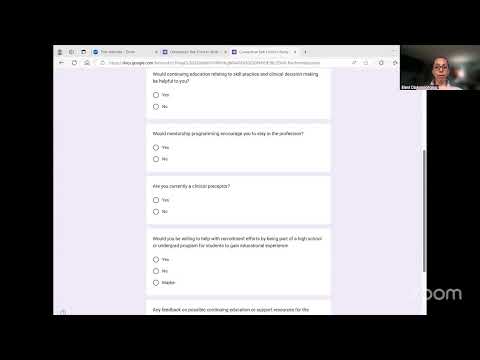
The survey, drafted by task force member Jess, is organized into sections covering demographics, clinical decision-making and support, work environment, and financial barriers such as student-loan debt and licensure costs. "I think it'll be ready to go out next week," Jess said, adding that the group planned a short delay so deployment coincides with the CATA symposium May 20 to boost response rates.
Why it matters: Task force members said more Connecticut-specific data is needed to understand why athletic trainers leave the traditional high-school and collegiate settings and whether compensation and debt-to-income ratios are driving departures. The survey aims to provide that evidence to support future training, grant and legislative efforts.
Key details and scope - Structure: The draft asks about work setting, years of experience, whether trainers graduated from Connecticut programs, and the likelihood of staying in the profession or the state. It also asks whether team physicians sign standing orders and whether standing orders are reviewed yearly. - Financial questions: Members debated including salary ranges and agreed on ranges rather than exact salaries to reduce identifiability. The draft will include student-debt categories and an option for respondents to decline to answer. - Anonymity and a two-stage approach: The task force discussed embedding a link to a second, fully anonymous survey for sensitive financial details. One member described it as: "This part's anonymous" to reassure respondents if they choose the optional follow-up survey. - Continuing education and recruitment: The survey also queries interest in continuing education (CE) tied to workforce support, mentorship, and willingness to act as a clinical preceptor. Task force members discussed offering CE credit (for example, 5 CEUs) to preceptors as an incentive. - Outreach and timing: The group will distribute the survey via CATA membership channels, social media, and the proposed legislative call-to-action emails. The task force plans to staff computers or a small lab at the CATA symposium on May 20 so attendees can complete the survey during breaks.
Discussion highlights - Targeting and applicability: The draft includes "does not apply" choices for items that may not fit emerging-career or nontraditional settings (for example, athletic trainers employed by third-party vendors or working in industrial settings). - Salary vs. adequacy: Members debated whether to ask exact salary amounts or ranges; the group favored ranges (for example, $40k–$60k, $60k–$80k, >$80k) plus a follow-up question asking whether current pay makes the respondent more likely to leave the job or state. - Qualitative follow-up: Public-health–affiliated members suggested adding focus groups or Zoom-based qualitative interviews after the survey to gather richer narratives that the closed-response survey cannot capture. One faculty member recommended partnering with university public-health or social-science programs to assist with focus-group facilitation and analysis. - Exit interviews and employer data: Participants recommended encouraging employers and larger contracting organizations to perform exit interviews and to share deidentified reasons for staff departures to supplement the survey.
Next steps and timeline - Final edits will be completed on the questionnaire; the task force intends to release the survey after the CATA symposium (May 20) to capture seasonal hiring decisions and reduce spring-break disruption. Jess said the group expects preliminary survey results in time to discuss them at the next task force meeting.
Ending note: Members agreed the combined quantitative survey and targeted qualitative work would better document barriers—such as student debt, inconsistent standing orders, and variable administrative support—and support future funding and legislative requests.