Get Full Government Meeting Transcripts, Videos, & Alerts Forever!
Get email alerts on the State Budget Judiciary Public Safety topic
No spam. Unsubscribe anytime.
Senate committee advances combined judiciary and public-safety omnibus after budget-only hearing; officials warn of operational shortfalls
Summary
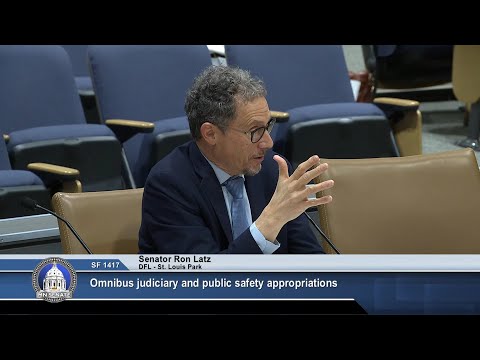
The Minnesota Senate Judiciary and Public Safety Committee on April 11 advanced Senate File 14-17, a combined judiciary and public-safety omnibus bill, after testimony from corrections, public-safety and victim-service officials who warned that lower operating adjustments in the package could force layoffs and program cuts.
The Minnesota Senate Judiciary and Public Safety Committee on April 11 advanced a combined omnibus bill—Senate File 14-17—as amended and recommended it to the Finance Committee, after a morning-and-afternoon session that combined budget targets, agency testimony and dozens of amendments.
The committee chair opened the meeting by saying the goal was a hard noon deadline to pass a budget bill with policy included; fiscal staff then walked members through a spreadsheet that set the committee's biennial targets and line-by-line recommendations. Fiscal staff said the committee was given a fiscal-year 2026-27 target of $106,200,000 over base (about 58% of the governor's recommendation) and a FY28-29 target of $114,400,000 over base (about 56% of the governor's recommendation). That target framed subsequent reductions across multiple agencies.
The chair and fiscal staff presented the committee's recommendations as a pared-down version of the governor's proposals, with many operating adjustments funded at roughly 45% of the governor's recommendation and some items retained at higher levels (for example, several judiciary salary and benefit adjustments were shown as 1.5% per year on the Senate side). The spreadsheet and the A1DE amendment were adopted and used as the vehicle for subsequent policy and technical insertions.
Why it matters: agency leaders and union representatives warned senators that the lower operating adjustments in the omnibus could force layoffs or service reductions. Department of Corrections leadership said shortfalls would impair staffing and programming; Department of Public Safety officials said cuts would force reductions in sworn positions and could leave a new statewide emergency-operations center unaffordable. Advocates and law-enforcement groups asked the committee to restore or protect funding for victim services, training reimbursement and programs used for recruitment.
Fiscal overview and committee actions
Fiscal staff told the committee the Senate package breaks many governor "one-line" recommendations into more granular line items and generally funds them at lower levels. For example, the governor's consolidated judiciary operating adjustment for the 2026-27 biennium was presented as a single biennial total; the Senate recommendation split that into judge salary, employee salary, health insurance and lease lines and showed the Senate providing 1.5% annual increases for judges and employees, producing a different dollar total on the spreadsheet.
The committee adopted a series of oral and written amendments during the hearing. Several policy bills were folded into the A1DE, including provisions from bills the committee had previously heard: Senate File 281 (section 1), Senate File 319, Senate File 456, House File 129 and the policy DE from Senate File 1098. The committee also adopted amendments to: restore funding for sentence-to-service programming (A5); add an amendment clarifying line-of-duty death benefits to include volunteer or paid-on-call firefighters (A3); require the state fire marshal to conduct a statewide firefighting-services assessment (A6); and add policy language and a special-revenue mechanism for crime-victim services (A7). Most votes were taken by voice and not recorded with numerical tallies in the committee minutes; the committee ultimately moved SF 14-17, as amended, to Finance.
Agency testimony and stakeholder concerns
Deputy Commissioner Sofia Khan of the Department of Corrections testified that the Senate package funds roughly "50,000,000 in the next biennium" for DOC operations, which she said is less than half of the governor's recommendation. "Without a strong operating adjustment, it will be difficult for the DOC to even maintain safe staffing levels, let alone let alone reach our recommended levels," Khan said, adding that reduced staffing could mean "more frequent lockdowns, challenges meeting mandates, and a less safe environment" for staff and people in custody.
Commissioner Bob Jacobson of the Department of Public Safety told the committee that, with the omnibus as drafted, "the BCA and alcohol and gambling enforcement will likely need to cut sworn peace officer positions" and the department "would be, currently, as it stands, unable to afford the rent cost for the new statewide emergency operations center, which is located in Blaine." Jacobson also described the proposal to transfer the state fraud and financial-crimes unit from the Department of Commerce to the Bureau of Criminal Apprehension as included in Article III and noted the committee did not fully fund the governor's recommended increase for that unit.
Nico Bauer, government-relations director for the Minnesota Department of Human Rights, said the committee's appropriation "is critical for the continued enforcement of the Minnesota Human Rights Act" but cautioned the Senate's operating increase would be insufficient to meet rising costs, including health-care and IT services.
Law enforcement and training funding
Jeff Potts, executive director of the Minnesota Chiefs of Police Association, and other law-enforcement representatives praised some policy inclusions and higher payments for forensic examiners but urged restoration of training dollars. Potts warned the appropriation for forensic examiners "doesn't go all the way that we negotiated with them, but we think it will help." He also thanked the committee for digital-accessibility funding to comply with federal mandates.
Multiple law-enforcement groups and unions urged restoration of the Philando Castile Memorial Training Fund and related recruitment programs. The committee's proposal spreads the governor's recommended $2 million Philando Castile Memorial Training Fund into $1 million each year rather than a single-year payment; law-enforcement groups said further cuts from the requested level could leave small agencies unable to meet statutory training obligations. AFSCME and MAPE representatives also warned the lower operating adjustments could worsen recruiting and retention at the Department of Corrections, probation and other agencies.
Crime-victim services and federal funding uncertainty
The committee adopted an A7 amendment that establishes language to support crime-victim services and creates special-revenue mechanics to direct certain penalties and assessments into a victim-services account. Office of Justice Programs staff and victim-services directors told the committee the federal funding streams that support victim services (for example, VOCA ' the Victims of Crime Act ' plus VAWA and FVPSA grants) have fluctuated in recent years and some federal awards or application processes have been delayed, reducing predictable reimbursement. The director explained that Minnesota's VOCA award has ranged historically and that the most recent federal award cited in testimony was $13,250,000 for federal fiscal year 2024, down from significantly higher years earlier in the decade.
Firefighter services assessment and fee questions
The committee adopted A6, directing the state fire marshal to produce a statewide report on firefighting services and allowing the Fire Service Advisory Committee to fund the study from the fire safety account. Assistant Commissioner John Cunningham and State Fire Marshal Dan Scribe described the study scope and estimated a comprehensive, statewide assessment could cost from roughly $60,000 to $700,000 or more depending on the level of contractor work and outreach; they said FSAC would evaluate funding requests under existing processes.
Property-record "cloaking" and fee debate
Members debated language that allows local governments to charge a fee for removing or redacting certain property-address information from public records (sometimes described in committee discussion as "cloaking"). The committee retained a $40 cap for local governments under the version adopted in committee after members discussed county estimates that ranged substantially higher. Some senators argued the state should absorb the cost for judges and other covered officials; others said local workload and costs would vary by county and $40 was a pragmatic compromise.
Actions and next steps
Senate File 14-17 as amended was recommended to the Finance Committee. The committee adopted several policy insertions and technical amendments and directed staff to make necessary conforming changes before committee transmittal. The chair said additional adjustments could follow in conference with the House and at Finance, and several committee members urged further work to seek higher targets or restore specific agency items in later negotiations.
Ending note
Committee members and agency witnesses agreed the bill reflects the session's tight revenue forecast and that additional negotiations will continue as the bill moves to Finance and into conference. Several agency leaders asked legislators to prioritize operating adjustments in later budget decisions to avoid staff layoffs and program reductions.