Get Full Government Meeting Transcripts, Videos, & Alerts Forever!
Get email alerts on the Affordable Housing Finance topic
No spam. Unsubscribe anytime.
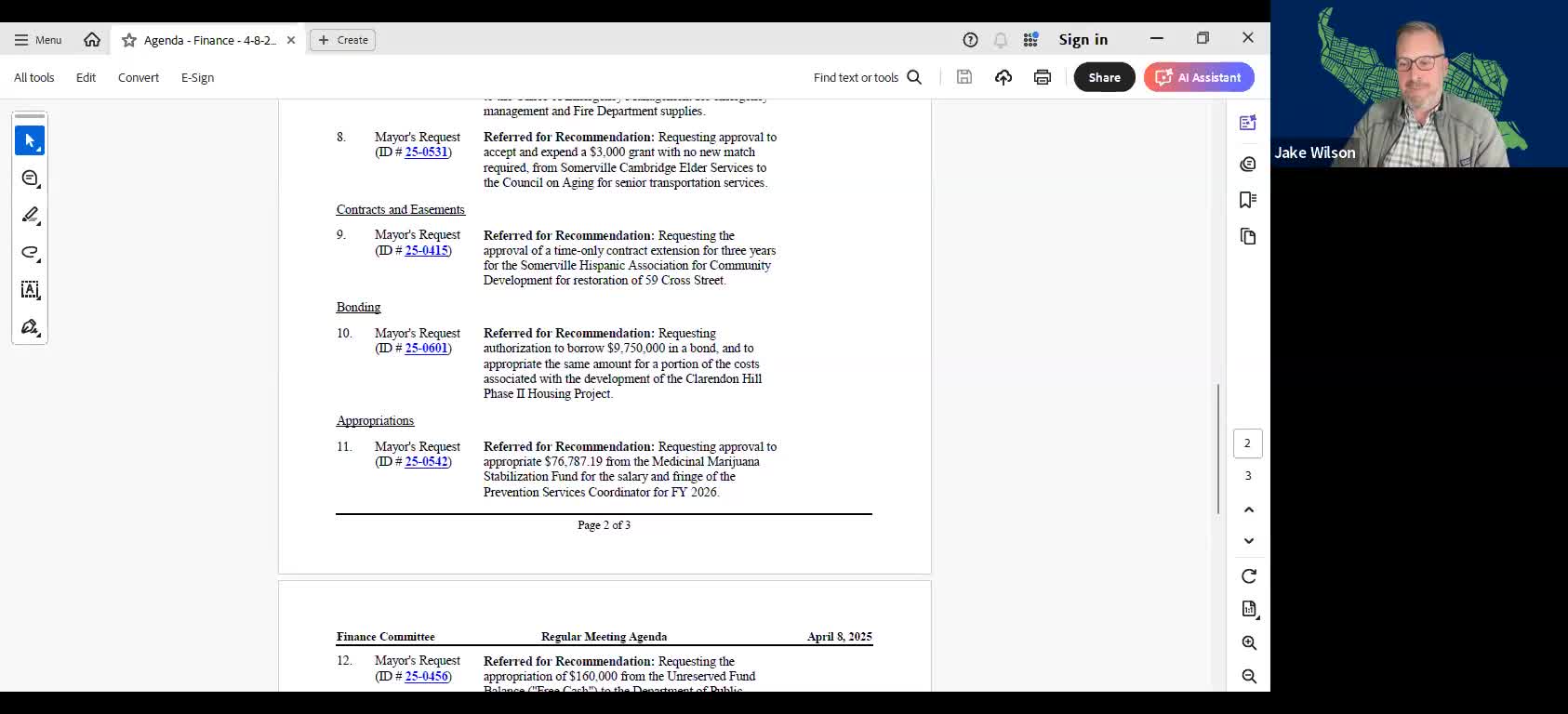
Finance committee backs $9.75 million Section 108 loan guarantee to advance Clarendon Hill phase 2
Summary
The Somerville Finance Committee voted to recommend the city authorize a Section 108 loan guarantee of $9,750,000 to support Clarendon Hill phase 2, shifting part of earlier city borrowing to HUD-backed financing and tying repayment to a future market-rate parcel sale and CDBG entitlements.
The Somerville Finance Committee voted 5-0 on April 8 to recommend the City Council authorize a Section 108 loan guarantee of $9,750,000 to help finance Clarendon Hill phase 2, a multi‑phase replacement and mixed‑income redevelopment of public housing along Alewife Brook Parkway, Powder House Boulevard and North Street.
The vote authorizes the city to apply for a federal Section 108 loan (a HUD Community Development Block Grant, or CDBG, loan product) that would let the city borrow against future CDBG entitlement allocations and re‑lend the proceeds to the development team for phase 2 construction. Director Alan Ignacio of the Office of Strategic Planning & Community Development said the move will refinance prior city DIF/general fund borrowings, add roughly $3.75 million to the project’s financing package, and keep the development moving amid difficult market conditions.
The committee’s action follows a detailed presentation by Director Ignacio that reviewed the project timeline, existing funding commitments and how the Section 108 mechanism works. Ignacio said the city intends to secure a collateral position on a market‑rate parcel that the Somerville Housing Authority (SHA) will later sell; proceeds from that sale are expected to repay the Section 108 loan in full when the parcel is sold. He also said the city can use on‑hand CDBG balances or future CDBG entitlements to make interim payments if needed. Ignacio flagged an estimated debt service of “approximately half a million dollars a year” in the application documents; he cautioned the final number will depend on HUD underwriting and market interest rates.
Councilors asked about risks if the market‑rate parcel sells for less than expected or the CDBG entitlement stream were reduced. Ignacio described a three‑tiered repayment backstop: (1) repayment from the sale/collateral position on the market‑rate parcel, (2) use of annual CDBG entitlements or accumulated CDBG reserves, and (3) as a last resort the city’s full faith and credit. Committee members also discussed the phase schedule: construction for phase 2 is anticipated to begin in early 2026 after phase 1 finishing work, with phase 2 completion currently estimated in 2028 and full lease‑up in 2029.
Committee members asked about developer changes (the original market‑rate partner Redgate is no longer involved) and whether prior 40B commitments carry forward; POA (Preservation of Affordable Housing) representative Corey Meehan and SHA Executive Director Diane Cohen told the committee that many commitments are embedded in the 40B permitting and will inform any new RFP for the market‑rate parcel. Councilors also asked about federal prevailing wage (Davis‑Bacon). Ignacio said Section 108 financing will trigger Davis‑Bacon requirements for phase 2 and that city staff will monitor certified payrolls and compliance at closing.
The committee recorded a roll‑call vote; Councilors Bahr, Burnley, Klingen, Scott and Chair Jake Wilson voted to recommend approval. With the committee recommendation, the item will go to the full City Council for final action.
Why this matters: Clarendon Hill is a major publicly owned redevelopment that replaces aging public housing and adds mixed‑income units, public realm improvements and a Head Start classroom. The Section 108 step is intended to allow the project to continue despite private‑market uncertainty.
What’s next: The city will submit the Section 108 application to HUD for underwriting. HUD review and a second public hearing will follow before a final loan agreement. SHA will later issue an RFP for the market‑rate parcel; sale proceeds are the primary repayment source the city expects.
Speakers quoted in this article are drawn from the meeting transcript.