Get Full Government Meeting Transcripts, Videos, & Alerts Forever!
Get email alerts on the Small Area Planning topic
No spam. Unsubscribe anytime.
Baltimore County officials outline Small Area Plan 11, seek more survey input and flags connectivity, waterfront and mall redevelopment as priorities
Summary
At a virtual public meeting on Baltimore County's Small Area Plan 11, planning staff summarized the plan's purpose, early findings from community outreach and next steps, highlighting connectivity, waterfront access, Green infrastructure and potential mixed-use redevelopment around White Marsh Mall.
Baltimore County planning officials on Monday presented early findings and outreach plans for Small Area Plan 11 in a virtual public meeting, walking residents through the county's approach to applying the countywide Master Plan 2030 at a local level and urging more people to complete an open survey before it closes next week.
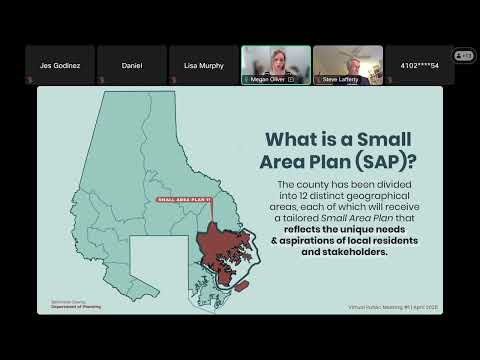
The presentation, led by Megan Oliver, community planner for District 6, framed Small Area Plan 11 as the first of 12 small area plans the county intends to produce to translate the countywide Master Plan 2030 into place-based recommendations for neighborhoods including White Marsh, Middle River, Essex and Bowleys Quarters.
Officials said the county will use community feedback to produce short-term "early wins," longer-term "big moves," and policy and program recommendations to make proposals implementable. Oliver said the county has collected background data, conducted interviews and focus groups, held intercept interviews and an in-person public meeting two weeks earlier, and has run an online survey since February. "This is the first small area plan that the county is creating. It's 1 of what will be 12," Oliver said.
Why it matters: county planners told attendees that Small Area Plan 11 will refine Master Plan 2030 recommendations at a neighborhood scale and help direct county resources more equitably across communities. The plan area spans the southeast corner of Baltimore County, crosses three councilmanic districts and lies both inside and outside the county's urban-rural demarcation line, giving rise to different land-use challenges and opportunities across the area.
Key takeaways from staff and public input
- Nodes and priorities: Staff identified four commercial or redevelopment "nodes" within Area 11: White Marsh Mall, Pulaski Highway, Eastern Boulevard at Martin State Airport (including the Lockheed Martin area and the Aviation Station project) and Eastern Boulevard at Middle River. The planning team said those node areas are strategic places to consider retrofitting for walkable, mixed-use development.
- Community preferences: Survey and live poll results shared during the meeting showed strong interest in more green/open spaces and improved connectivity. In a live poll during the session, participants who responded indicated roughly 67% representation from White Marsh and 33% from Middle River; staff noted that March survey respondents were overrepresented from White Marsh relative to resident population (White Marsh accounted for roughly 9% of the resident population but about 25% of March survey respondents), while Middle River represents about 35% of the resident population. Oliver emphasized the county's goal to increase participation from underrepresented subareas, including Rossville and Essex.
- Redevelopment and the mall site: Attendees and staff discussed the White Marsh Mall regional commercial node as a candidate for mixed-use redevelopment. A resident identified as Kathy said she wants a "very vibrant, multi-layered" redevelopment that includes "residential affordable housing, transit oriented development" and fewer expanses of surface parking. Planning officials said many U.S. mall properties are being reimagined toward mixed use and green infrastructure, but acknowledged change requires property-owner interest and long-term planning.
- Transportation and connectivity: Planners and residents repeatedly flagged traffic and limited pedestrian connectivity as key challenges across the area, especially at major corridors and intersections around White Marsh and along Eastern Boulevard. Staff identified mobility improvements ' including greenways, trails and better multimodal connections ' as recurring priorities.
- Waterfront assets and cultural resources: The plan area includes extensive waterfront frontage between Bird River and Back River and a concentration of maritime businesses and facilities. Participants highlighted cultural assets such as the Glenn L. Martin Aviation Museum, the Essex Landmark Sculpture, the Avenue at White Marsh (public gathering space) and local events (movie nights, food truck rallies) as opportunities to build civic activity and visitor destinations.
Process and next steps
Planning staff said the survey (Slido code 9451062) will remain open for a few more days and they will synthesize responses with prior focus groups, intercept interviews and the earlier in-person meeting. The team plans to return to the community in early summer with draft recommendations for review and then compile a final report, modeled in format on Master Plan 2030, that will list implementable actions. Oliver: "The important thing in our department is to make things implementable ... so the plan doesn't just end up sitting on a shelf collecting dust."
Public participation and questions
During the meeting one resident asked whether the survey required answers to every question; staff acknowledged the concern and encouraged participation, noting the project team tracks respondent location and can analyze resident versus visitor responses. Multiple attendees urged more outreach to underrepresented neighborhoods. A resident who identified herself as Kathy urged prioritizing walkable, transit-oriented redevelopment at the mall site and improving pedestrian connections to parks.
No formal decisions or votes were taken at the meeting. Staff described the Small Area Plan 11 effort as a listening and synthesis phase: background analysis, community engagement, and later development of recommendations and implementation steps.
What residents said they want to experience
Attendees and survey respondents repeatedly named nature, green space, safer and more walkable streets, cultural activities and places to gather as priorities. Staff also noted demand for a wider variety of housing types, including housing advertised in survey comments as "livable, affordable housing," and for improvements to parks and trails that link neighborhoods to amenities.
What staff will do next
Staff will close the survey in the next few days, synthesize the input, and return early next summer to present draft recommendations, according to Oliver. The team said it will publish meeting materials and answers to chat questions on the Small Area Plan 11 project hub on the county's website.
— Reporting by Baltimore County Department of Planning meeting materials and staff presentations; no formal votes were recorded at this session.