Get Full Government Meeting Transcripts, Videos, & Alerts Forever!
Get email alerts on the Sidewalks topic
No spam. Unsubscribe anytime.
Hearing examiner backs 4-year timeline for sidewalk at Turner Adventures site after staff urged denial
Summary
The hearing examiner recommended approval of a modified commitment that gives Turner Adventures LLC up to four years — or earlier if a permit is sought or the property is sold — to install a sidewalk at 4021 W. 70th St.; staff had recommended denial and proposed phased installation alternatives.
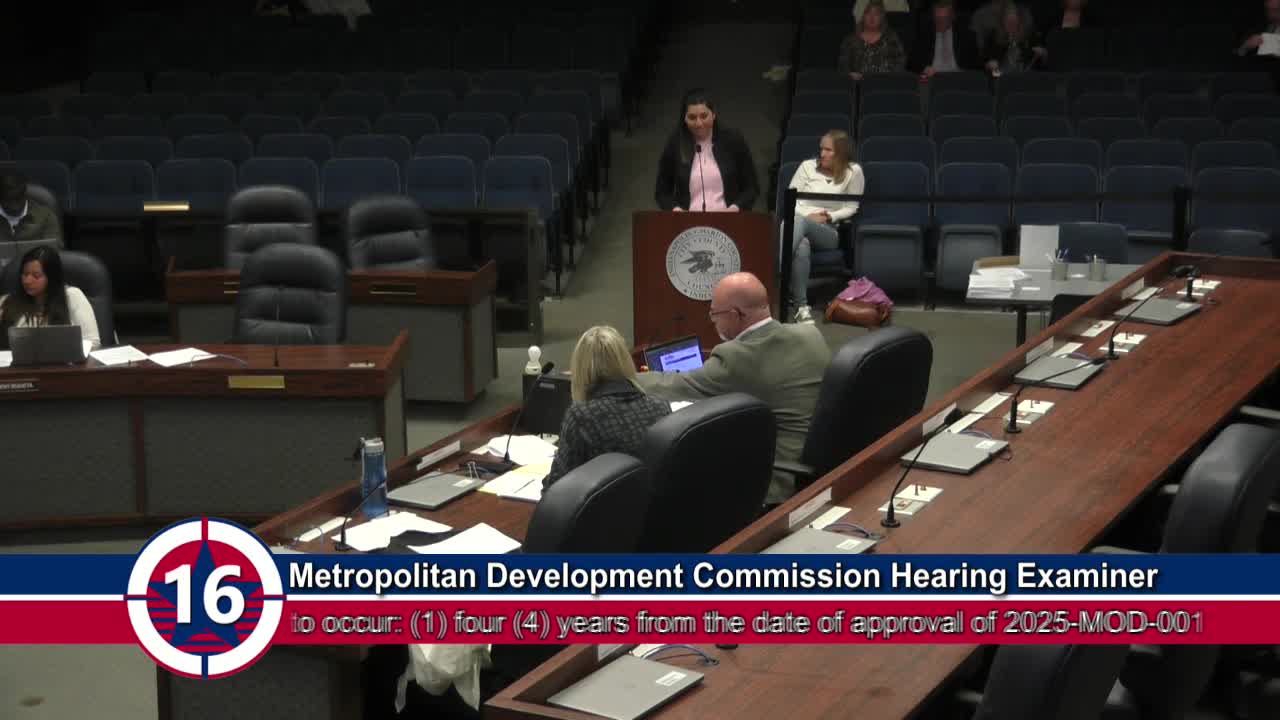
The hearing examiner recommended approval April 10 of a modified commitment that delays installation of a sidewalk at 4021 West 70th Street by Turner Adventures LLC, and sent the petition to the Metropolitan Development Commission for consideration on May 7, 2025.
The petitioner’s attorney, Rebecca Phillips, told the hearing examiner that the company originally agreed to install roughly 150 feet of sidewalk in 2023 after estimating the concrete cost at just under $11,000. When the owner sought permits, Phillips said, engineers told them for the first time that engineering work would also be required — and that engineering estimates ran from about $20,000 to $30,000. “The cost ended up being three times what they had anticipated,” Phillips said, and the petitioner asked to modify the commitment to allow either 4 years from approval, installation upon a future structural permit, or installation upon sale of the property.
Owner Capricia Turner said the business remains committed to installing the sidewalk but needs time to marshal funds. “We’re still committed to installing the sidewalk just on an extended timeline,” Turner said.
City planning staff, represented by Marlene, opposed the change. Staff recommended denial, saying an annual step-down approach would allow incremental progress and that DPW had proposed constructing a section of the North Town Trail along the frontage instead. Marlene told the hearing examiner staff was worried the petition’s language — especially the clause tying installation to a future sale — would be difficult to enforce and could be invoked again to extend or terminate the commitment. She said: “Staff is recommending denial of the request as amended. Extension considered on a year-by-year basis so that the progress can occur over time.”
In rebuttal, Phillips replied that the commitment would be recorded and would surface in a title search, which she said would obligate a purchaser to complete the sidewalk. The petitioner also argued the major upfront engineering cost was the primary obstacle, and that installments or a trail alternative would still force the owner to pay that engineering bill.
The hearing examiner acknowledged both positions and said she understood staff’s enforcement concerns but was persuaded by the neighborhood groups that ultimately supported the modification. “I can see both sides of this,” the hearing examiner said. “I am going to recommend approval of 2025 MOD001.”
What the examiner recommended is a recorded modification requiring the sidewalk to be installed upon the first of: 1) four years from the date of approval; 2) the date a new structural permit is sought; or 3) upon sale of the property. The examiner’s recommendation will go to the Metropolitan Development Commission for final action.
The record includes letters from the Pike Township Residents Association and the Crooked Creek Community Land Use Committee indicating they moved from opposition to supporting the modified timeline after meeting with the petitioner and staff. The petitioner agreed to the recorded modification rather than seek a fee-in-lieu after neighborhood pushback.
If the MDC endorses the recommendation, the recorded commitment will remain on the property until the sidewalk is installed under one of the three triggering events.
Votes at the hearing level were recommendations rather than final rezoning decisions; the Metropolitan Development Commission and, where applicable, City-County Council retain final approvals or appeals rights.