Get Full Government Meeting Transcripts, Videos, & Alerts Forever!
Get email alerts on the City Administration topic
No spam. Unsubscribe anytime.
Durham council weighs election costs, commission attendance and affordable‑housing loan; excuses councilmember Freeman
Summary
Durham City Council discussed rising election costs and a possible change to election timing, concerns about attendance on advisory boards, details of a condonable loan for a 168‑unit affordable housing project, and regional research funding cuts. The council voted to excuse Councilmember Freeman from the meeting.
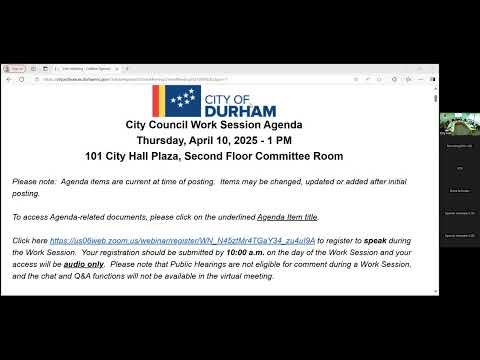
Durham City Council discussed the rising cost of running local elections, attendance and effectiveness of citizen advisory boards, the structure of a condonable loan for an affordable housing project, and regional research funding reductions during a regular meeting; the council also voted to excuse Councilmember Freeman from the session.
Mayor Pro Tem and several council members raised concerns about recent notices of large workforce reductions at regional research organizations and the potential local economic impact. Mayor Pro Tem Middleton warned that “we are receiving more demands, notifications or warnings” from employers and said the region could face major funding and staffing losses at organizations mentioned in the meeting, including RTI, Duke and the Museum of Life & Science; he described the situation as “grave” and said federal and private research cuts would affect the local economy.
The council also took up a policy question about the cost of local elections and whether to explore changing the city’s election schedule so more local contests are held on state or presidential ballots. A council member said an increase in election costs this cycle has been reported at about $900,000; the city clerk and other council members clarified that costs are shared with the state and county and that the city would not necessarily pay the full amount. Councilmember Caballero asked that the Rules/Procedures committee and the city attorney review the legal steps and cost implications; the Procedures committee agreed to meet the following week to begin that work.
Council members discussed attendance and role clarity for the city’s many advisory boards and commissions after reviewing recent nomination lists and meeting records. Assistant City Secretary Ashley told the council that Councilmember Freeman has been unable to attend some commission meetings and that staff and council leadership will follow up; council members noted that some commissions are required by statute while others were created for temporary, issue‑specific work and may warrant a review to determine whether they should continue.
On affordable housing, staff described a financing package for a 168‑unit development that relied on a small gap loan from the city’s dedicated housing fund. Mr. Dodson, a city staff member, explained that the city frequently uses a “condonable” loan instrument: the loan is structured as repayable but is forgiven in increments over a set term (the example given was a 10‑year schedule with portions forgiven annually), and the remaining principal becomes payable if program conditions are not met. A council member asked whether the city would be providing direct subsidy; staff described the loan as gap financing and said the loan mechanics are intended to preserve performance incentives while allowing subsidy without an immediate grant payment. Item 7 on the agenda, which related to this development, had been pulled for further staff follow‑up.
The council handled several procedural items and a set of nominations to boards and commissions. The mayor read a list of agenda items and noted that items 3, 5 and 7 had been pulled from the consent or regular agenda. Assistant City Secretary Ashley and council members discussed the Commission on Workers’ Rights, including attendance and the need to confirm which bodies require a council representative versus an informal liaison.
Formal action: a motion to excuse Councilmember Freeman from the meeting was moved, seconded and approved; the transcript records the motion as “moved, seconded, all in favor,” but does not name the mover or seconder.
The meeting concluded with the council scheduling follow‑up: the Procedures committee will meet to examine election timing and costs, staff will return with additional details on the pulled agenda items and on the housing loan mechanics, and council leadership said they would follow up with the Commission on Workers’ Rights and other advisory boards about attendance and charter questions.