Get Full Government Meeting Transcripts, Videos, & Alerts Forever!
Get email alerts on the Property Tax Documents 441d topic
No spam. Unsubscribe anytime.
Assessment board urges applicants to provide purchase documents, sets June 2 status hearing in dispute over Revenue and Taxation Code §441(d) requests
Summary
The Ventura County Assessment Appeals Board discussed whether property-acquisition documents requested under Revenue and Taxation Code §441(d) are relevant to 2024 decline-in-value appeals, directed applicants to provide income records and narrowed next steps, and set a June 2 status hearing to check compliance.
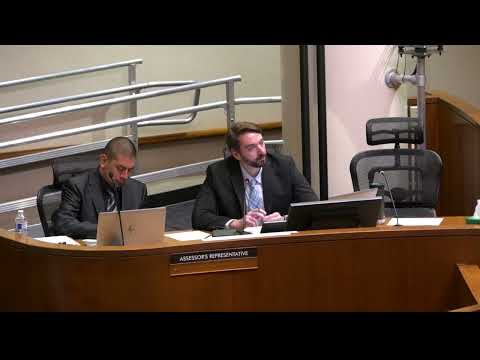
The Ventura County Assessment Appeals Board on April 7 pressed applicants to supply property acquisition documents the assessor says are needed to value apartment complexes in 2024 decline‑in‑value appeals, and set a status hearing for June 2 to track progress.
The issue arose during a group of appeals in which the assessor requested property acquisition materials — purchase-and-sale agreements, escrow and closing statements, bank loan documents, inspection reports and any appraisals — for transfers that occurred within roughly two years before the Jan. 1, 2024 lien date. Assessor’s Office staff said those transfers are likely to be among the best comparables for lien‑date valuation and that details of the original purchases help the office “emulate market participants” when estimating value.
The assessor read from Revenue and Taxation Code §441(d) during the hearing, noting that the statute requires an assessee to make available “information or records regarding their property” including “details of property acquisition transactions” when requested by the assessor. The assessor’s representative said the office has long requested such documents for transfers within three years of a lien date.
Applicant representatives said they had already provided rent rolls, year‑end income statements and market data and that they recently received additional trailing income records. Tanner Brault, appearing for the applicants, said his teams had provided much of the financial information relied upon for their Jan. 1, 2024 valuation and that some transfer‑date documents either might not exist or had to be requested from third parties. He said the parties had no interest in contesting the enrolled purchase prices for the earlier transfers; the current appeals concern whether values declined by the lien date.
Board members said documents that directly support a purchase price or a valuation — purchase agreements, contemporaneous appraisals and rent/income data as of the sale — are relevant to deciding appeal cases and useful to both the assessor and the board. Members encouraged applicants to provide material they have and to specify which requested items are unavailable. The board said it would avoid immediately ordering subpoenas and instead sought a voluntary narrowing of outstanding items before considering formal compulsion.
The board and parties agreed the applicants would transmit trailing income information they had received (the agent said that material arrived on Friday) to the assessor promptly. The board then set a status hearing for June 2, at which the parties will report what has been produced; remote attendance for that status hearing was approved. The board’s direction was phrased as guidance to the parties rather than a formal order to produce every requested document; if necessary later, the assessor may seek a subpoena or a continuance under the procedures that apply when §441(d) material is missing from a party’s case.
The board closed the discussion by instructing staff and counsel to follow the narrowing process: applicants should identify unavailable items or supply documents they have, the assessor will review them, and the board will reconvene at the June 2 status hearing to assess whether further steps (including a potential subpoena request) are warranted.
The board did not make any final evidentiary rulings at the hearing and did not adjudicate the appeals themselves; it limited its action to scheduling the follow‑up status hearing and encouraging the exchange of documentation.
Ending: The board set the June 2 status hearing, approved remote attendance for status updates, and asked applicants to provide income records and identify unavailable transfer documents before that date. If required documents remain missing after the status check, the assessor may seek a subpoena or request a continuance under existing procedures.