Get Full Government Meeting Transcripts, Videos, & Alerts Forever!
Get email alerts on the School Finance topic
No spam. Unsubscribe anytime.
Tunkhannock Area SD approves preliminary 1-mil increase as board considers 2025–26 budget options
Summary
The Tunkhannock Area SD board voted to advance a preliminary 1-mill tax increase option for the 2025–26 proposed final budget after a presentation that outlined multiple budget scenarios and major cost pressures including rising health insurance, the end of ESSER funds and high cyber‑charter tuition costs.
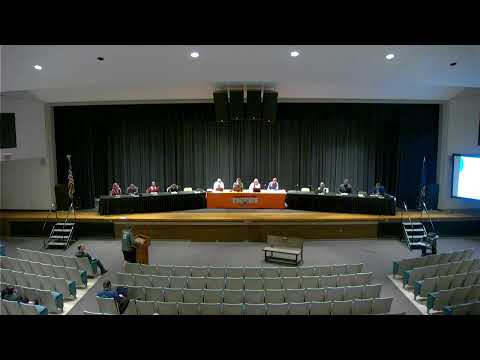
The Tunkhannock Area School District Board of Directors voted on April 10 to advance a preliminary budget option that would raise property taxes by 1 mill as it considers four proposed budgets for 2025–26.
Paul (staff member), who presented the district's budget outlook, told the board that "a proposed budget deficit would be just over $3 million" if the district adopted a 0-mill option and that the board was considering four scenarios: 0 mil, 1 mil, 2 mil and the Act 1 index maximum of 3.984 mills. He said the board must select one of those options for advertisement under Pennsylvania Department of Education timelines, with a final budget expected in June.
The presentation outlined the district's largest cost drivers: wages (about 41% of the budget, roughly $22 million), benefits (about 31% and subject to a reported 16% health insurance increase), transportation and utilities (utilities reported above $1 million). The presenter said expiring federal ESSER funds reduce available revenue by roughly $3 million, and that the district is carrying a roughly $900,000 deficit from the previous year into the 2025–26 calculations. He also reported the district's fund balance at about $14.4 million, earmarked for future capital needs.
Why it matters: the board faces a choice between using local tax increases, drawing on fund balance, or making programmatic and staffing reductions. The superintendent and board members repeatedly said they want to avoid using long-term reserves for day-to-day operating costs.
Key figures and options presented by district staff: a 0-mill budget would leave an estimated shortfall of about $3,027,000; a 1-mill option reduces the shortfall to about $2,739,000; a 2-mill option to about $2,452,000; and the 3.984-mill (Act 1 maximum for the district) option to about $1,880,000. The district reported a tax collection rate of roughly 93%, and that one mill is roughly $287,881 in revenue for the district.
The presentation also called out two items the board may pursue to narrow the gap. First, the district continues to examine a proposed solar project estimated at about $10 million that staff said could cut annual electric costs by roughly $1 million if federal and state incentives are available; the availability of those rebates and grants was described as uncertain. Second, district staff highlighted cyber‑charter tuition as a major cost: a typical general‑education cyber student from the district currently costs about $17,000 and a special‑education cyber placement roughly $34,000; a proposed state flat rate of $8,000 per general‑education cyber student in some proposals could save the district an estimated $800,000, staff said.
Board discussion emphasized the health insurance increase and the end of ESSER funding as the principal drivers of the deficit. Mrs. Arnold (Board President) reminded the board that the vote tonight was preliminary and said the district would continue work on savings and present updated figures at the May 15 meeting; the board must adopt a final budget by June 30. Board member Bill said, "I'll make a motion for a 1 mil increase, knowing that this is only preliminary," and the motion was seconded.
At roll call, the board voted to advance the 1-mill preliminary option. The roll call recorded the following responses: Doctor O'Sharaq — yes; Doctor Paribola — yes; Mister Burke — yes; Missus Eckert — yes; Mister Franco — no; Missus Goble — yes; Mister Farr — yes; Missus Arnold — yes. The motion passed on that preliminary vote.
What remains unresolved: staff said the district does not yet know final state budget outcomes (including cyber‑charter relief) and that federal funding uncertainties and negotiated contract increases could alter the final June decision. The board will receive an update at the May 15 meeting and could change course before the final adoption scheduled for June.
The board's vote tonight sets a single advertised option in compliance with PDE timelines, with the understanding that the advertised scenario is not final and that staff will continue to pursue savings, grant opportunities and feasibility studies for major capital projects such as solar.
Ending: The board's next regular meeting is scheduled for May 15, when staff will present updated budget options before a final vote targeted for June 19.