Get Full Government Meeting Transcripts, Videos, & Alerts Forever!
Get email alerts on the Last Mile Delivery Text Amendment topic
No spam. Unsubscribe anytime.
CB2 committee reviews draft EIS scope for DCP last‑mile facility text amendment; raises bike‑lane, charging and flooding concerns
Summary
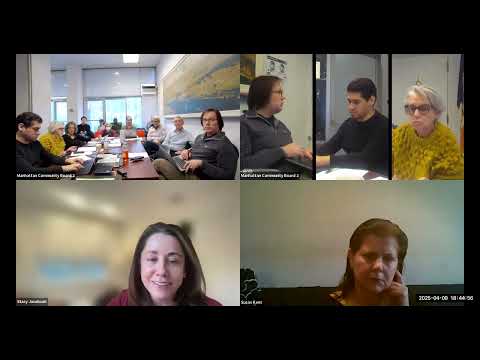
Community Board 2 discussed the Department of City Planning’s draft scope for the environmental impact statement (DEIS) of a proposed last‑mile distribution facility text amendment. Committee members asked the city to study non‑car delivery modes, impacts on bike lanes and pedestrian safety, charging infrastructure and flood resilience.
City planners asked Community Board 2 to comment on the draft scope for an environmental impact statement (EIS) tied to a Department of City Planning text amendment that would create a special permit for last‑mile distribution facilities in manufacturing and commercial districts.
The draft EIS scope covers many standard CEQR chapters; DCP staff have proposed studying land use and zoning, transportation, energy, hazardous materials, and neighborhood character, among others. The committee’s discussion focused on three areas members said merit stronger attention in the DEIS: multimodal traffic and pedestrian safety, charging and energy infrastructure for electric micromobility and cargo‑bikes, and flood/stormwater resilience in waterfront and low‑lying zones.
Bicycle and pedestrian impacts
Committee members noted that the last‑mile concept embraces a range of delivery modes beyond conventional trucks — cargo bikes, e‑bikes and small electric trucks — and asked the draft scope to address how those vehicles would operate in bike lanes and sidewalks, and how repeated commercial activity would affect pedestrian flow and safety.
One committee member said the DEIS should explicitly assess commercial delivery activity in bicycle lanes and the potential need for separate commercial cycling infrastructure. Members also asked for a pedestrian‑conflict analysis that goes beyond counts, because repeated loading/unloading and frequent short deliveries can disrupt pedestrian circulation in high‑foot‑traffic shopping streets.
Charging infrastructure, hazardous materials and energy demand
Members asked the DEIS to study charging infrastructure for e‑bikes and small electric vehicles (tasking hazardous materials and energy chapters where relevant). Committee members flagged safety risks associated with large numbers of battery charging stations and battery storage — including fire risk — and called for the EIS to consider safe charging locations and building‑level safety systems.
Flooding and infrastructure resilience
Because many mapped areas are in low‑lying floodplains and waterfront precincts, the committee also asked that the DEIS examine stormwater and wastewater system capacity and how flooding risk would affect facilities and their electrical systems. The board suggested linking the energy, water/sewer and hazardous‑materials analyses to evaluate resilience under more frequent coastal storm scenarios.
Other comments and next steps
Committee members recommended that the DEIS explicitly consider noncompliant or nonconforming land uses and the frequent occurrence of residential uses by variance in manufacturing districts when evaluating “buffers” from residences. Members also requested a clearer map and higher‑resolution exhibits showing the special‑permit mapping over CB2’s zoning mix.
DCP will hold a public informational session and a public hearing on the text amendment; written comments on the DEIS scope are due in mid‑May. The committee asked staff to circulate a draft comment letter; members flagged task areas 2 (land use), 8 (urban design), 10 (hazardous materials), 11 (water/wastewater/stormwater), 13 (energy) and 14 (transportation) as priorities to strengthen in the DEIS scope.
Ending
The committee agreed to prepare a draft comment letter emphasizing pedestrian safety, bike‑lane impacts, charging and flood resilience and requested clearer mapping of where the DCP’s special‑permit areas would overlay CB2 zoning.