Get Full Government Meeting Transcripts, Videos, & Alerts Forever!
Get email alerts on the Board Meetings topic
No spam. Unsubscribe anytime.
Santa Rosa school board reviews major rewrite of meeting policy, debates closed-session attendees and speaker rules
Summary
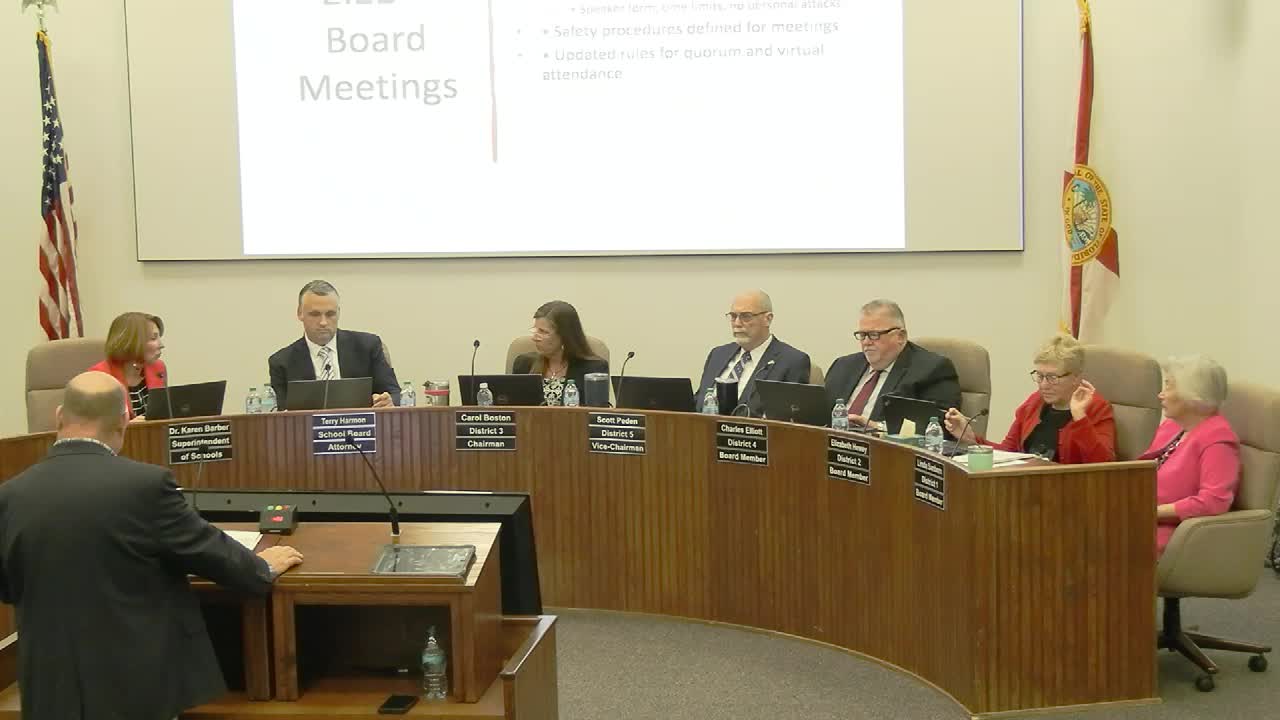
The Santa Rosa County School Board on March 11 reviewed a comprehensive draft rewrite of Policy 2.22, which expands meeting rules and prompted questions about closed-session attendees, public-comment limits and the level of detail to include in official minutes.
The Santa Rosa County School Board on March 11 reviewed a comprehensive draft rewrite of Policy 2.22, which expands the district's formal meeting rules and sparked discussion about who may attend closed sessions, how public comment is limited and what the written minutes should contain.
Board members said the rewrite, which increases the written policy from roughly three pages to nine, attempts to codify current practice but needs clearer language on closed sessions and public participation.
The draft defines meeting types (regular, special, emergency and closed) and adds procedures for public comment forms, speaker time limits and basic safety measures at the podium. Board members questioned a provision that says closed sessions "shall be conducted with only the school board, the superintendent, school board attorneys, appropriate staff members, and advisers present," asking the board to define "appropriate staff members." Board attorney Mr. Harmon told the board the statute governing closed bargaining sessions permits the superintendent (the public officer or CEO) to have a bargaining team and that the Attorney General's office guidance is the likely reference point for who may attend. Harmon said allowable attendees may vary depending on the subject being negotiated (for example, transportation staff might participate if transportation issues are part of bargaining).
Board members pressed for explicit policy language rather than leaving attendance solely to superintendent discretion. Several members asked counsel to confirm the draft aligns with Chapter 447 and related Attorney General guidance on collective bargaining closed sessions.
The draft also restricts certain topics at public-comment time, including language that would bar speakers from addressing the bargaining process or other workplace-labor concerns. Several board members said they were uncomfortable broadly restricting employees or parents who happen to be district staff from speaking about labor or workplace topics; the board asked counsel to review that provision and to incorporate recent case law. Mr. Thorpe and Mr. Harmon referenced a recent Eleventh Circuit opinion involving Brevard County that addressed when a board may limit a speaker's comments and warned the policy will need to reflect controlling federal-court guidance on limits such as "personal attack" rules.
Board members also debated how detailed written minutes should be. The draft emphasizes that minutes will record motions, resolutions, the names of makers and seconders, and the vote, and adds that a board member may request a statement be recorded in the minutes. Several members said they prefer retaining short narrative summaries of substantive comments rather than reducing minutes to only motions and votes; counsel replied the phrase "necessary information related thereto" is intended to capture salient discussion but agreed to clarify the language.
On speaker time limits, the draft preserves the district's current four-minute allotment for public comment. Board members discussed alternatives (three minutes is common in many Florida counties) and whether the chair should have discretion. Several members favored keeping four minutes, saying it gives the public adequate time to prepare remarks and reduces accusations of curtailed transparency. Counsel advised the board that the policy can treat agenda and non-agenda comment periods differently (for example, slightly longer time for agenda speakers) and that any limits must be viewpoint-neutral.
Board members directed staff and counsel to (1) define or tie the "appropriate staff members" language to statute/AG guidance for closed bargaining sessions, (2) revisit the restriction on speaking about bargaining/workplace matters in light of recent appellate guidance, and (3) clarify the minutes language so it reflects current practice and the board's transparency expectations. Staff said the draft will be revised and returned for a noticed public hearing and vote in May. The presenter said the policies were published for public inspection in March and that a formal public hearing is scheduled to precede the May vote.
The board did not take a final vote on the policy at the workshop; the discussion was framed as direction to counsel and staff to revise the draft and return it for formal public notice and hearing.