Get Full Government Meeting Transcripts, Videos, & Alerts Forever!
Get email alerts on the Proposition A Procedure topic
No spam. Unsubscribe anytime.
Houston committee clarifies Proposition A submission process; Prop A attorney to issue guidelines
Summary
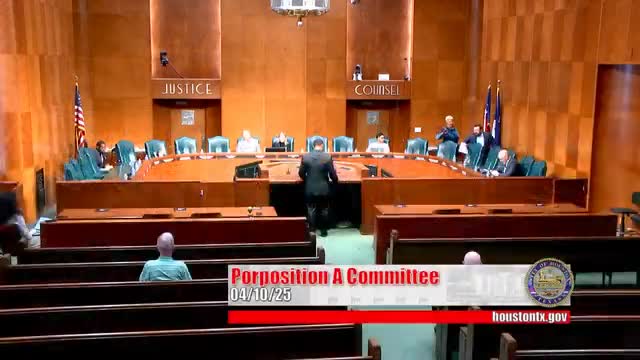
The City of Houston Proposition A Committee heard a presentation April 10 from the city———————Prop A attorney Danny Norris explaining submission rules under Proposition A, the legal review roles, timelines and confidentiality options for council members.
Danny Norris, the City of Houston's Proposition A attorney, told the Proposition A Committee on April 10, 2025, that he will work with council members to prepare and refine Prop A submissions and will produce written guidelines and an intake checklist within weeks.
Norris said the authority for council-initiated agenda items under Proposition A comes from the city charter ("Article 7, Section 3") and that submissions must meet procedural rules now codified as Rules 23 and 24. "You can either submit Prop A items through 23, if you want to do it directly, or you can do the committee route," Norris said, summarizing the two routes for bringing items to a regular council agenda.
The nut of the committee's discussion was how legally binding checks and practical support will work. Norris told members he will help draft language and advise on the front end but that formal lawfulness memos will be issued by general counsel when an item is formally submitted to the agenda office. "I will work with you on the front end, but the actual there will be an official lawfulness check through general counsel," he said.
Norris described several specific procedural points discussed with council members during the session: Prop A submissions must be in writing; they require signatures from at least three council members but no more than eight (to avoid Open Meetings Act complications); they must be lawful; and they must include a draft resolution or ordinance. He also described timing differences between the two submission routes: items routed through a committee under Rule 24 must be submitted at least 14 days before the scheduled meeting and will receive a general counsel review within approximately seven to 14 days; items submitted under Rule 23 proceed to the regular agenda after they are deemed lawful, typically within the next two regular meetings.
Committee members pressed Norris on how confidential early-stage consultations will be handled and on his relationship to the rest of the legal office. Council Member Ramirez asked whether Norris owes a duty of confidentiality to individual council members. "You guys are my clients, so to speak," Norris replied, adding that if council members explicitly request confidentiality while drafting an item, "then yes. I will keep your'I will not bring up anything" until they are ready to submit. At the same time he noted that, for an item to reach the agenda, it must eventually be shared with at least two other council members and the agenda office.
Council Member Kamen and others compared the role Norris will play to legislative counsel at the state level: a drafting resource that can prepare and wordsmith ordinance language for individual offices while protecting a requester's confidentiality until the office chooses to disclose it. Vice Chair Council Member Evan Shabazz said the legal guidance is "needed and necessary" and predicted many members will use the Rule 23 route because it will be difficult to assemble large groups for committee meetings.
Norris described the position's internal standing: he is housed in the legal department and has access to its resources, but the position is intended to operate with some separation so he can serve council needs without acting as a "gatekeeper." He said he will prepare an OIG-like set of internal procedures and a public-facing checklist to clarify how members should work with his office.
Public commenters voiced support and offered suggestions. Doug Smith, who said he helped campaign for Proposition A, said he originally feared the committee would be where "ideas go to die" but praised the presentation. Dominic Mazock urged more public access and remote participation options and recommended letting citizens speak earlier in hearings so staff and members hear public input before deliberations.
The committee set no formal votes or actions at the meeting. The chair said the Proposition A Committee will meet next on May 27 at 10 a.m.