Get Full Government Meeting Transcripts, Videos, & Alerts Forever!
Get email alerts on the International Conflict topic
No spam. Unsubscribe anytime.
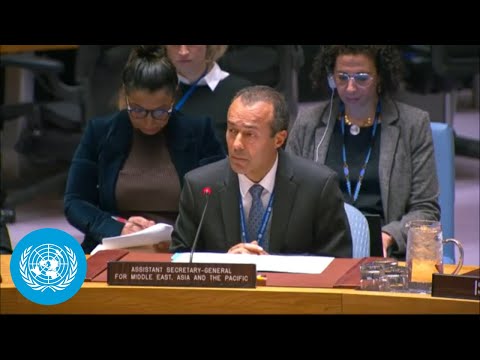
Syrian representative tells Security Council Israeli strikes breach 1974 disengagement pact
Summary
Khaled Hiyari told the United Nations Security Council that hundreds of Israeli air strikes since Dec. 8 and the building of positions near the Golan violate the 1974 disengagement agreement and threaten Syria—s fragile political transition.
Khaled Hiyari, a representative of Syria, told the United Nations Security Council that recent Israeli military actions in Syria amount to violations of the 1974 disengagement-of-forces agreement between Israel and Syria and are undermining Syria—s fragile political transition.
Hiyari said, "This security council has been regularly briefed on Israeli violation of 1974 disengagement of forces agreement between Israel and Syria." He told council members there have been "hundreds of reported Israeli air strikes across Syria since December 8" and that the Israel Defense Forces had "built multiple positions in the area of separation on the Golan." He also said Israeli officials had "spoken about Israel intentions to stay in Syria for the foreseeable future."
The statement placed the reported strikes across multiple parts of Syria s causes for concern. Hiyari cited locations including the southwest, the Syrian coast, northeastern Syria, Damascus, Hama and Homs. He referred to reporting conveyed to the council on April 7 that simultaneous attacks in Daraa "reportedly resulted in 9 civilian casualties." He also noted reporting that air strikes had struck the Hama military airport and the T4 military airport in Homs.
In situating those claims, Hiyari recalled a council presidential statement from March 14 that reaffirmed support for "the sovereignty, independence, unity, and territorial integrity of Syria" and called on states to refrain from actions that could further destabilize the country. He also quoted a statement by the U.N. secretary-general condemning actions "inconsistent with the agreement." Hiyari cited Special Envoy Geir Pedersen—s earlier remark that military escalation "undermine[s] a force to build a new Syria at peace with itself and the region and destabilize Syria at a sensitive time."
Hiyari urged that short-term tactical security gains not derail prospects for a peace agreement between the two neighbors and long-term stability along internationally recognized borders. He said Syria—s stabilization after 14 years of conflict "must be supported and protected for Syrians and for Israelis."
The remarks in the excerpt were a formal statement to the council; no vote or formal council action is recorded in the provided transcript segment. The statements summarize Syria—s view of recent events and cite prior council and U.N. statements and reporting to argue that the alleged actions threaten regional stability and a political transition in Syria.
Background: the 1974 Agreement on Disengagement of Forces between Israel and Syria established separation arrangements along the Golan following the 1973 Arab-Israeli war. Hiyari linked reported Israeli strikes and the construction of positions in the separation area to risks for Syria—s internal political transition and regional peace.