Get Full Government Meeting Transcripts, Videos, & Alerts Forever!
Get email alerts on the Childcare Policy Funding topic
No spam. Unsubscribe anytime.
Minn. committee adopts camera requirement tied to maltreatment findings, rejects amendment shifting large operating funds to child-care scholarships
Summary
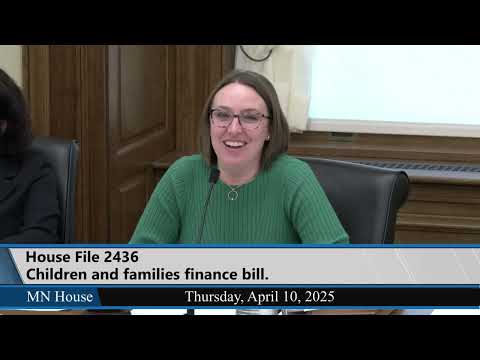
The House Children and Families Finance and Policy Committee on its final hearing adopted an amendment that requires closed‑circuit video cameras in licensed child‑care centers that are required to post a maltreatment investigation memorandum, and approved the DE1 package as amended before re‑referring House File 2436 to the Committee on Ways and Means.
The House Children and Families Finance and Policy Committee on its final hearing adopted an amendment that requires closed‑circuit video cameras in licensed child‑care centers that are required to post a maltreatment investigation memorandum, and approved the DE1 package as amended before re‑referring House File 2436 to the Committee on Ways and Means.
The committee adopted the camera amendment, A25, by voice vote after nonpartisan staff outlined technical changes and fiscal adjustments. A separate amendment, A9 — offered by Representative Nadeau to reduce the department’s operational adjustment and redirect money into early‑learning scholarships — failed on a roll call, 6‑7.
The A25 amendment narrows the bill’s original camera mandate in several ways: it excludes outdoor space not located on the licensed center’s property; it requires cameras to be closed‑circuit; it applies the camera requirement only to centers that must post a maltreatment investigation memorandum; and it grandfathered centers with qualifying cameras already installed before July 1, 2025. The amendment also changes when parents may request footage, limiting requests to instances supported by a physician’s documentation of a child’s physical injury. Nonpartisan staff said the amendment also authorizes technology grants of up to $4,000 per licensed center to help cover camera and training costs.
“We have reached an agreed upon amendment,” Chair West said in presenting A25, adding, “my end goal would still be to put a camera across every center, but the legislature is the art of the possible.”
Nonpartisan staff member Ms. Mach walked members through the text of A25, describing the scope and technical specifications. Fiscal analyst Mr. Berg explained the budget adjustments tied to the amendment, including a change that removes $150,000 from early‑learning scholarships in 2026 and a net reduction in the department’s central office appropriation driven by loss of federal financial participation.
“To get a net change of $350,000 at the central office, you have to remove $770,000 of general fund appropriation and you lose $420,000 of federal offset for a net change of $350,000,” Mr. Berg said, explaining how federal match affects the gross and net appropriation figures.
Representative Nadeau moved A9, saying the amendment — which he called “the do do the right thing amendment” — would reduce an operational adjustment on the department and move those dollars into early‑learning scholarships. “What it does is it ultimately reduces on line 800 in the spreadsheet … I’m literally reducing the amount of the increase in the operational adjustment to the department by $89,000,000 and I’m moving those into early education scholarships,” Nadeau said, and added the change would fund “about 200 scholarships.” The roll‑call on A9 was requested; the amendment failed 6‑7.
Several members debated whether to prioritize operating funding for the department or direct dollars to family scholarships. Representative McDonald and Representative Nadeau urged support for A9, arguing that funding scholarships would more directly help families. Representative Celeste Ngarr and Representative Hengleston Yeager spoke against A9, saying cuts to operating adjustments risked layoffs of state employees who administer scholarship programs and other child‑welfare services. Representative Hengleston Yeager warned that reductions could worsen backlogs in licensing and maltreatment investigations.
Committee members also discussed other elements of the DE1 package as amended, including additional funding for the Statewide Supervision and Information System (SSIS), changes to Great Start compensation program language and special‑revenue protections, and licensing and staffing ratio provisions for family child care. Representative Kolter and others said they supported the bill despite reservations about certain provisions, and Representative Hicks expressed disappointment about funding for Head Start but said she would vote for the package.
After adoption of the A25 amendment, the committee adopted the DE1 amendment as amended and Chair West renewed a motion to re‑refer House File 2436, as amended, to the Committee on Ways and Means; the motion prevailed by voice vote.
Votes at a glance - A9 (Representative Nadeau): Roll call requested. Motion to reduce the department operational adjustment and redirect funds to early‑learning scholarships — FAILED, vote 6 aye, 7 nay. Motion text (as moved): reduce operational adjustment on line 800 and move $89,000,000 into early‑learning scholarships (estimated to fund ~200 scholarships). Mover: Representative Nadeau. Outcome: failed. - A25 (Chair West): Motion to adopt camera and related technical/fiscal changes — ADOPTED (voice vote). Key provisions: closed‑circuit cameras required only where maltreatment investigation memorandum must be posted; outdoor spaces off‑site exempt; grandfathering for existing qualifying cameras; parents may request footage only with physician documentation of physical injury; grants up to $4,000 available for camera costs. - DE1 as amended: ADOPTED (voice vote). Includes agency policy and funding provisions, additional funding for SSIS, and the A25 camera language as described. - House File 2436 as amended: Motion to re‑refer to Ways and Means (motion renewed by Chair West) — ADOPTED (voice vote).
Why this matters The bill and its amendments affect how Minnesota licenses and oversees child care, how the state funds early‑learning scholarships, and how the Department of Human Services’ central office is funded and staffed. The camera requirement, as amended, ties surveillance equipment to documented maltreatment investigations and narrows parental access to footage; it also provides limited grant support to centers for technology costs. The failed A9 amendment highlights an intra‑committee debate over prioritizing operating funding to agencies versus direct scholarship support to families.
What’s next House File 2436, as amended, moves to the House Committee on Ways and Means. If advanced, the bill will proceed through the legislative process, including potential floor action and conference negotiations with the Senate.
Sources: committee hearing transcript; explanations of amendment text and fiscal impacts provided by nonpartisan staff Ms. Mach and fiscal analyst Mr. Berg; members’ remarks as recorded in committee proceedings.