Get Full Government Meeting Transcripts, Videos, & Alerts Forever!
Get email alerts on the Omnibus Transportation Bill Hf2438 topic
No spam. Unsubscribe anytime.
House Transportation Committee introduces omnibus HF2438 DE1, walks through funding spreadsheet
Summary
Committee members heard an overview of the Delete-All amendment to House File 2438, including a line-by-line funding spreadsheet from House fiscal staff, several policy riders and reporting changes. The committee scheduled formal markup and a vote for the next day; a routine motion to approve minutes was also carried.
The Minnesota House Transportation Committee on April 30 received a line-by-line introduction to the omnibus transportation bill H.F. 2438 (DE1), including a spreadsheet of appropriations and multiple policy provisions; committee leaders said they will mark up the DE1 amendment at 9 a.m. the next day in Room G-3.
The presentation focused on the bill—s Article 1 appropriations spreadsheet and Article 2 policy provisions. "This is the introduction of the omnibus house transportation bill. It's there's a DE amendment to house file 2,438," Chair Cagle said as the committee began, noting the committee had limited time after the amendment was posted earlier that day.
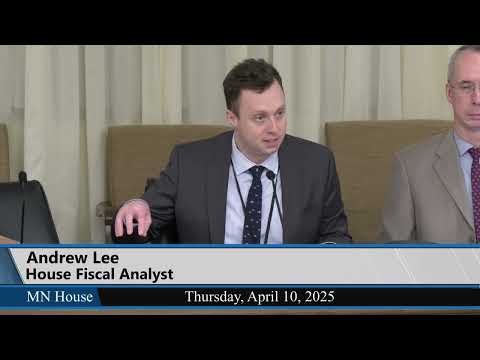
The DE1 amendment contains operating adjustments, one-time appropriations and policy changes affecting MnDOT, the Department of Public Safety (DPS), the Metropolitan Council and other entities. House fiscal staff member Mr. Lee walked the committee through a spreadsheet dated April 2025 that shows base funding, changes from base and total appropriations; House research staff member Mr. Burris summarized the bill language, riders and several statutory cross-references.
Why it matters: Committee members and staff said the bill combines wide-ranging transportation spending and policy changes that affect state highways, local road aid, transit operations, vehicle services and several reporting and compliance requirements. Several provisions will require Department of Revenue (DOR) revenue notes or further estimates before final action, committee staff said.
Key details and most substantive items discussed
- Appropriations and major line items: Mr. Lee identified multiple changes in the DE1 spreadsheet, including a $10,000,000 biennial appropriation for the Duluth airport tower from the state airports fund; a reduction of $12,000,000 over the biennium for Greater Minnesota Transit; increases in trunk highway and state road construction accounts (including federal funds recognition for the Blotnik Bridge); a one-time annual increase to the Quarters of Commerce appropriation from $25,000,000 to $40,000,000 (a $15,000,000 one-time increase reported as $80,000,000 over the biennium in the spreadsheet presentation); a $30,000,000 one-time biennial appropriation for Transportation Economic Development; a $14,000,000 one-time appropriation from the 9-1-1 fund for statewide radio tower projects; and one-time appropriations for local road and local bridge programs.
- Revenue interactions and pending estimates: The amendment includes tax and fee changes that cascade into the Highway User Tax Distribution Fund and the trunk highway, county state-aid and municipal state-aid accounts. Mr. Lee noted adjustments tied to blackout plate fee allocations and an electric vehicle surcharge; he said DOR revenue notes were not yet available for some items and the spreadsheet will be updated when those notes arrive.
- Policy provisions: Mr. Burris summarized Article 2 policy changes in the DE1 amendment, including trunk-highway turnbacks (statutory route changes), modifications to the state—s greenhouse gas emissions mitigation and assessment schedule (a delay to a programmatic approach until Aug. 1, 2028, for projects added on or after Feb. 1, 1932, as described in the amendment language), expanded reporting and a required MnDOT transportation project portal and fiscal transparency dashboard (with an implementation target no later than Jan. 1, 2028), and new or revised rules for driver and vehicle services (online driver—s-license renewal, ignition interlock rulemaking, changes to temporary permits and dealer-plate rules).
- Metropolitan Council provisions: The DE1 would authorize the Metropolitan Council to issue property-tax-supported bonds for regionwide projects and requires the council to repay state general-fund costs caused by tax interactions from that borrowing; it also contains a section directing the council to analyze alternatives for the Blue Line extension and to submit that analysis by Jan. 15, 2026.
- Metro Mobility and transit: The bill contains an authorization for Metro Mobility customers to receive free bus and train rides across the Metropolitan Council system, a governor—s recommendation reported in the DE1 summary. The committee—s fiscal presentation also included a proposed loan from the Metro Council to MnDOT for a major transitway project.
- Reporting consolidation: Multiple sections centralize and consolidate reporting, moving some existing local and MnDOT reports into the proposed portal and creating new consolidated reporting requirements for regional railroad authorities, metropolitan counties and others. The DE1 also contains a withholding provision if required information is not provided to MnDOT.
Discussion, questions and clarifications
Committee members asked multiple clarifying questions of House fiscal staff and House research staff about specific line items, revenue estimates and draft language. Representative Kraft asked about an appropriation tied to an ignition-interlock bill; Mr. Burris said the appropriation is included in DE1 to identify and track costs even though implementing language for that bill is located elsewhere. Representative Scrabba asked about the salvage-title provisions and whether the change affected inspection timelines; staff said the DE1 language dealt primarily with titling, not inspection process timelines.
On reporting and portal implementation, Representative Jones said the intent was to "consolidate the reporting and make it so that MnDOT doesn't have to do all of this reporting" and to provide an interactive website for project-level transparency. Chair Cagle and staff said DOR revenue notes and a few technical conforming changes remain to be updated.
Votes at a glance
- Motion to approve the minutes of April 2, 2025: Representative Murphy moved the motion; the committee chair called for voice vote and the minutes were approved by voice vote; no roll-call was recorded in the transcript.
Next steps and meeting context
Chair Cagle and committee staff said the committee will reconvene the following morning at 9:00 a.m. in Room G-3 to "move the bill and mark it up in passage." Staff repeatedly emphasized that some revenue estimates and technical cross-references remain pending (noted to be updated when DOR and other staff provide formal notes).
Ending
Committee leaders said the DE1 is intended as a complete budget-and-policy package for transportation but that the compressed posting schedule limited advance public review. Committee chairs thanked House fiscal and research staff for the spreadsheet and bill walkthrough and urged members to return the packets and handouts for the next day's markup.