Hartford emergency communications outlines staffing gains, RapidSOS upgrade and mobile backup plans
Loading...
Summary
The Department of Emergency Services and Telecommunications reported staff increases, a plan for a 16-person trainee class starting May 5, improved 911 answer rates, a planned RapidSOS upgrade and steps to enable mobile/backup dispatching after an in-center fire-suppression activation forced an evacuation during the hearing.
Director Jeffrey Covello of the City of Hartford Department of Emergency Services and Telecommunications (ES&T) told the council committee the department has increased staffing and is pursuing technology and redundancy improvements to improve 911 performance and resilience.
Covello said the department has 45 authorized dispatcher positions; of those, 24 dispatchers are fully trained, two additional fully trained call takers and three current trainees are on staff, and the department has extended 16 job offers to build a new class of trainees with a tentative start date of May 5. He said that, depending on training progress, the new trainees could be working on the floor within six months to a year.
Why this matters: ES&T answers emergency calls for police, fire and EMS; staffing levels, training capacity and technology investments affect how quickly callers reach an operator and how well the city coordinates emergency response.
On performance metrics, Covello highlighted Connecticut's 10-second standard for emergency-call answering (90% of calls answered within 10 seconds) and reported the center answered about 74% of calls within 10 seconds last year. He told the committee the most recent quarter improved to about 86 percent, and he credited increased staffing and an automated attendant that routes non-emergency routine calls away from dispatchers.
Technology and redundancy changes described by Covello included an upgraded RapidSOS connection to improve location and data capture from cellular callers (he noted the system can provide elevation and precise location details inside structures), a CAD-to-CAD connection project with ambulance providers to reduce phone-based handoffs, a summer cutover to a new radio system, and purchase of satellite phones. Covello said the RapidSOS upgrade would also capture landline-originated calls and provide AI-aided language interpretation and transcription.
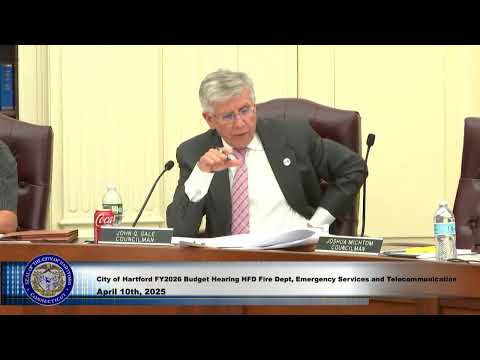
The committee heard a real-time example of the need for redundancy. Covello described an accidental activation of the dispatch center's fire-suppression system earlier in the day that forced immediate evacuation; staff split operations with some functions moved to New Britain and others to the city Emergency Operations Center (EOC). He said the department had prepared an EOC backup environment and used state-supplied laptops to continue accepting 911 calls during the outage.
Covello told members ES&T is also working to connect its CAD to ambulance providers so run assignments can flow electronically. He described efforts to reduce repeated false-alarm responses and to enable online payment for alarm fines. On staffing metrics he said the center handled about 498,000 calls last calendar year, of which roughly 40,000 were 911 calls.
Committee members asked about recruitment, retention and training success rates. Covello said retention of trainees has varied since he arrived, rising from about 30% to roughly 50% completion in some recent cycles; he said some newly trained hires leave for other centers with higher pay or lower call volume. He said the starting salary is around $54,000 and will increase under a recent union contract.
Director Covello described investments in training, peer support and community outreach to improve morale and retention, and told the committee the department aims to reach the ability to take 911 calls from multiple locations if needed, including council chambers or the library, so long as Internet and power are available.
Ending note: The presentation prompted multiple committee questions about recruitment, call-abandon rates and contingency planning; no formal vote was taken during the hearing.