Hartford Fire Department presents $43.09 million recommended budget, cites overtime and station repairs
Loading...
Summary
At a committee budget hearing, Hartford Fire Department leaders outlined a $43.09 million recommended 2026 budget, attributing most of the year-to-year increase to overtime, step increases and capital work on aging firehouses. Officials also described recruitment, training and public-education outputs and a planned accreditation site visit.
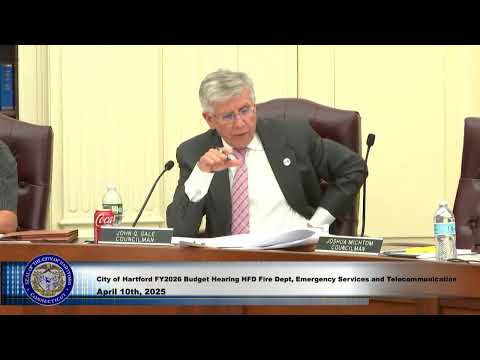
At a Hartford City Council Operations, Management, Budget and Government Accountability Committee budget hearing, Chief Barco of the Hartford Fire Department presented the department's recommended 2026 budget and outlined staffing, capital and training priorities.
The department is recommending a total general-fund budget of $43,093,926 for 2026, an increase Chief Barco said is about $1.0 million, or roughly 3.7 percent, over the adopted 2025 general fund. Chief Barco told the committee the increase largely reflects overtime costs and firefighter step increases, while attrition savings and other offsets partially reduce the net change.
Why this matters: The Fire Department said sustained overtime and aging facilities are driving near-term budget pressure and planned capital work. Committee members pressed leaders on specific repairs and how filling vacancies would affect overtime costs.
The department reported 375 full-time positions and 25 vacant positions. Chief Barco described the department's staffing mix as including suppression personnel, support staff and administrative positions; he reported roughly 320 suppression members and said about 54 percent of firefighters live in the city. On the overtime increase he said that minimum manning rules require the department to staff a fixed level of personnel on each shift and that sick time, long-term injury and accrued-time usage contribute to overtime. "If those positions are filled, we do expect overtime costs to come down," Chief Barco told the committee, while noting seasonal and accrual-driven spikes.
Capital and facility work was a focal point of questioning. Councilman Gail asked about a line in the capital improvement plan for Firehouse No. 5. Chief Barco said the roof and a structural wall on the building are failing and that recent water intrusion created interior safety issues, including asbestos-containing materials in a basement area; city funds were allocated for immediate repairs and the long-term plan is to build a new firehouse in the general vicinity of the current Station 5. Chief Barco also described planned work on other historic houses, including Engine 9, where specialized masonry and repointing can increase costs because of historic preservation requirements.
The department described several operational and program highlights: more than 33,000 calls for service in 2024; 94 significant structure fires; special-services public-education work that reached 22,133 residents; installation of 485 smoke and carbon monoxide detectors; and relocations of people after incidents that assisted about 450 residents. The special-services division received a $100,000 grant/donation from The Hartford to acquire a Next Gen Fire Safety trailer for outreach.
Chief Barco said the department is preparing for a site visit from an international accreditation peer team in May and that, if approved, the department will pursue reaccreditation for another five years. Other stated priorities included succession planning for specialized roles, PPE replacement on a 10-year lifecycle, equipment research and testing, and maintaining the department's ISO Class 1 rating.
Committee members asked about recruitment and retention. Chief Barco and Council members discussed pay competitiveness for entry-level firefighters compared with neighboring jurisdictions and the effect of that gap on recruitment. Chief Barco said recruitment yields varied but the department had about 200 applicants for a recent hiring round; he also noted some firefighters had left for other departments but that departures had slowed since the peak attrition observed during the COVID period.
On training and inspections, Fire Marshal Chief Ewan Sharif summarized fire marshal office changes since additional staff were added: three personnel now dedicated to plan review and approximately 16 lieutenants conducting day-to-day inspections and investigations. Chief Sharif said the division expects to complete around 12,000 inspections in the fiscal year and is coordinating with housing and building departments to improve compliance and abatement follow-through.
Council members pressed for timelines on station renovations and for details about the overtime drivers in the budget. Chief Barco repeated that vacancies and long-term injuries increase overtime costs, and that filling authorized positions should reduce the overtime burden but will not eliminate all overtime due to minimum-manning rules and seasonal leave patterns.
The hearing closed with committee members thanking the cadets and firefighters in attendance and announcing a separate recognition for four firefighters at an upcoming council event.
Ending note: The department's presentation did not include formal votes at the hearing; council budget decisions will be taken in subsequent committee and council actions.