Get Full Government Meeting Transcripts, Videos, & Alerts Forever!
Get email alerts on the Community Development topic
No spam. Unsubscribe anytime.
Providence committee reviews mayor’s proposed CDBG budget amid federal funding uncertainty
Summary
City staff presented the mayor’s draft Community Development Block Grant (CDBG) budget for program year 2025–26, emphasizing sustaining basic services amid likely federal cuts and proposing an equitable pro rata adjustment if allocations fall short.
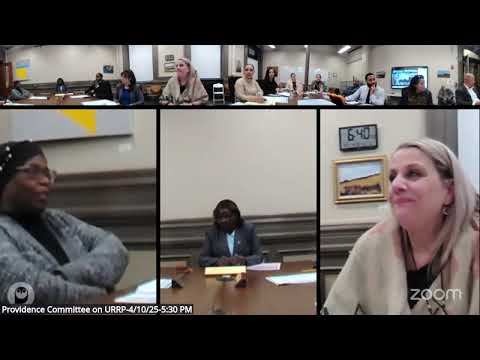
Members of the Providence City Committee on Urban Redevelopment, Renewal and Planning on Thursday reviewed the mayor’s proposed Community Development Block Grant budget for program year 2025–26 and heard staff describe priorities for food, childcare, homelessness prevention, refugee services and other basic needs as federal funding remains uncertain.
The mayor’s draft, presented by Emily Friedkin, director of Housing and Human Services, and Alyssa McDermott, director of Housing and Community Development, responds to nearly 100 applications for funding and prioritizes sustaining existing operations rather than launching new pilot projects because HUD allocations for the coming fiscal year are not yet final. Friedkin told the committee staff received “a staggering $20,500,000 in requests” and warned that “best case scenario is we’re looking at level funding, but more likely, it’s anywhere between a 5 to 10% cut” when final allocations arrive from the federal government.
The committee heard that staff used HUD program rules and scoring criteria to evaluate proposals, prioritizing number of clients served, equity and access, geographic targeting of concentrated poverty, past performance and agency capacity. McDermott said the office emphasized “clearly defined projects that are already ready to proceed,” and noted many recommendations are for direct service, emergency operations, facility repairs that address safety or flooding risks, or projects that will generate affordable housing units.
Key program amounts mentioned in the presentation include: the HOME Investment Partnerships program (line-item amounts discussed in committee ranged around $1.1 million), an Emergency Solutions Grant of about $450,000 for shelter and rapid rehousing, and a HOPWA (Housing Opportunities for Persons With AIDS) allocation of roughly $1.4 million to serve Providence and the Providence metropolitan statistical area (including Bristol County). Friedkin said some funding available for this cycle also derives from prior-year program income and returned or underspent project funds.
Staff described one specific source of program income: a prepayment from a developer associated with Lockwood Plaza 2. Friedkin and McDermott said the city received a prepayment of approximately $1,165,000 that staff proposed to relend as gap financing to another approved affordable housing project. McDermott explained the prepayment must remain in the HOME program account and be used for HOME-eligible activities.
Committee members asked how applicants could seek feedback and improve future submissions. Friedkin said the department holds an application workshop, posts materials online, and encourages debrief meetings outside the live procurement period so unsuccessful applicants can prepare stronger proposals next year. She also said staff uses a consistent web-based grant application system and a minimum score threshold before further analysis.
Members discussed particular proposals and eligibility constraints. Staff said Design by Rhode Island (design RI) has historically received funding for a program that provides direct capital grants to low- and moderate-income businesses; this year that program was reduced to a single award of about $150,000. Staff told the committee that a recent application from the local Hispanic Chamber of Commerce requested operating support including marketing and mortgage payments; those line items are generally not eligible under CDBG rules, so staff did not recommend that application for funding as submitted. Staff suggested that if the chamber pursued a brick-and-mortar project that met income-eligibility rules and had eligible line items, it could be considered under a different activity category.
On budgeting under federal uncertainty, staff outlined two options and recommended an equitable pro rata adjustment if HUD’s final allocation is smaller than the draft. Friedkin explained that an equitable pro rata reduction would apply the same percentage decrease across all activities rather than cutting particular providers entirely: “what we recommend is simply building in an equitable pro rata adjustment.”
Council staff also updated the committee on ward-level allocations. Kyle Delgado, director of project management for the city council office, said the council’s office has identified most of the ward projects for the board allocations and expected to confirm the remainder before the committee’s next action.
The committee made routine motions during the meeting: members voted to enter the mayor’s handout into the record as Exhibit 1 (motion made by Councilwoman McDonald, second by Councilwoman Briggs), voted to continue the matter (motion made by Councilman Gunn, second by Councilman Grace), and then voted to adjourn (motion made by Councilman Charles, second by Councilman Face). All motions were approved by voice vote.
What happens next: staff said the committee must finalize the draft for city council consideration, the council will release the annual action plan for a 30-day public comment period, and the plan must be submitted to HUD for approval in time to avoid service disruption. Friedkin told the committee the city aims to have all steps complete by July 1 so programs can continue without interruption.
Reporting note: quotes and attributions in this article are drawn from committee remarks during the CDBG budget presentation and question-and-answer period. Where amounts or counts were unclear in the record, the article uses the phrasing discussed in committee (for example, the approximate $20.5 million in requests and staff’s estimate of a 5–10% possible cut).