
Glendale Elementary board approves meet-and-confer package, pay-for-performance increase, accepts audit and passes budget and personnel items
Get AI-powered insights, summaries, and transcripts
Sign Up Free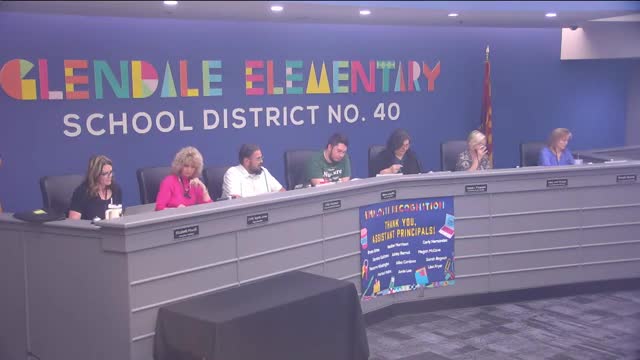
Summary
The Glendale Elementary School District Governing Board on April 10 approved a package of employee recommendations and a 6% pay-for-performance increase for 2025-26, accepted the district's FY2024 audit and compliance questionnaire, approved a 2024-25 budget revision and multiple administrative hires, and recessed into executive session for legal advice on federal attestations.
The Glendale Elementary School District Governing Board on April 10 approved the district's meet-and-confer recommendations, a pay-for-performance increase for 2025-26, accepted the district's audited financial statements for the year ended June 30, 2024, and approved a set of personnel hires and a fiscal-year budget revision.
The board voted by roll call on multiple items; votes recorded during the meeting show board members Bartels, Wilson, Pimentel, Jaramillo and Board President Martinez voting "aye" on the consent agenda, the meet-and-confer recommendations, the pay-for-performance plan, the FY2024 financial audit and compliance questionnaire, and the 2024-25 budget revision presented as Revision No. 2.
Why it matters: the meet-and-confer package and the pay-for-performance plan affect compensation and working conditions for district employees; the accepted audit and compliance questionnaire are statutorily required public records used by the district and state education authorities; the budget revision adjusts spending authority for the current fiscal year.
Board action and key details
- Meet-and-confer and staff compensation: The board approved the meet-and-confer recommendations presented by district staff and the Glendale Education Association. Jessica Peck, president of the Glendale Education Association, told the board the team "comprise[s] 5 members of the team" and that the process yielded recommendations from certified and classified employee groups. Superintendent Sagata Jones and Meet-and-Confer lead Debbie Valadis explained the updated agreement adds items such as an introduction to the meet-and-confer agreement at the start of the school year and an exploration of a parental leave bank. The board also approved language that specifies future pay-for-performance amounts will change "proportionately based on state funding." The district told the board the pay-for-performance amounts for 2025-26 will increase by 6 percent.
- Pay-for-performance plan: The board approved the pay-for-performance plan for the 2025-26 school year as presented. During discussion, board members asked about the professional-development component of the plan; a board member asked whether any college course could qualify as professional development, and staff replied that courses are acceptable if the employee can explain how the course would benefit classroom instruction. The motion to adopt the pay-for-performance plan passed on a roll-call vote with all five members voting aye.
- Financial audit and compliance questionnaire: Representatives from the district's auditors presented the annual comprehensive financial report (ACFR) and the compliance questionnaire. Dan Johnson, a partner at the audit firm, said the district received an "unmodified opinion," the clean audit opinion, and reported "we had no material weaknesses or significant deficiencies this year." The compliance questionnaire consists of 171 yes/no items; auditors reported four findings for 2024 (98 percent compliant), an improvement from 10 findings the prior year. Auditors also reported federal-award testing covered the special education cluster and ESSER programs and that coverage was roughly 58 percent for the year under audit.
- Budget revision: Chief financial staff reviewed Revision No. 2 to the 2024-25 expenditure budget. Presenters described shifts in average daily membership (ADM) and supplemental funding and said the budget revision includes a capital revision of approximately $14.8 million. The board approved the budget revision by roll call.
- Personnel and appointments: The board approved multiple employment items for the 2025-26 school year, including: - Michelle Nunez, coordinator for district communications (approved) - Chris Kane, assistant principal, Harold W. Smith School (approved) - Keegan Coleman, assistant principal, William C. Jack School (approved) - Alba Cordova, director of special education programs and educational services (approved) - Dr. John Hecht, director of special education operations and early childhood (approved) All appointments were approved by roll call with the same members voting aye.
- Executive session and federal attestations: The board recessed into executive session under Arizona law for legal advice (citing the executive-session statute) on federal guidance related to Title VI and the Family Educational Rights and Privacy Act (FERPA) and on required attestations from the Arizona Department of Education and the U.S. Department of Education. After reconvening to public session, a public commenter identified in the transcript as a citizen criticized the federal attestations, saying, "This piece of paper that we have to sign is essentially holding our kids hostage and forcing us to take actions that go against everything we stand for." A board member noted the fiscal consequences of refusing funding and indicated they would not fault colleagues who voted to approve the attestation; the meeting record states "the motion carries" though a detailed final roll-call for that specific item was not recorded in the available transcript excerpt.
Votes at a glance (items called and recorded in transcript) - Adopt agenda: Aye (Bartels, Wilson, Pimentel, Jaramillo, Chair Martinez) - Approve consent agenda: Aye (Bartels, Wilson, Pimentel, Jaramillo, Chair Martinez) - Approve meet-and-confer recommendations: Aye (Bartels, Wilson, Pimentel, Jaramillo, Chair Martinez) - Approve pay-for-performance plan for 2025-26: Aye (Bartels, Wilson, Pimentel, Jaramillo, Chair Martinez) - Certify/classify administrative performance pay for 2025-26: Aye (Bartels, Wilson, Pimentel, Jaramillo, Chair Martinez) - Accept FY2024 financial audit and compliance questionnaire (year ended 06/30/2024): Aye (Bartels, Wilson, Pimentel, Jaramillo, Chair Martinez) - Approve 2024-25 expenditure budget Revision No. 2 (FY24/25): Aye (Bartels, Wilson, Pimentel, Jaramillo, Chair Martinez) - Approve second reading of multiple district policies: Aye (Bartels, Wilson, Pimentel, Jaramillo, Chair Martinez) - Approve Governing Board calendar for FY26: Aye (Bartels, Wilson, Pimentel, Jaramillo, Chair Martinez) - Approve employment of communications coordinator and multiple assistant principals and directors (listed above): Aye (Bartels, Wilson, Pimentel, Jaramillo, Chair Martinez) - Motion to recess into executive session for legal advice under ARS provision cited in meeting and related reconvened action on federal attestations: motion carried (transcript: "the motion carries"); detailed final roll-call for that reconvened attestation item is not specified in the available transcript.
What the record shows and what it does not: The board record in the transcript shows roll-call votes for most action items with unanimous ayes from the five board members present. The transcript excerpt documents the auditors' presentation, the meet-and-confer presentation (including a referenced employee survey response rate and the committee membership), and public comment opposing federal attestations. The transcript does not include the exact text of the final attestation motion taken after the executive session (the motion is referred to in the minutes but the full motion text and a roll-call tally for that specific motion are not included in the available excerpt). The article does not invent language that was not read into the public record.
Ending: The board scheduled follow-up items including a demographic presentation and a study session to discuss that data; the district noted continuing efforts on enrollment/retention and monitoring of expenditures as officials prepare for the next fiscal year.