Get Full Government Meeting Transcripts, Videos, & Alerts Forever!
Get email alerts on the Site Plan Review topic
No spam. Unsubscribe anytime.
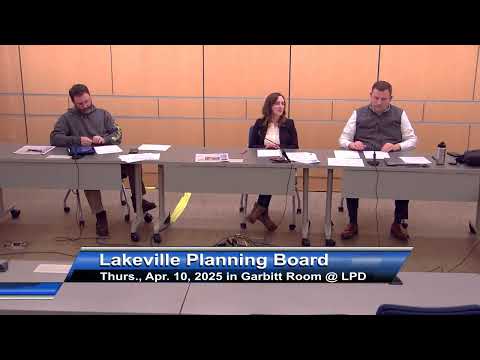
Planning board gives conditional approval for 10 Harding Street site plan, debates inspections and surety
Summary
The Lakeville Planning Board conditionally approved Lex Development Inc.'s site plan for a 13,300-square-foot building at 10 Harding Street after negotiating conditions on surety, peer-review inspections and final as-built review; the board asked town council to advise on a question about recording approved site plans.
The Lakeville Planning Board granted conditional approval Thursday to a site plan for 10 Harding Street, a proposed 13,300-square-foot commercial building submitted by Lex Development Inc., while negotiating several conditions including surety amounts, peer-review inspections and how final as-built plans will be verified.
The applicant team included a project representative identified as Timothy National and environmental consultant Bob Rigo of Riverhawk Environmental. Planning staff circulated a standard draft of conditions and the board reviewed edits suggested by the applicant's attorney and staff counsel. The board approved the plan subject to the edits discussed at the meeting and with one open question referred to town council for guidance about whether approved site plans themselves must be recorded at the Plymouth County Registry of Deeds.
A central point of debate was financial surety and inspection obligations. Board members said the town has been using a fixed surety of $10,000 for similar private-site projects; the applicant's attorney removed language that would have tied the amount to disturbed acreage and the board accepted a flat $10,000 condition. The draft decision also included a provision that the applicant submit a $5,000 check to be held in a Section 53G account to pay for peer-review engineering to review final as-built plans prior to endorsement and prior to issuance of certain permits.
The applicant's representatives objected to requiring multiple construction-phase peer-review inspections on a private site, noting the applicant already retained an engineer who oversees construction and arguing that frequent third-party inspections could slow construction and duplicate work. As the applicant put it during discussion, "I'm already paying an engineer... what I don't see is the need of paying two engineers when we already did go through peer review," (Timothy National, project representative). Town peer-review engineers described a typical scope of 4–8 site visits for similar projects — initial erosion-control check, observations of drainage installations, representative checks of structure and pipe installations, pavement subbase reviews, and a final as-built punch list.
To balance those concerns the board and applicant agreed to specific inspection triggers and notice requirements: the applicant must notify the planning department by email at least two working days before certain construction milestones (the board agreed to refine this to 1 business day for site access consent), and peer-review will at a minimum review the final as-built plans. The board also revised inspection language to focus on stormwater and drainage milestones (for example, bottom-of-hole checks) and to allow limited interim inspections rather than continuous on-site oversight.
Another live issue was sequencing of site construction, surety and building permits. Staff had proposed language requiring drainage facilities, loam-and-seed and related site work to be completed prior to issuance of a building permit unless appropriate surety is provided; the applicant said obtaining bank financing and a building permit is necessary to fund construction and warned that requiring full site completion before a building permit could be impossible. The board agreed to keep a condition requiring stormwater systems to be functional and stable prior to occupancy, to retain the original planning staff language on final site completion timed to occupancy, and to use surety options where appropriate to allow phased completion without impermissibly withholding building permits.
On the procedural question raised by the applicant's attorney about recording approved site plans at the registry, the board asked town counsel to review that provision. Staff reported plans are not always drawn to registry standards and that recording can require reformatting (black-and-white plans, registry blocks, font sizes). The board voted to conditionally approve the site plan with the agreed edits and to forward the single question about recording to town council for a written opinion.
A motion to conditionally approve the site plan with the edits as discussed and the question for town council carried by voice vote at the April 10 meeting. The board closed the public hearing and instructed staff to finalize conditions and the decision for issuance once the town counsel response on the recording question is received.