Get Full Government Meeting Transcripts, Videos, & Alerts Forever!
Get email alerts on the Bikeway Infrastructure topic
No spam. Unsubscribe anytime.
National City safety committee reviews Bayshore Bikeway alignment, funding and business access concerns
Summary
City engineers presented a finalized alignment for the Bayshore Bikeway connection through National City, saying recent grants closed the funding gap and construction is targeted for contract award in September; nearby business owners raised truck-access and parking concerns and city staff committed to on-site testing and follow-up.
City of National City engineers presented a proposed alignment and design details for the Bayshore Bikeway and Bikeway Connections project at a Rapid Safety Committee meeting, describing a two-way protected bike path, recent grant funding that closed the project's budget gap and a target to award a construction contract in September.
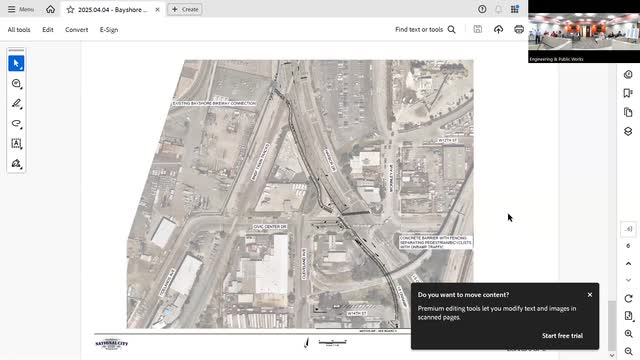
The alignment presented would continue the regional 26-mile Bayshore Bikeway down Harbor Drive, cross the BNSF railroad with signal upgrades coordinated with the California Public Utility Commission, pass under a Caltrans off-ramp onto McKinley Avenue, and proceed through Marina Way and the marsh area to tie into the existing bikeway. Steve Manganiello, City director of engineering and public works, said the city has environmental permits from the Coastal Commission for the marsh segment and that the project has been on the city's bicycle master plan and general plan for years.
The plan would convert McKinley Avenue to one-way to create room for a two-way protected bike path; Manganiello said the design keeps parking where possible and would retain curb parking on the west side while adding angle parking on the east. "For all McKinley Avenue, almost get to net 0 lost parking... we only lose a total of 6 parking spaces for about a half mile stretch of McKinley Avenue. The project overall, we have a net loss of about 10 parking spaces," Manganiello said. He also described traffic and turning tests with truck drivers and fire apparatus as part of final quality checks.
On funding, Manganiello said the San Diego Association of Governments provided Active Transportation Program (ATP) funds that "roughly $6,000,000" and that the city recently received the last chunk of money the project needed to build. The total construction budget figure discussed in the meeting was not specified precisely and appears inconsistent in the transcript; the city representative said funding now closes the gap and staff expect to put a construction contract out for award in September.
Nearby businesses raised concerns about heavy truck access and loss of customer parking. A business representative identified as Daniel Myers said, "We have, 5 or 6 tractor trailers coming every day," and worried that a southbound one-way configuration could force trucks to back into the facility in a way that would be unsafe or impractical. Manganiello responded that staff will schedule on-site truck-turn testing with a driver from the business and that he would follow up directly: "I'll call you tomorrow, and let me know when's a good time when they're accessing your business." The city also said it had negotiated an easement with Caltrans to go under the off-ramp and that BNSF had been unwilling in prior outreach to allow an alignment inside its right-of-way.
Mitchell Beacham, secretary of the National City Depot Museum, said the alignment would remove parking near the depot and asked the city to study alternatives such as shifting the sidewalk or reconfiguring the parcel to retain spaces used during museum events. A representative from Deaf Community Services expressed support, noting improved access for clients. Committee members asked about effects on nearby Kimball Elementary School; Manganiello said the design includes "always stop" controls at key intersections and that Nineteenth Street would be closed to vehicle traffic and repurposed for pedestrians and bicyclists.
City staff said the design aims to improve safety and circulation for bicyclists and pedestrians by moving the regional bikeway away from existing railroad crossings and truck traffic on Tidelands and Cleveland avenues. Staff also noted planned lighting, vandal-resistant fencing, and safety cameras for the under-freeway connection at Eighteenth and Nineteenth streets.
Next steps described by staff included field truck-turning tests with business drivers, follow-up meetings with affected property owners, refinement of parking layouts with the project's consultant (CR and Associates), and outreach to residents and businesses. Manganiello invited affected parties to contact him and said the committee will hold a public open house on May 14 for a separate but related 20th Street transit-center connections project.
Votes or formal committee actions were not recorded during the presentation; staff framed the session as design review and public outreach and described schedule and follow-up tasks rather than taking a formal vote.