Get Full Government Meeting Transcripts, Videos, & Alerts Forever!
Get email alerts on the School Transportation topic
No spam. Unsubscribe anytime.
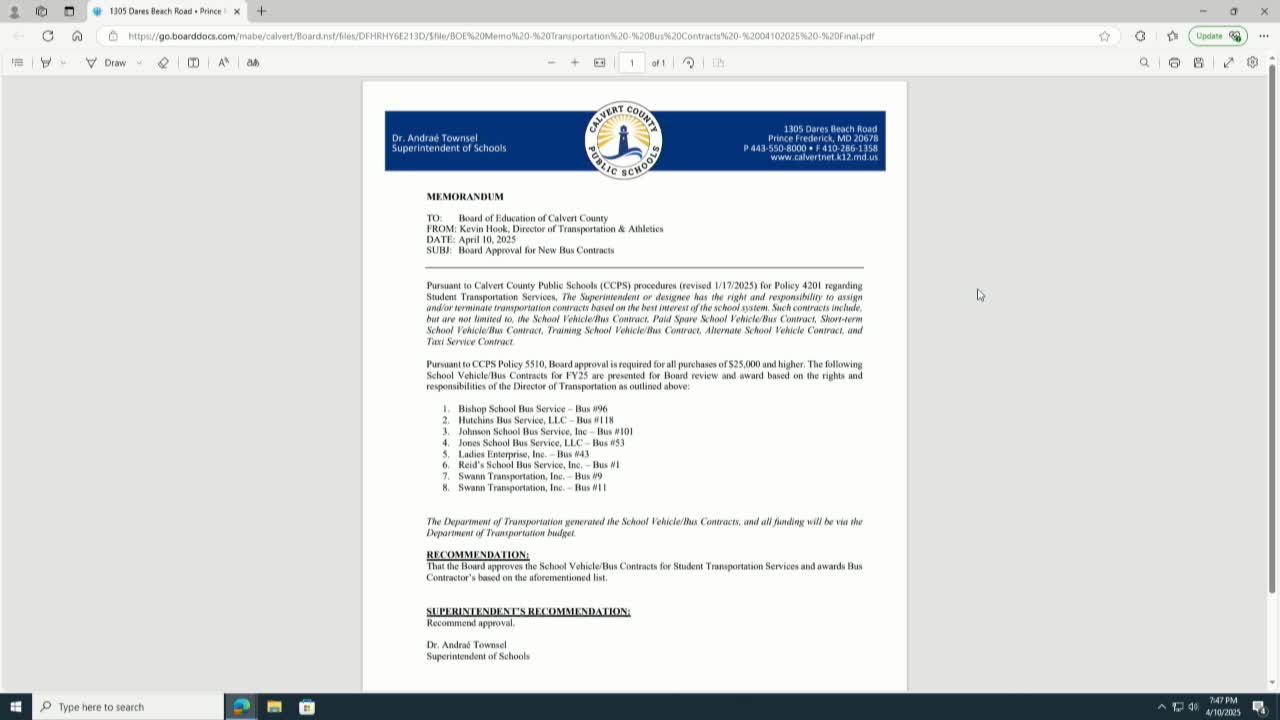
Board approves eight replacement bus contracts; staff discuss contractor model and driver benefits
Summary
The board voted to award eight school-vehicle contracts to replace aged buses. Directors answered questions about the existing contractor model (currently 163 contracts), paid sick leave arrangements and the potential long-term costs of owning a fleet instead of contracting.
The Calvert County Board of Education approved eight school‑vehicle contracts on Tuesday to replace buses that have reached the district’s 12‑year replacement threshold.
Director of Transportation Kevin Hook presented the awards and said the eight contracts are replacements for aging vehicles; the recommendation included contracts with Bishop Bus Service; Hutchins Bus Service; Johnson's Bus Service; Jones School Bus Service LLC; Ladies Enterprises Incorporated; Reed School Bus Service Incorporated; and two contracts for Swan Transportation Incorporated. The motion to award the contracts passed on a voice vote.
Board members and staff discussed operational details. Hook told the board the district currently manages roughly 163 separate bus contracts. He said bus contractors are treated as independent contractors under current agreements, and routes are paid by miles driven with a minimum-hours payment per route; contractors also receive payments for equipment (GPS and video surveillance), operations fees and a prorated bus purchase allocation under existing formulas.
The board asked about driver benefits and historical arrangements. Hook described a longstanding local practice, dating to the 1990s, in which the district provided paid sick leave pay for drivers as part of the contractor relationship and discussed a healthcare benefits trust established years ago to address driver needs. Directors noted most routes run fewer than eight hours daily.
Board members also asked about the cost and tradeoffs of purchasing buses and operating an in‑house fleet versus the current contracting model. Hook said multiple studies have shown owning a fleet can be more efficient over a 10‑ to 12‑year horizon but that the upfront cost, the need for bus storage and maintenance staff and benefit costs make contracting more practical in the short term. He said other Maryland counties are split on the model: Frederick County recently switched to owning its buses outright, while Anne Arundel and Charles counties use hybrid approaches.
Hook provided per-bus purchase data: a single new bus was priced at approximately $154,000, and the formula that includes financing and related factors results in a per-unit cost in the roughly $200,000 range when spread over a 12‑year life. The board asked for further analysis comparing long-term lifecycle costs and for clarification of legal and procurement citations for food-service fund inclusion in another policy under review.
The contracts were approved; the director said deliveries replace buses that had reached the district’s 12‑year age limit and will put new vehicles into service for the coming school year.