Get Full Government Meeting Transcripts, Videos, & Alerts Forever!
Get email alerts on the Behavior Interventions topic
No spam. Unsubscribe anytime.
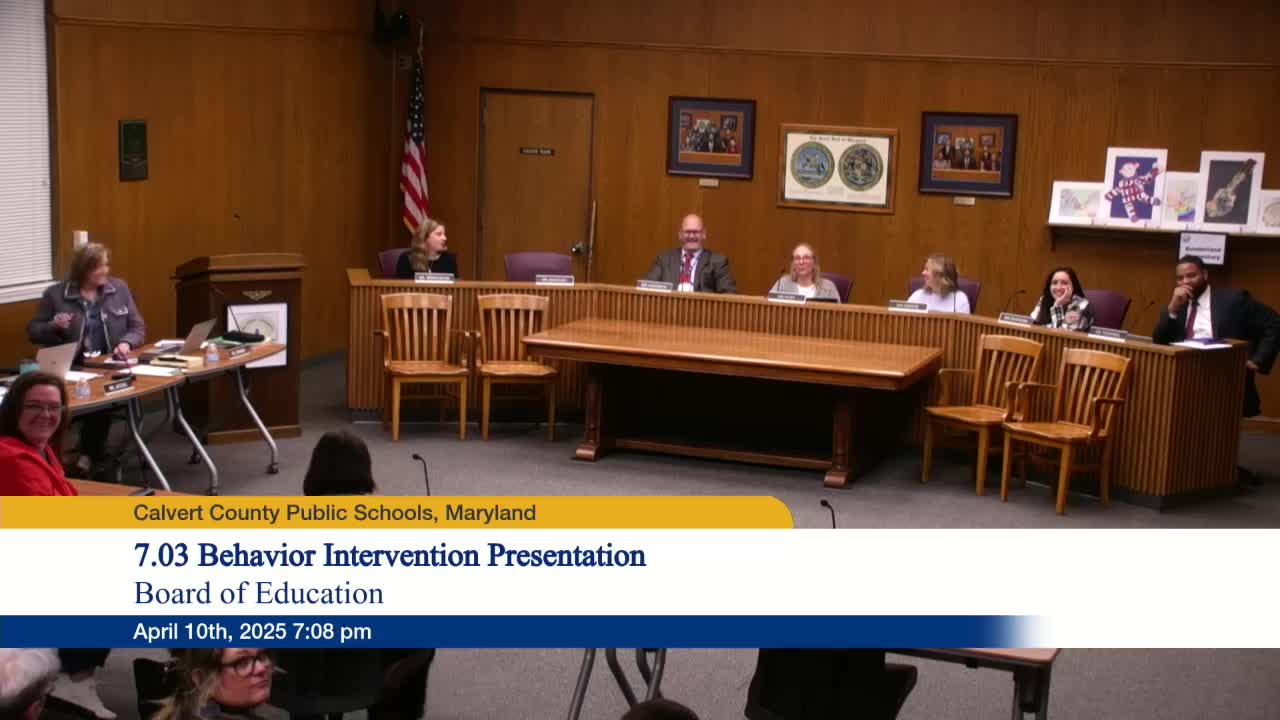
Board hears overview of behavior interventions as staff training increases
Summary
District special-education and student-services staff outlined tiered behavior supports — CPS, TEACCH-style structured teaching, LSCI and CPI — and reported training numbers and historical restraint figures as student dysregulation rose in recent years.
Calvert County Public Schools officials told the Board of Education on Tuesday that the district is expanding staff training in tiered behavior interventions to respond to an increase in student dysregulation across grade levels.
Suzanne McGowan, supervisor of student services, and Dr. Kendi Anderson, director of special education, presented the framework the district uses — a multi-tiered system of supports (MTSS) — and described three evidence-informed interventions that staff are being trained to use: Collaborative and Proactive Solutions (CPS), TEACCH-style structured teaching (an approach from the University of North Carolina), and Life Space Crisis Intervention (LSCI). They also described crisis-prevention training and a restraint-reduction strategy that uses padded mats for safe blocking rather than seclusion.
McGowan said CCPS has trained staff to build local capacity: roughly 100 staff took University of North Carolina TEACCH trainings in August 2024; about 300 staff have received two- or four-day LSCI training countywide; and district teams have participated in CPS implementation cohorts at eight schools. The presenters said some trainings were funded by federal grant dollars so that district employees could be trained as future trainers and provide in-house continuing professional development.
Officials described CPI (Crisis Prevention Institute) as the system’s formal nonviolent crisis-intervention training; McGowan reported 8 initial CPI trainings and 11 renewals this school year, supporting 205 staff, and additional CPR certifications tied to CPI. Separately, the district reported 65 staff completed training in a restraint-free crisis management program and the district maintains padded “blue pads” at multiple schools for safe blocking when necessary.
The presenters supplied historical restraint and seclusion figures and said that seclusion was prohibited starting in 2022. McGowan said the district now uses seclusion alternatives and a restraint-review committee reviews incidents and videotape to coach staff and refine practices.
Board members asked about day-to-day implementation, the burden on classroom teachers, staffing levels and how the district monitors fidelity. The presenters said strong tier-1 schoolwide practices (consistent rules, trauma-informed strategies, routines and SEL instruction) reduce downstream needs for intensive intervention, and that teams of trained staff in schools are necessary to support teachers implementing tier-2 and tier-3 plans. Dr. Anderson said IEP teams remain responsible for individual placement decisions and the district’s aim is to make placements fluid and skill-based rather than “place”-based.
Board members asked for additional cost and staffing estimates as the district plans future budget requests. Officials said initial grant funding covered many of the training sessions but that ongoing maintenance—retraining, coaching and specialized staff—will require budget planning and continued grant-seeking.
Supervisors said they would follow up with more granular fidelity measures and suggested reporting back to the board with needs and cost estimates during the next budget cycle.